


Fireman yesterday extinguished the last blazes on a runaway freight train loaded with fuel and chemicals that blew up in eastern Iran and killed over 300 people, allowing rescue workers to start digging for more victims.
Revolutionary guards cordoned off a wide area around the disaster site overnight due to fears of further blasts and pollution, leaving relief teams helpless to search the rubble of shattered mud houses for more bodies.
But at dawn the head of the Khorasan province emergency headquarters, Vahid Barakchi, said: "There have not been any further explosions since last night and the danger of further explosions has disappeared."
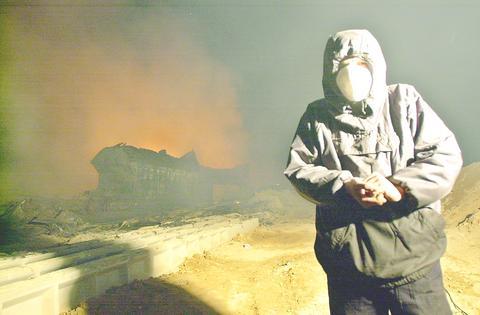
PHOTO: AP
"Firefighters have given the all-clear. There is no danger and rescue teams need only wear ordinary masks," he said.
Authorities decreed a day of mourning in Iran's northeastern province as the dead -- many of them firemen, security forces and local officials -- were to be buried in the nearest town, Nishapur.
Speaking by mobile phone from a crater ripped open by Wednesday's massive blast, Barakchi said the death toll stood at 309 with some 460 people injured, and more corpses might be found beneath the ruins of a village.
Many of the bodies were charred beyond recognition.
Engineers began lifting the mangled wreckage of 51 train cars that broke loose and hurtled downhill until the train derailed from the main Tehran-Mashad rail line and caught fire.
Roads and Transport Minister Ahmad Khorram said that the cause of the disaster had not yet been determined. Repairs were expected to take three days.
Some initial reports said the cars were detached by earth tremors, but officials said the explosion, which sent shock waves felt some 70km away in the city of Mashad, was so massive that it may have been confused with an earthquake.
Barakchi said the lethal cocktail of gasoline and fertilizer had polluted the nearest village, Deh-e No Hashemabad. Three other villages were devastated by the blast.
The train cars had first caught fire and attracted crowds of bystanders who were then engulfed along with firefighters in a massive explosion.
Doctors called for supplies of blood to treat the hundreds of people who were injured, many of them scorched black by Wednesday's fiery chemical blast.
The force of the explosion razed homes to the ground, crushing their inhabitants under crumbled mud brick walls and shattering windows far around.
"The earth shook. We thought it was an earthquake. We were so scared," said Ali, 42, from Nishapur, 20km from the scene in the saffron-growing province of Khorasan.
Photographs showed the blast site strewn with shredded torsos, clothes ripped from bodies and severed limbs.
Ali Soleimani said he found the body of the governor of Nishapur: "I pulled out the corpse of the governor myself. He had no legs and was sliced to bits."
The disaster came amid political uncertainty in Iran, ahead of parliamentary elections today overshadowed by a bitter dispute over the mass disqualification of reformist candidates.
The country is still recovering from a December earthquake that killed over 40,000 people in the ancient city of Bam.
In the worst rail crash of the last quarter century, at least 575 people died in June 1989 when two passenger trains in Russia's Ural mountains were engulfed in an explosion from a leaking gas pipeline.

‘IN A DIFFERENT PLACE’: The envoy first visited Shanghai, where he attended a Chinese basketball playoff match, and is to meet top officials in Beijing tomorrow US Secretary of State Antony Blinken yesterday arrived in China on his second visit in a year as the US ramps up pressure on its rival over its support for Russia while also seeking to manage tensions with Beijing. The US diplomat tomorrow is to meet China’s top brass in Beijing, where he is also expected to plead for restraint as Taiwan inaugurates president-elect William Lai (賴清德), and to raise US concerns on Chinese trade practices. However, Blinken is also seeking to stabilize ties, with tensions between the world’s two largest economies easing since his previous visit in June last year. At the

UNSETTLING IMAGES: The scene took place in front of TV crews covering the Trump trial, with a CNN anchor calling it an ‘emotional and unbelievably disturbing moment’ A man who doused himself in an accelerant and set himself on fire outside the courthouse where former US president Donald Trump is on trial has died, police said yesterday. The New York City Police Department (NYPD) said the man was declared dead by staff at an area hospital. The man was in Collect Pond Park at about 1:30pm on Friday when he took out pamphlets espousing conspiracy theories, tossed them around, then doused himself in an accelerant and set himself on fire, officials and witnesses said. A large number of police officers were nearby when it happened. Some officers and bystanders rushed

Beijing is continuing to commit genocide and crimes against humanity against Uyghurs and other Muslim minorities in its western Xinjiang province, U.S. Secretary of State Antony Blinken said in a report published on Monday, ahead of his planned visit to China this week. The State Department’s annual human rights report, which documents abuses recorded all over the world during the previous calendar year, repeated language from previous years on the treatment of Muslims in Xinjiang, but the publication raises the issue ahead of delicate talks, including on the war in Ukraine and global trade, between the top U.S. diplomat and Chinese
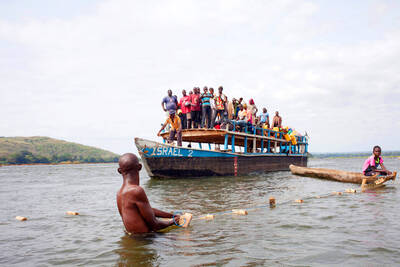
RIVER TRAGEDY: Local fishers and residents helped rescue people after the vessel capsized, while motorbike taxis evacuated some of the injured At least 58 people going to a funeral died after their overloaded river boat capsized in the Central African Republic’s (CAR) capital, Bangui, the head of civil protection said on Saturday. “We were able to extract 58 lifeless bodies,” Thomas Djimasse told Radio Guira. “We don’t know the total number of people who are underwater. According to witnesses and videos on social media, the wooden boat was carrying more than 300 people — some standing and others perched on wooden structures — when it sank on the Mpoko River on Friday. The vessel was heading to the funeral of a village chief in


 RSS
RSS