


Iraq and its six neighbors concluded talks in Kuwait on Sunday with a call for a central role for the UN in Iraq, including supervision of elections and of the transfer of power to Iraqis.
In a final statement after a two-day meeting, they also said it was vital to eliminate "all terrorist and other armed groups from Iraqi territory that constitute a danger for the neighboring states."
That was a clear reference to anti-US fighters operating in Iraq, including the al-Qaeda network headed by Saudi-born Osama bin Laden, which Washington blames for the Sept. 11, 2001 attacks on the US.
Scores of gunmen firing mortars and grenades stormed Iraqi security posts in Falluja on Saturday, killing 27 people, including 22 police, in the latest strike on forces vital to the transfer of power in Iraq.
Iraq had demanded at the Kuwait talks that its neighbours take "decisive measures" to impose tight security to stop cross-border infiltrations by foreign guerrillas fighting US-led forces.
But the ministers' final statement only referred to the need to support "the effort made by Iraq towards achieving security and stability."
"There are incidents of infiltration [into Iraq] from the outside. I do not want to accuse anyone, but most of the suicide and terrorist operations are not carried out by Iraqis," Iraqi foreign minister Hoshiyar Zebari told a news conference.
He said however such attacks would not undermine Iraqis' ability to take over government from US authorities as scheduled on June 30.
Iraq and its neighbors Saudi Arabia, Jordan, Syria, Turkey, Iran and Kuwait, affirmed "the importance of enhancing the role of the UN so that it can assume its central responsibilities throughout the transitional process in Iraq."
The statement said these respo-nsibilities include "preparing the ground for the withdrawal of occupying powers as soon as possible, and providing advice and technical expertise for formulating the constitution, holding elections, and expediting the transfer of power."
The US plans to hand over power to an interim Iraqi administration, chosen by a system of caucuses, by June 30. Iraq's Shiite leaders, fearful of losing influence, are demanding popular elections before any handover.
Washington, seeking to speed the process, is eager to revive UN involvement. The UN withdrew its staff from Baghdad last year after suffering two bomb attacks.
A visiting UN delegation said last week time was short and it would be difficult to hold popular elections ahead of a July 1 handover.
Iraqi authorities will ask the US to hand over Saddam Hussein and to remove his status as a prisoner of war (POW) when they take over power on June 30, Zebari said.
The US last month declared the former Iraqi president a POW, meaning he has certain specific rights under the Geneva Convention on treatment of POWs.
That provoked protests in Baghdad by Iraqis opposed to the move, who also demanded Saddam face the death penalty.
"From a legal viewpoint, his status as a prisoner of war does not bar putting him on trial," Zebari added.
Egypt's foreign minister Ahmed Maher told reporters Egypt was willing to start training Iraqi police and diplomats and to help rebuild the country's damaged electric grid.
The foreign ministers meeting in Kuwait re-emphasized "respecting the sovereignty, independence and unity of Iraq." Syria, Turkey and Iran fear a break-up of Iraq, especially a secession by the Kurdish north, could stir similar aspirations among their own Kurdish populations.
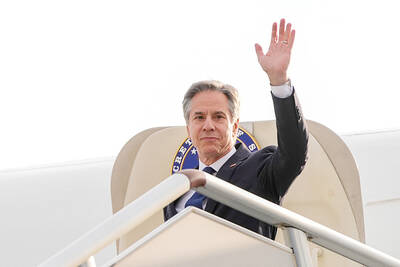
‘IN A DIFFERENT PLACE’: The envoy first visited Shanghai, where he attended a Chinese basketball playoff match, and is to meet top officials in Beijing tomorrow US Secretary of State Antony Blinken yesterday arrived in China on his second visit in a year as the US ramps up pressure on its rival over its support for Russia while also seeking to manage tensions with Beijing. The US diplomat tomorrow is to meet China’s top brass in Beijing, where he is also expected to plead for restraint as Taiwan inaugurates president-elect William Lai (賴清德), and to raise US concerns on Chinese trade practices. However, Blinken is also seeking to stabilize ties, with tensions between the world’s two largest economies easing since his previous visit in June last year. At the
Nearly half of China’s major cities are suffering “moderate to severe” levels of subsidence, putting millions of people at risk of flooding, especially as sea levels rise, according to a study of nationwide satellite data released yesterday. The authors of the paper, published by the journal Science, found that 45 percent of China’s urban land was sinking faster than 3mm per year, with 16 percent at more than 10mm per year, driven not only by declining water tables, but also the sheer weight of the built environment. With China’s urban population already in excess of 900 million people, “even a small portion

UNSETTLING IMAGES: The scene took place in front of TV crews covering the Trump trial, with a CNN anchor calling it an ‘emotional and unbelievably disturbing moment’ A man who doused himself in an accelerant and set himself on fire outside the courthouse where former US president Donald Trump is on trial has died, police said yesterday. The New York City Police Department (NYPD) said the man was declared dead by staff at an area hospital. The man was in Collect Pond Park at about 1:30pm on Friday when he took out pamphlets espousing conspiracy theories, tossed them around, then doused himself in an accelerant and set himself on fire, officials and witnesses said. A large number of police officers were nearby when it happened. Some officers and bystanders rushed

Beijing is continuing to commit genocide and crimes against humanity against Uyghurs and other Muslim minorities in its western Xinjiang province, U.S. Secretary of State Antony Blinken said in a report published on Monday, ahead of his planned visit to China this week. The State Department’s annual human rights report, which documents abuses recorded all over the world during the previous calendar year, repeated language from previous years on the treatment of Muslims in Xinjiang, but the publication raises the issue ahead of delicate talks, including on the war in Ukraine and global trade, between the top U.S. diplomat and Chinese


 RSS
RSS