


A rebel force trying to oust President Jean-Bertrand Aristide grew as former exiled paramilitary troops joined the insurrection and aid workers hurried to get doctors and supplies to the north, where barricades have choked off help.
A humanitarian convoy was to leave yesterday from Haiti's capital, Port-au-Prince, for St. Marc, a northern port city where rebels burned the police station and torched a clinic. The Geneva-based International Committee of the Red Cross would be leading the convoy, officials said.

PHOTO: AP
The rebels launched a rebellion on Feb. 5 from Gonaives, 112km northwest of Port-au-Prince. Although the rebels are thought to number less than Haiti's 5,000-member police force, exiled paramilitary leaders and police have reportedly joined them.
Louis-Jodel Chamblain, a former Haitian soldier who headed army death squads in 1987 and a militia known as the Front for the Advancement and Progress of Haiti, or FRAPH, which killed and maimed hundreds of people between 1991 and 1994, was seen in Gonaives by several witnesses. He had fled to the Dominican Republic in the mid-'90s.
Also spotted was Guy Philippe, a former police chief who fled to the Dominican Republic after being accused by the Haitian government of fomenting a coup in 2002.
In the video obtained by Associated Press Television News and shot by a print photographer, Philippe was seen laughing and surrounded by a handful of rebels in Gonaives on Saturday.
Philippe said since fleeing Haiti in 2000, he has been in the Dominican Republic and Ecuador, where he received police academy training and learned English.
Philippe says he's come back to fight for the people and has no political aspirations.
"We don't have any platform," said Philippe, 35. "Our fight is for a better country ... We are fighting for the presidency, we're fighting for the people, for our convictions."
Philippe said the rebels have an arsenal of weapons.
He said he doesn't think it was in US' interests to pursue another intervention.
"We don't want to fight with them," he said. "We are fighting for our own cause."
Two Dominican soldiers were killed on the Dominican border at Dajabon on Saturday and their weapons were taken from them. It was unclear who was responsible for the killings but Chamblain reportedly led a commando of 20 men across the border.
Dominican President Hipolito Mejia said on Sunday that authorities would arrest any Haitian trying to enter the Dominican Republic suspected of taking part in the uprising.
Meanwhile in Jamaica, police detained 10 Haitians, including eight police officers, who arrived on Saturday by boat to Jamaica's eastern shore requesting asylum. Police seized eight guns and some ammunition from the men. Immigration authorities were reviewing their asylum requests.
As the suspense built with the revolt in the north, more than 1,000 anti-government demonstrators held a peaceful march on Sunday.
Shouting "Down with Aristide!" members of a broad opposition alliance known as the Democratic Platform massed for the demonstration in Port-au-Prince, saying they didn't support violence but shared the same goal as the rebels -- ousting the embattled president.
Demonstrators ended the peacful protest about a quarter of the way through when police told them they would have to change the route because of security concerns.
While there has been no reported rise in the numbers of Haitians leaving for US shores, Aristide's wife -- US-born Mildred Trouillot Aristide -- reportedly flew to Fort Lauderdale, Florida, over the weekend. Haitian press liaison Michelle Karshan said the first lady left to attend a funeral and was to return yesterday. The couple has two children.
In another twist, the 13-year-old grandson of Mildred Aristide's aunt and former government social affairs minister, was reportedly kidnapped on Friday, friends of the family told reporters, asking that their names not be used. It was unclear who abducted the boy but there have been reports of at least three other kidnappings since the rebel unrest began.

As the sun sets on another scorching Yangon day, the hot and bothered descend on the Myanmar city’s parks, the coolest place to spend an evening during yet another power blackout. A wave of exceptionally hot weather has blasted Southeast Asia this week, sending the mercury to 45°C and prompting thousands of schools to suspend in-person classes. Even before the chaos and conflict unleashed by the military’s 2021 coup, Myanmar’s creaky and outdated electricity grid struggled to keep fans whirling and air conditioners humming during the hot season. Now, infrastructure attacks and dwindling offshore gas reserves mean those who cannot afford expensive diesel

Does Argentine President Javier Milei communicate with a ghost dog whose death he refuses to accept? Forced to respond to questions about his mental health, the president’s office has lashed out at “disrespectful” speculation. Twice this week, presidential spokesman Manuel Adorni was asked about Milei’s English Mastiff, Conan, said to have died seven years ago. Milei, 53, had Conan cloned, and today is believed to own four copies he refers to as “four-legged children.” Or is it five? In an interview with CNN this month, Milei referred to his five dogs, whose faces and names he had engraved on the presidential baton. Conan,

French singer Kendji Girac, who was seriously injured by a gunshot this week, wanted to “fake” his suicide to scare his partner who was threatening to leave him, prosecutors said on Thursday. The 27-year-old former winner of France’s version of The Voice was found wounded after police were called to a traveler camp in Biscarrosse on France’s southwestern coast. Girac told first responders he had accidentally shot himself while tinkering with a Colt .45 automatic pistol he had bought at a junk shop, a source said. On Thursday, regional prosecutor Olivier Janson said, citing the singer, that he wanted to “fake” his suicide
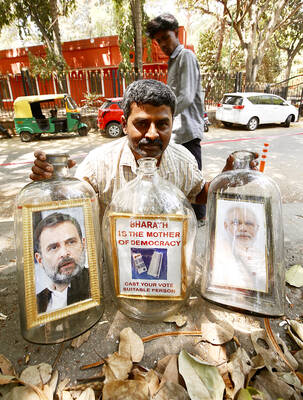
Indian Prime Minister Narendra Modi reaffirmed his pledge to replace India’s religion-based marriage and inheritance laws with a uniform civil code if he returns to office for a third term, a move that some minority groups have opposed. In an interview with the Times of India listing his agenda, Modi said his government would push for making the code a reality. “It is clear that separate laws for communities are detrimental to the health of society,” he said in the interview published yesterday. “We cannot be a nation where one community is progressing with the support of the Constitution while the other


 RSS
RSS