


Bathtub tutorials and a baby-making contest on television? Why not, says Singapore's self-styled sex guru, Wei Siang Yu, nicknamed Dr. Love.
As the island-state grapples with falling birth rates, the flamboyant medical doctor is preparing to launch a midnight television talk show which will feature bathtub tutorials, hoping it can rekindle passions and encourage couples to have more children.
Wei told reporters the program will be launched in the second quarter of this year.
This will be followed in the third quarter by a reality television program called Dr. Love Superbaby Making Show in which couples from different nationalities will compete to be the first to conceive.
Wei's unique efforts to fire up libidos come after repeated urgings from Singapore's leaders for the affluent state's population of 4 million people to reverse the nation's reproductive slow-down.
The fertility rate fell to a historic low of 1.37 per woman in 2002 despite repeated government statements urging couples to procreate. This is well below the rate of 2.1 per woman which demographers say is necessary to replenish the population naturally.
"We will have people come and talk about their love lives and private lives. We will also talk about their strategies on love, basically allowing them to talk, listen, understand and analyze," Wei said of the TV talk show.
One of the program's high-lights will be the bathtub tutorials involving real-life couples and conducted by Dr. Love himself.
"We will teach couples how to massage each other in a bathtub," said Wei, an Australian-educated doctor whose previous novel programs to help ease the decline in the fertility rate have gained international publicity.
Wei said he did not foresee any conflict with the island's strict censorship laws as the tutorials will be carried out with decency by a trained medical professional.
"We will not reveal the breast or the groin. Viewers will only see the back," he said. "This is not pornography, this is `edu-tainment.'"
The baby-making contest will be launched in the third quarter of this year, said Wei, whose US-based company Meggpower.com is co-funded by American and Asian partners.
"This is a reality TV show with 10 couples from all over the world competing in Singapore to make a baby," he said.
Couples will be given a time frame and will be judged on who will be the first one to report a conception.
Dr. Love will closely monitor the couples' hormonal cycles and recommend changes in their diets to aid conception. Seduction strategies will also be featured.
"It's like a baby race," he said.
Wei, who is unmarried, shot to the spotlight last year when he launched iDream, where couples finding it difficult to have children board a "love boat" for a luxury resort with the sole purpose of baby-making.
The package, launched in April last year and costing up to S$1,000 (US$600) per night, includes sex counsellors on standby to advise the couples, fertility seminars aboard cruise boats as well as massage and aromatherapy.
Wei said SARS spoiled his business after only three months, as travel demand to Asia ground to a halt. He plans to re-launch the idea in March.
Wei revealed plans to follow the "love boat" package with a "love plane" which will ferry couples to romantic hideaways in Asia with the same intention.
This will be done through a tie-up with a regional airline.
An existing service where women receive mobile phone text messages to alert them ahead of their ovulation period, so they can make love during that time, is showing signs of success.
Wei said he had received e-mails from some of the women saying they were already pregnant.
The doctor said a government program giving cash incentives to encourage couples to have more children was inadequate.
"Not everything can be addressed by a national kind of policy-making ... money does not solve everything," he said.

It began as a satirical online project. Now millions of young people in India are flocking to it as an outlet for their frustration. A parody political party called the Cockroach Janta Party, with the insect as its symbol, has exploded across India’s social media by turning absurdist humor into protest. Memes and short videos mocking corruption, joblessness and political dysfunction have flooded social media sites, where millions of users are embracing the cockroach — known for its ability to survive harsh conditions — as a tongue-in-cheek symbol of endurance. The online movement’s rise has been unusually rapid. The Cockroach Janta Party (CJP)

SPEAKING OUT: After Siranudh Scott’s allegations surfaced, celebrities and public figures took to social media to share their own experiences of sexual misconduct and abuse A high-profile alleged sexual abuse case within a wealthy Thai beer brewing family has prompted a wave of painful accounts from survivors of unconnected abuse in the conservative nation. Siranudh Scott, a member of the billionaire Thai family that founded the ubiquitous Singha beer brand, posted an emotional video this month accusing his elder brother Sunit of repeatedly abusing him when he was a teenager. Sunit, who is in his 30s, later denied the allegations in a video posted online, but Singha parent Boonrawd dismissed him from his executive role with the company on Tuesday last week. “I felt I needed to speak

A Hong Kong astronaut is to join a Chinese space mission for the first time as part of a three-person crew launching today, as Beijing edges closer to its goal of landing people on the moon. The Tiangong space station — crewed by teams of three astronauts that are typically rotated every six months — is the crown jewel of China’s space program, boosted by billions in state investment in a bid to catch up with the US and Russia. The Shenzhou-23 mission is to blast off at 11:08pm from the Jiuquan Satellite Launch Center in northwestern China, carrying three astronauts to
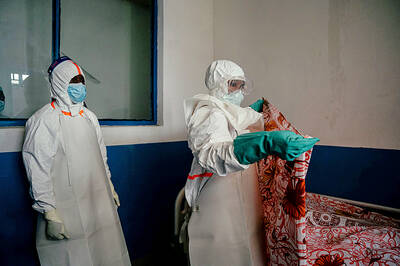
UPGRADED ALERT: The risk inside DR Congo is now considered ‘very high,’ while neighboring countries face a ‘high’ threat as the outbreak continues, the WHO said Ebola is spreading faster than responders can track it in eastern Congo, where health workers managed to follow up with barely one in five identified contacts in a single day. Authorities in the Democratic Republic of the Congo (DR Congo) reported 83 confirmed infections, 746 suspected cases and 1,603 identified contacts as of Thursday, but health workers were able to follow up on only 342 contacts that day — about 21 percent of the total under monitoring — data released by the DR Congo Ministry of Public Health on Friday showed. The figures suggest the response is falling behind the outbreak itself,


 RSS
RSS