


US President George W. Bush proposed new steps to halt illicit weapons trafficking, warning that black-market dealings by the architect of Pakistan's nuclear weapons program had exposed holes in global enforcement efforts.
"Every civilized nation has a stake in preventing the spread of weapons of mass destruction," Bush said Wednesday.
He promised that the steps he outlined would prevent such weapons from being used, and he painted a grim portrait of the consequences of failing to pursue such steps.
Bush also gave a boost to his intelligence agencies, under fire over miscalculations in Iraq, citing their work in exposing the underground Pakistani network that supplied nuclear weapons technology to Iran, Libya and North Korea.
Abdul Qadeer Khan, the Pakistani nuclear scientist who was the father of that country's nuclear weapons program, last week admitted being the mastermind of the scheme.
Khan was pardoned by Pakistani President General Pervez Musharraf.
"Breaking this network is one major success in a broad-based effort to stop the spread of terrible weapons," Bush said.
Yet Bush skated past the fact that the intelligence successes came after Iran, North Korea and Libya had already obtained the weapons technology from Khan's network.
The president hailed Libya's agreement to abandon illicit weapons efforts; Iran and North Korea have not said they plan to follow suit.
Bush for the first time publicly accused Khan's network of supplying North Korea with the centrifuge technology that is needed to make highly enriched uranium for nuclear weapons. The administration previously had said it believed Khan's network was supplying weapons technology to North Korea, Libya and Iran, but had not specified what.
The administration and North Korea are in a dispute over whether the North Koreans are trying to develop nuclear weapons using highly enriched uranium -- a key dispute as the two nations head into talks later this month with four other countries, including China. Bush offered doomsday predictions on what would happen if terrorists come to possess weapons of mass destruction.
Some of his language was reminiscent of his warnings a year ago, when he said Iraq had such banned weapons.
"The greatest threat before humanity today is the possibility of secret and sudden attack with chemical or biological or radiological or nuclear weapons," Bush said.
He offered a seven-point plan to combat the spread of such weapons. He proposed expanding a US-led international effort to halt commerce in weapons moving by land, sea or air; tightening laws and international controls on weapons proliferation; increasing government spending worldwide on programs aimed at securing vulnerable nuclear arsenals in Russia and other former Soviet-bloc nations; banning new countries from having the ability to enrich or process nuclear material, a step he said would deprive additional nations of being able to produce fissile material for nuclear bombs; prohibiting nations that do not back the Additional Protocol -- which requires states to declare a broad range of nuclear activities and facilities, and allow the International Atomic Energy Agency (IAEA) to inspect those facilities -- from importing equipment for their civilian nuclear programs; creating a special panel of the IAEA to buttress its ability to monitor countries' compliance; and barring countries under investigation for violating nuclear nonproliferation obligations from serving on the board of governors of the IAEA.
Bush is making national security and the fight against terrorism the centerpiece of his re-election campaign. In the speech, he sought to rally Americans behind him in the cause, reminding listeners that the shadow of attack remains.
He chose a friendly setting for the speech -- National Defense University in Washington, where members of his state and defense departments, along with university students and staff, think-tank employees and military veterans applauded fervently throughout his remarks.
Bush walked a delicate political tightrope, using his first public accusations of Khan to illustrate the dangers of rogue arms sales, while avoiding criticizing Pakistan's government.
Musharraf's government claims it knew nothing of Khan's network, though the Pakistani military controlled Pakistan's nuclear program.
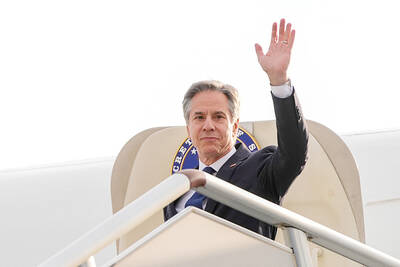
‘IN A DIFFERENT PLACE’: The envoy first visited Shanghai, where he attended a Chinese basketball playoff match, and is to meet top officials in Beijing tomorrow US Secretary of State Antony Blinken yesterday arrived in China on his second visit in a year as the US ramps up pressure on its rival over its support for Russia while also seeking to manage tensions with Beijing. The US diplomat tomorrow is to meet China’s top brass in Beijing, where he is also expected to plead for restraint as Taiwan inaugurates president-elect William Lai (賴清德), and to raise US concerns on Chinese trade practices. However, Blinken is also seeking to stabilize ties, with tensions between the world’s two largest economies easing since his previous visit in June last year. At the

UNSETTLING IMAGES: The scene took place in front of TV crews covering the Trump trial, with a CNN anchor calling it an ‘emotional and unbelievably disturbing moment’ A man who doused himself in an accelerant and set himself on fire outside the courthouse where former US president Donald Trump is on trial has died, police said yesterday. The New York City Police Department (NYPD) said the man was declared dead by staff at an area hospital. The man was in Collect Pond Park at about 1:30pm on Friday when he took out pamphlets espousing conspiracy theories, tossed them around, then doused himself in an accelerant and set himself on fire, officials and witnesses said. A large number of police officers were nearby when it happened. Some officers and bystanders rushed

Beijing is continuing to commit genocide and crimes against humanity against Uyghurs and other Muslim minorities in its western Xinjiang province, U.S. Secretary of State Antony Blinken said in a report published on Monday, ahead of his planned visit to China this week. The State Department’s annual human rights report, which documents abuses recorded all over the world during the previous calendar year, repeated language from previous years on the treatment of Muslims in Xinjiang, but the publication raises the issue ahead of delicate talks, including on the war in Ukraine and global trade, between the top U.S. diplomat and Chinese
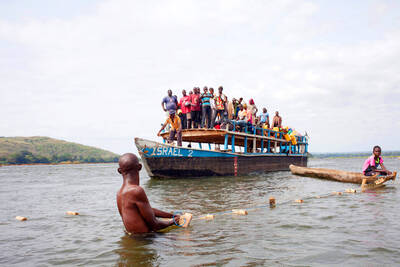
RIVER TRAGEDY: Local fishers and residents helped rescue people after the vessel capsized, while motorbike taxis evacuated some of the injured At least 58 people going to a funeral died after their overloaded river boat capsized in the Central African Republic’s (CAR) capital, Bangui, the head of civil protection said on Saturday. “We were able to extract 58 lifeless bodies,” Thomas Djimasse told Radio Guira. “We don’t know the total number of people who are underwater. According to witnesses and videos on social media, the wooden boat was carrying more than 300 people — some standing and others perched on wooden structures — when it sank on the Mpoko River on Friday. The vessel was heading to the funeral of a village chief in


 RSS
RSS