


A Thai health official warned yesterday that authorities must prepare for an expected second onslaught of bird flu, as Vietnam reported the region's 19th fatality from the virus that has ravaged poultry farms across Asia.
Malaysia, which has so far kept free of the disease and restricted poultry imports from affected countries, also cleared a 40-year-old pet-store owner and bird breeder of fears that he caught the virus. He was quarantined on Saturday when he displayed flu symptoms.
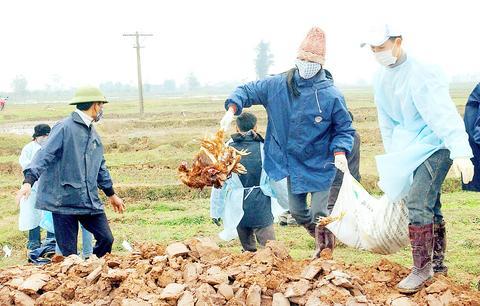
Cambodia, China, Indonesia, Japan, Laos, Pakistan, South Korea, Taiwan, Thailand and Vietnam have battled bird flu in recent weeks and officials in the US confirmed an outbreak in the state of Delaware on Friday.
But Pakistan, Taiwan and the US are reporting milder versions of bird flu than the H5N1 strain that has jumped to humans in Vietnam, where it has killed 14 people, and Thailand, where it has killed five and is suspected of sickening 23 others, nine of whom have died.
Charan Trinwuthipong, director general of Thailand's Department of Communicable Disease Control, said the "first wave of bird flu outbreak has passed," in an apparent reference to the country's almost complete cull of poultry in bird flu-affected areas.
He said the Agriculture Ministry is trying to eliminate the sources spreading the disease, "but we don't know when the second wave will come, and we don't trust the situation. So the Public Health Ministry is being as careful as possible."
A 27-year-old Vietnamese man, from southern Binh Phuoc province, died yesterday at Ho Chi Minh City's Hospital of Tropical Diseases, officials said. His family had kept chickens.
Three of his family's chickens recently died, and the man slaughtered and prepared them for a family meal. He fell ill three days afterward, said To Duc Sinh, director of the Preventive Medicine Center in Binh Phuoc province.
Most of the bird flu deaths in the current outbreak have been directly traced to contact with sick birds, and health officials have said they do not believe the illness can be contracted from eating properly cooked chicken meat and eggs.
Also yesterday, Vietnamese health officials reported a new infection, a 23-year-old man from the Koho ethnic minority group in central Lam Dong province. The man, who had lived near a poultry market, is hospitalized in stable condition in Ho Chi Minh City.
Vietnam has 19 confirmed cases of people becoming infected with bird flu -- 14 of them have died, three remain in hospitals and two have recovered.
Although details of how bird flu spreads across regions remain unclear, the World Health Organization has said it can be spread by migratory birds. Many birds can carry the virus without showing symptoms of the disease.
Also yesterday, Philippine Health Secretary Manuel Dayrit said the government has banned poultry imports from the US state of Delaware after officials there confirmed an outbreak of a different strain of bird flu.
Trade Secretary Cesar Purisima said there was no danger that the virus could spread "because we don't actually import anything out of Delaware."
The Philippines also burned 353 imported lovebirds from the Netherlands that passed through Thailand on their way to the Philippines because of fears they could have been infected by the virus, officials said.
China said over the weekend that it has newly confirmed cases of bird flu in poultry in six provinces -- Hubei, Shaanxi, Gansu, Hunan, Guangdong and Zhejiang -- in an upgrade of cases previously listed as suspected outbreaks. It also said new suspected cases were found in Guangdong and in the Guangxi region -- both of which already have confirmed cases.

‘CROSSING THE LINE’: China’s embassy in Seoul criticized US Forces Korea Commander General Xavier Brunson, asking if his ‘hostile’ remarks were authorized by Washington South Korea and the US are in talks over recent public remarks by the commander of US Forces Korea, Seoul’s presidential office said yesterday, after the comments drew sharp criticism from China. In a recent podcast interview, US Forces Korea Commander General Xavier Brunson described South Korea as “the dagger in the heart of Asia” from China’s east coast, prompting the Chinese embassy in Seoul to say that he had “truly crossed the line.” The interview came amid growing speculation that Washington might seek to expand the role of US Forces Korea in countering the growing regional influence of China, a key

Through the noise of rushing papers and whirring belts at a print factory in Kyoto, two creators watch their photo essay come to life in broadsheet form — part of an effort to win new audiences in the age of artificial intelligence (AI). Despite the decline of the publishing industry, self-publication and handmade “zine” magazines are growing in popularity in Japan, reflecting the nation’s enduring love of paper in the digital era. While speaking to Agence France-Presse at the plant, his hands black with ink, one of the creators, Kazuma Obara, said: “I think [paper] is a medium that engages all five

Australian researchers have trained lab-grown brain cells on a silicon computer chip to play the 1990s shooter game Doom and said they are just scratching the surface of what the neurons could be capable of doing. It is the science-fiction work of biotech boffins at Cortical Labs, who researched and developed the technology that harnesses the workings of the brain’s networking system. Each so-called “biological computer” contains about 200,000 living human brain cells, grown from stem cells that were harvested from blood donations. Having mastered the simple computer game Pong, where a paddle is moved up and down to send a ball

France experienced its hottest spring on record, the French weather service said on Tuesday, after an exceptional early heat wave that also broke highs for the season in England and Wales. Meteo-France said the average nationwide temperature over March to May was 13.8°C — about 1.7°C above the norm, and surpassing records set in 2011 and 2020. “The warmest spring since records began in 1900,” it said in a bulletin. All three months were warmer than average, but the onset of an “unprecedented heatwave” late last month pushed the mercury to highs typically seen at the height of the summer. “Our country had never


 RSS
RSS