


Everybody was shoving, but Vasily Mandazhe held his ground.
"They won't let us in," he shouted. "When are they going to let us in?"
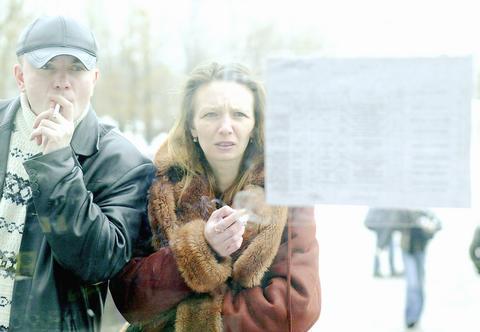
PHOTO: AFP
The names of Mandazhe's sons, Sergei and Ivan, were on a list of the wounded taped to the hospital door. But that was all the information anybody was going to get about the victims of a bombing in the Moscow subway on Friday morning, in which officials said at least 39 people died and 130 were wounded.
Family members were pushing desperately against a metal turnstile at the entrance to the Sklifasovsky Hospital, where most of the scores of wounded were being treated.
"No one's going to let you in, and that's it," said a man in a gray uniform standing guard at the turnstile.
"There's been an explosion in the Metro, do you understand?" the guard said. "They're busy. Busy. They don't need you in there."
A woman in the crowd seemed near tears. "What if you just take me by the hand and lead me in?" she pleaded.
The guard barely looked at her. "I don't want your hand," he said.
Added to the horror of the bombing was the anguish of the victim's relatives, desperate for information in a country where government officials have little regard for the families of disaster victims.
After the Kursk submarine sank in Aug. 2000 with 118 sailors aboard, it took the government days to even admit the seriousness of the accident.
After a terrorist hostage-taking in a theater in Oct. 2002 in which 129 people died, family members beseeched hospitals for days for word about whether their relatives were alive or dead.
The glasnost -- or openness -- that Mikhail Gorbachev brought to the Soviet Union two decades ago does not run deep. There is little sense here of a public right to know.
Reporters and family members were rebuffed repeatedly on Friday by police officers, ambulance drivers, doctors, government officials and hospital administrators.
"We put up a list," said Aleksandr Yermolov, director of the hospital, at a news conference in the hospital's big, empty lobby. "They'll read it, and then they can come to us. We have the names."
As he spoke, Mandazhe and a cluster of other relatives were almost within earshot, just beyond the turnstile, arguing with the only representatives the hospital made available -- the security guards.
Mandazhe gave up. He and his sister and niece stumbled through the snow and ice to a back entrance to the hospital, holding on to one another for balance.
There, a guard in a gray uniform was holding a metal door open just a crack, allowing people to plead with him for a moment before he sent them on their way.
"Come back Sunday," he told the Mandazhe family, in what seemed to be emerging as the official word.
As the guard watched the Mandazhe family walk away, someone asked him why he was being so rude to the desperate relatives.
"Well, we're fed up," he said. "Do you know how many people have been coming? `Please, please!' Everyone wants something. Ahh, the tragedy. They're driving me crazy."
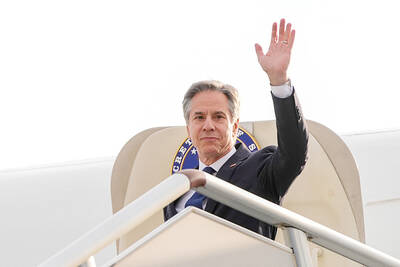
‘IN A DIFFERENT PLACE’: The envoy first visited Shanghai, where he attended a Chinese basketball playoff match, and is to meet top officials in Beijing tomorrow US Secretary of State Antony Blinken yesterday arrived in China on his second visit in a year as the US ramps up pressure on its rival over its support for Russia while also seeking to manage tensions with Beijing. The US diplomat tomorrow is to meet China’s top brass in Beijing, where he is also expected to plead for restraint as Taiwan inaugurates president-elect William Lai (賴清德), and to raise US concerns on Chinese trade practices. However, Blinken is also seeking to stabilize ties, with tensions between the world’s two largest economies easing since his previous visit in June last year. At the

UNSETTLING IMAGES: The scene took place in front of TV crews covering the Trump trial, with a CNN anchor calling it an ‘emotional and unbelievably disturbing moment’ A man who doused himself in an accelerant and set himself on fire outside the courthouse where former US president Donald Trump is on trial has died, police said yesterday. The New York City Police Department (NYPD) said the man was declared dead by staff at an area hospital. The man was in Collect Pond Park at about 1:30pm on Friday when he took out pamphlets espousing conspiracy theories, tossed them around, then doused himself in an accelerant and set himself on fire, officials and witnesses said. A large number of police officers were nearby when it happened. Some officers and bystanders rushed

Beijing is continuing to commit genocide and crimes against humanity against Uyghurs and other Muslim minorities in its western Xinjiang province, U.S. Secretary of State Antony Blinken said in a report published on Monday, ahead of his planned visit to China this week. The State Department’s annual human rights report, which documents abuses recorded all over the world during the previous calendar year, repeated language from previous years on the treatment of Muslims in Xinjiang, but the publication raises the issue ahead of delicate talks, including on the war in Ukraine and global trade, between the top U.S. diplomat and Chinese
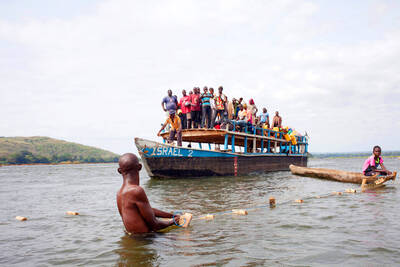
RIVER TRAGEDY: Local fishers and residents helped rescue people after the vessel capsized, while motorbike taxis evacuated some of the injured At least 58 people going to a funeral died after their overloaded river boat capsized in the Central African Republic’s (CAR) capital, Bangui, the head of civil protection said on Saturday. “We were able to extract 58 lifeless bodies,” Thomas Djimasse told Radio Guira. “We don’t know the total number of people who are underwater. According to witnesses and videos on social media, the wooden boat was carrying more than 300 people — some standing and others perched on wooden structures — when it sank on the Mpoko River on Friday. The vessel was heading to the funeral of a village chief in


 RSS
RSS