


Intelligence analysts never told President George W. Bush before the invasion of Iraq that then-president Saddam Hussein's rule posed an imminent threat, CIA Director George Tenet said in a heated defense of agency findings central to the decision to go to war.
The urgency of the Iraqi threat was Bush's main argument for the war.
But the president said on Thursday he still would have invaded Iraq if he'd known no weapons stockpiles existed -- adding a new element to the much-debated question of whether the US went to war based on faulty assumptions.
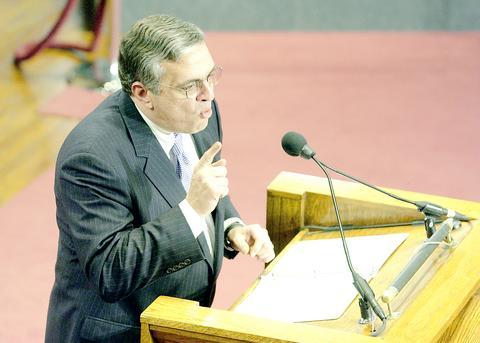
PHOTO: AP
Tenet, addressing such questions for the first time after weeks of silence, acknowledged that analysts believed before the war that Saddam had chemical and biological weapons, although none have been found.
He said he believes some of what US intelligence predicted about Iraq will turn out to have been right -- and some wrong -- as is often the case in such matters.
He made clear that analysts differed among themselves all along on important aspects of Saddam's chemical, biological and nuclear programs and spelled out those disputes in an October 2002 intelligence estimate given to the White House.
"They never said there was an imminent threat," Tenet said in a speech at Georgetown University. "Rather, they painted an objective assessment for our policy-makers of a brutal dictator who was continuing his efforts to deceive and build programs that might constantly surprise us and threaten our interests."
Tenet's remarks hit back at his former special adviser on Iraqi weapons, David Kay, who said last month "we were almost all wrong" about Iraq's weapons of mass destruction. The comments also seemed designed to inoculate the CIA from becoming a scapegoat in the fight over whether the war was justified.
Speaking in Charleston, South Carolina, Bush acknowledged that the weapons have not been found, although investigators have discovered evidence of possible programs. He said the war was still justified.
"Knowing what I knew then and knowing what I know today, America did the right thing in Iraq," Bush said.
Tenet, in his 40-minute defense, never said in detail how the Bush administration, citing US intelligence, might have painted an inaccurate picture of Iraq's weapons arsenal.
He insisted that the intelligence analysts had not tailored their findings for any political purpose.
That leaves the door open for Democrats to demand more investigation and explanation, and for many to question the basis of the administration's pre-emptive strike doctrine.
"It goes to the core of why a nation went to war," said Democratic presidential front-runner, Senator John Kerry of Massachusetts.
Before the war, Bush and his senior advisers made clear they viewed the threat from Saddam as urgent.
In October 2002, Bush told an audience in Ohio that "the danger is already significant and it only grows worse with time. If we know Saddam Hussein has dangerous weapons today -- and we do -- does it make any sense for the world to wait to confront him as he grows even stronger and develops even more dangerous weapons?"
On Sept. 13, 2002, Bush said of Saddam: "He's a threat we must deal with as quickly as possible."
White House aides have pointed out that Bush, while he cited the urgency of Saddam's threat, never specifically characterized the threat as "imminent."
In his State of the Union address in January last year, Bush said: "Some have said we must not act until the threat is imminent. Since when have terrorists and tyrants announced their intentions, politely putting us on notice before they strike? If this threat is permitted to fully and suddenly emerge, all actions, all words and all recriminations would come too late."
In general, the Bush administration before the war cited three main justifications for military action: preventing Iraq from using weapons of mass destruction, protecting America and liberating Iraq.
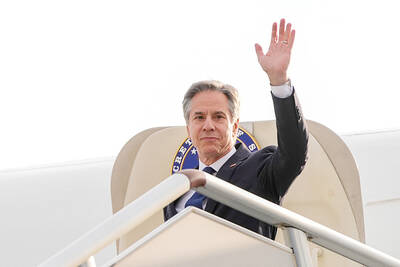
‘IN A DIFFERENT PLACE’: The envoy first visited Shanghai, where he attended a Chinese basketball playoff match, and is to meet top officials in Beijing tomorrow US Secretary of State Antony Blinken yesterday arrived in China on his second visit in a year as the US ramps up pressure on its rival over its support for Russia while also seeking to manage tensions with Beijing. The US diplomat tomorrow is to meet China’s top brass in Beijing, where he is also expected to plead for restraint as Taiwan inaugurates president-elect William Lai (賴清德), and to raise US concerns on Chinese trade practices. However, Blinken is also seeking to stabilize ties, with tensions between the world’s two largest economies easing since his previous visit in June last year. At the

UNSETTLING IMAGES: The scene took place in front of TV crews covering the Trump trial, with a CNN anchor calling it an ‘emotional and unbelievably disturbing moment’ A man who doused himself in an accelerant and set himself on fire outside the courthouse where former US president Donald Trump is on trial has died, police said yesterday. The New York City Police Department (NYPD) said the man was declared dead by staff at an area hospital. The man was in Collect Pond Park at about 1:30pm on Friday when he took out pamphlets espousing conspiracy theories, tossed them around, then doused himself in an accelerant and set himself on fire, officials and witnesses said. A large number of police officers were nearby when it happened. Some officers and bystanders rushed

Beijing is continuing to commit genocide and crimes against humanity against Uyghurs and other Muslim minorities in its western Xinjiang province, U.S. Secretary of State Antony Blinken said in a report published on Monday, ahead of his planned visit to China this week. The State Department’s annual human rights report, which documents abuses recorded all over the world during the previous calendar year, repeated language from previous years on the treatment of Muslims in Xinjiang, but the publication raises the issue ahead of delicate talks, including on the war in Ukraine and global trade, between the top U.S. diplomat and Chinese
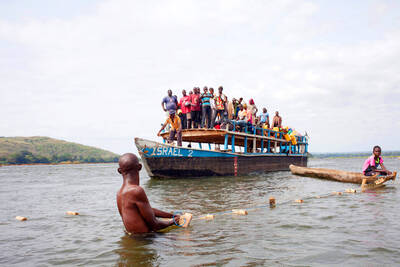
RIVER TRAGEDY: Local fishers and residents helped rescue people after the vessel capsized, while motorbike taxis evacuated some of the injured At least 58 people going to a funeral died after their overloaded river boat capsized in the Central African Republic’s (CAR) capital, Bangui, the head of civil protection said on Saturday. “We were able to extract 58 lifeless bodies,” Thomas Djimasse told Radio Guira. “We don’t know the total number of people who are underwater. According to witnesses and videos on social media, the wooden boat was carrying more than 300 people — some standing and others perched on wooden structures — when it sank on the Mpoko River on Friday. The vessel was heading to the funeral of a village chief in


 RSS
RSS