


Plans for a major extension of Britain's anti-terror laws floated by UK Home Secretary David Blunkett provoked widespread condemnation from lawyers and civil liberties groups on Monday.
Blunkett is considering consulting on measures which would include allowing British terror suspects to be tried at least partly in secret, with convictions reached on evidence from security and intelligence sources, rather than through traditional policing routes.
Sensitive evidence could be kept secret even from defendants and their lawyers, while state-appointed special advocates would protect defendants' interests.
The standard of proof could be lowered from the criminal standard of "beyond reasonable doubt" to "the balance of probabilities," meaning the defendant was more likely guilty than not.
"Pre-emptive" action could be taken before suicide bombers had a chance to carry out their plans.
The Labour peer Helena Kennedy described Blunkett as a "shameless authoritarian" and called his ideas "an affront to the rule of law." She compared him to the Zimbabwean dictator, Robert Mugabe. His debate on the issue was "a classic Blunkett tactic," she told BBC Radio 4's Today program.
"You suggest all kinds of outrageous and awful things because then you get away with half of them," she said.
"But all of this is terrible and even half of it would be a disgrace," she said.
She said it was particularly untimely to propose convicting people on the basis of intelligence material at a time when such security services were coming under criticism for failures in Iraq.
Stephen Irwin, chairman of the bar, said: "No one should contemplate changing the standard of proof or trying people in secret, unless everything else has been tried, and we are still failing to convict terrorists. We have not tried everything.
"For example, government does not use evidence from intercepts in court. The last thing we should do is to risk generating more terrorists from within our own country by creating grievances," he said.
Mark Littlewood of the civil rights group Liberty said: "Simply introducing more laws, greater powers and stiffer penalties will go a long way to undermining British justice and will not make our country any safer."
Neil Durkin of Amnesty International UK said: "What is particularly worrying is the suggestion that there might be some wider introduction of internment-like measures that have already created a small-scale Guantanamo Bay in our own backyard by imprisoning 14 foreign nationals without charge or trial."
Blunkett, outlining his thoughts during a visit to India, said: "I think we need to debate how we can amalgamate the Terrorism Act 2000 and the 2001 terrorism legislation and deal with these delicate issues of proportionality and human rights on the one hand and evidential base and the threshold of evidence on the other.
"That is quite a challenge because we are having to say that the nature of what people obtain through the security and intelligence route is different to the evidence gained through the policing route," he said.
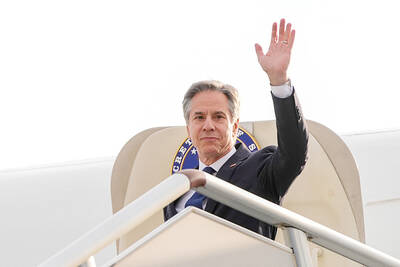
‘IN A DIFFERENT PLACE’: The envoy first visited Shanghai, where he attended a Chinese basketball playoff match, and is to meet top officials in Beijing tomorrow US Secretary of State Antony Blinken yesterday arrived in China on his second visit in a year as the US ramps up pressure on its rival over its support for Russia while also seeking to manage tensions with Beijing. The US diplomat tomorrow is to meet China’s top brass in Beijing, where he is also expected to plead for restraint as Taiwan inaugurates president-elect William Lai (賴清德), and to raise US concerns on Chinese trade practices. However, Blinken is also seeking to stabilize ties, with tensions between the world’s two largest economies easing since his previous visit in June last year. At the
Nearly half of China’s major cities are suffering “moderate to severe” levels of subsidence, putting millions of people at risk of flooding, especially as sea levels rise, according to a study of nationwide satellite data released yesterday. The authors of the paper, published by the journal Science, found that 45 percent of China’s urban land was sinking faster than 3mm per year, with 16 percent at more than 10mm per year, driven not only by declining water tables, but also the sheer weight of the built environment. With China’s urban population already in excess of 900 million people, “even a small portion

UNSETTLING IMAGES: The scene took place in front of TV crews covering the Trump trial, with a CNN anchor calling it an ‘emotional and unbelievably disturbing moment’ A man who doused himself in an accelerant and set himself on fire outside the courthouse where former US president Donald Trump is on trial has died, police said yesterday. The New York City Police Department (NYPD) said the man was declared dead by staff at an area hospital. The man was in Collect Pond Park at about 1:30pm on Friday when he took out pamphlets espousing conspiracy theories, tossed them around, then doused himself in an accelerant and set himself on fire, officials and witnesses said. A large number of police officers were nearby when it happened. Some officers and bystanders rushed

Beijing is continuing to commit genocide and crimes against humanity against Uyghurs and other Muslim minorities in its western Xinjiang province, U.S. Secretary of State Antony Blinken said in a report published on Monday, ahead of his planned visit to China this week. The State Department’s annual human rights report, which documents abuses recorded all over the world during the previous calendar year, repeated language from previous years on the treatment of Muslims in Xinjiang, but the publication raises the issue ahead of delicate talks, including on the war in Ukraine and global trade, between the top U.S. diplomat and Chinese


 RSS
RSS