


Under mounting pressure, US President George W. Bush said on Monday he would appoint an independent commission to investigate whether the intelligence used to justify the war in Iraq was flawed.
British Prime Minister Tony Blair followed the US lead yesterday, announcing he had appointed a commission to investigate flaws in the intelligence he cited in going to war with Iraq.
Bush had previously opposed an independent probe of pre-war intelligence, but was under strong pressure from Republicans and Democrats in Congress to call an investigation.
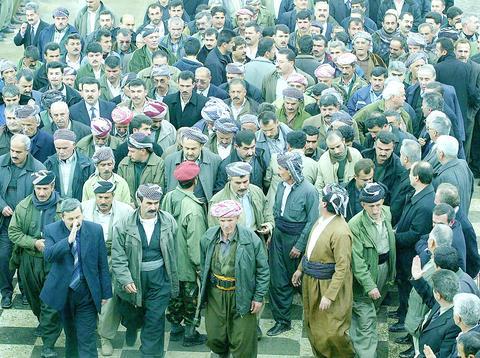
PHOTO: EPA
"I want to know all the facts," Bush told reporters on Monday. He said he would soon meet with David Kay, the former chief US weapons hunter in Iraq, who told a congressional hearing last week that much of the intelligence about Iraq's alleged weapons of mass destruction was wrong.
The failure to find chemical, biological or nuclear weapons in Iraq in months of searching has become a major political issue in a year when Bush must seek re-election.
Blair used a scheduled appearance before a parliamentary committee yesterday morning to announce the official inquiry. The announcement came just days after a senior judge cleared the British government of allegations that it distorted what it knew about Iraq's weapons programs to build a case for war.
Both men justified going to war by saying former Iraqi president Saddam Hussein possessed chemical and biological weapons that posed an immediate threat to international security.
Blair's spokesman would not provide details about the probe and declined to say whether Blair would support calls for an inquiry committee of legislators from both houses of parliament, with an independent chairman.
The British government had also previously rejected calls for an inquiry. But on Monday, Blair's spokesman said last week's ruling by senior judge Lord Hutton that the government had not "sexed up" intelligence had cleared the air and allowed for a rational discussion of Iraqi weapons.
The Blair spokesman said that British officials had "been talking with the Bush administration and were keeping in close touch with their thinking on how to approach this issue."
The threat posed by Iraq's alleged nuclear, chemical and biological weapons was Blair's main argument for war.
No such weapons have been found, and David Kay, the former head of the US-led Iraq Survey Group, has said he doesn't believe they ever will be. Kay, who quit last month, told the US Congress last week that "it turns out we were all wrong, probably" about the Iraqi threat.
On Monday, the House of Commons Foreign Affairs Committee said the failure to find Iraq's weapons of mass destruction "has damaged the credibility of the US and the United Kingdom in their conduct of the war against terrorism."
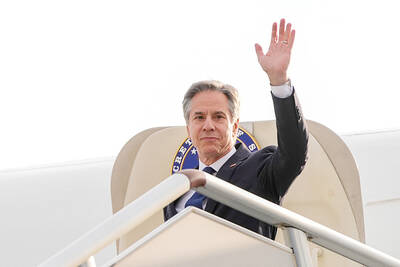
‘IN A DIFFERENT PLACE’: The envoy first visited Shanghai, where he attended a Chinese basketball playoff match, and is to meet top officials in Beijing tomorrow US Secretary of State Antony Blinken yesterday arrived in China on his second visit in a year as the US ramps up pressure on its rival over its support for Russia while also seeking to manage tensions with Beijing. The US diplomat tomorrow is to meet China’s top brass in Beijing, where he is also expected to plead for restraint as Taiwan inaugurates president-elect William Lai (賴清德), and to raise US concerns on Chinese trade practices. However, Blinken is also seeking to stabilize ties, with tensions between the world’s two largest economies easing since his previous visit in June last year. At the

UNSETTLING IMAGES: The scene took place in front of TV crews covering the Trump trial, with a CNN anchor calling it an ‘emotional and unbelievably disturbing moment’ A man who doused himself in an accelerant and set himself on fire outside the courthouse where former US president Donald Trump is on trial has died, police said yesterday. The New York City Police Department (NYPD) said the man was declared dead by staff at an area hospital. The man was in Collect Pond Park at about 1:30pm on Friday when he took out pamphlets espousing conspiracy theories, tossed them around, then doused himself in an accelerant and set himself on fire, officials and witnesses said. A large number of police officers were nearby when it happened. Some officers and bystanders rushed
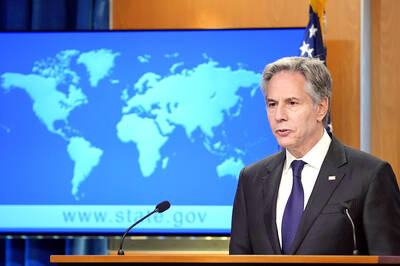
Beijing is continuing to commit genocide and crimes against humanity against Uyghurs and other Muslim minorities in its western Xinjiang province, U.S. Secretary of State Antony Blinken said in a report published on Monday, ahead of his planned visit to China this week. The State Department’s annual human rights report, which documents abuses recorded all over the world during the previous calendar year, repeated language from previous years on the treatment of Muslims in Xinjiang, but the publication raises the issue ahead of delicate talks, including on the war in Ukraine and global trade, between the top U.S. diplomat and Chinese
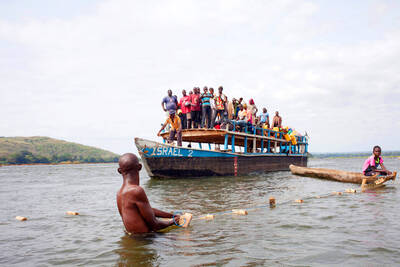
RIVER TRAGEDY: Local fishers and residents helped rescue people after the vessel capsized, while motorbike taxis evacuated some of the injured At least 58 people going to a funeral died after their overloaded river boat capsized in the Central African Republic’s (CAR) capital, Bangui, the head of civil protection said on Saturday. “We were able to extract 58 lifeless bodies,” Thomas Djimasse told Radio Guira. “We don’t know the total number of people who are underwater. According to witnesses and videos on social media, the wooden boat was carrying more than 300 people — some standing and others perched on wooden structures — when it sank on the Mpoko River on Friday. The vessel was heading to the funeral of a village chief in


 RSS
RSS