


Voters headed to the polls in seven states yesterday on the biggest day of the Democratic presidential race so far, with front-runner John Kerry hoping for a strong showing that could knock rivals out of the race.
Voters in Missouri, South Carolina, Delaware, Arizona, New Mexico, North Dakota and Oklahoma will cast ballots in the race to find a challenger to US President George W. Bush, with 269 delegates to this summer's nominating convention at stake.
Kerry, on a roll since starting the race with big wins in Iowa and New Hampshire, is leading or near the top in polls in all seven states, putting him on the cusp of a sweep that would make his campaign hard to stop.
But rivals John Edwards and Wesley Clark hope to halt Kerry's momentum in South Carolina and Oklahoma, respectively, giving their campaigns new life and extending the race for at least a few weeks and possibly into early March.
The voting yesterday offered the first national test for the candidates, who spent almost all of January battling in Iowa and New Hampshire, largely white and rural states that hosted the first two nominating tests.
Yesterday, candidates competed in the first contest in the South and the first in a state with a large black population, South Carolina; and the first contests in states with large Hispanic populations, Arizona and New Mexico.
Kerry, a Massachusetts senator, is under pressure to prove he can win on more unfamiliar terrain in the South and West, and in states with a more moderate electorate than in Iowa and New Hampshire.
Edwards, a senator from North Carolina, has admitted he must win in South Carolina to stay in the race, and polls show him with a narrow lead over Kerry. Clark, a retired general and former NATO commander, is in a virtual dead heat with Kerry in Oklahoma.
Kerry leads in polls in all of the other five states.
Anyone who could not come up with a victory yesterday will face immediate pressure from party officials and donors to bow out of the race. That could mean the end for Connecticut Senator Joseph Lieberman, who is likely to pull the plug on his campaign if he cannot spring a stunning upset on Tuesday.
Former front-runner Howard Dean, struggling to halt his downward slide after poor finishes in Iowa and New Hampshire, is largely looking beyond yesterday and focusing instead on Saturday, when Michigan and Washington will host nominating contests, and to Feb. 17 in Wisconsin.
Dean has become more aggressive in recent days, criticizing Kerry's record on health care in the Senate and his acceptance of special interest campaign donations; otherwise, Kerry has largely escaped the sort of attacks that Dean faced regularly when he was the front-runner.
Kerry is the only candidate who advertised and campaigned in all seven of the states this week, and is almost certain to meet the 15 percent threshold required to pick up delegates in every state, even if he loses.
While yesterday offered a rich harvest of delegates to the nominating convention, when it is completed only about 10 percent of the delegates to the convention will have been chosen.
Dean and Kerry's other rivals hope to extend the race to March 2, when huge states like New York and California will vote.
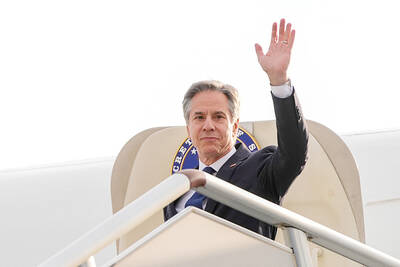
‘IN A DIFFERENT PLACE’: The envoy first visited Shanghai, where he attended a Chinese basketball playoff match, and is to meet top officials in Beijing tomorrow US Secretary of State Antony Blinken yesterday arrived in China on his second visit in a year as the US ramps up pressure on its rival over its support for Russia while also seeking to manage tensions with Beijing. The US diplomat tomorrow is to meet China’s top brass in Beijing, where he is also expected to plead for restraint as Taiwan inaugurates president-elect William Lai (賴清德), and to raise US concerns on Chinese trade practices. However, Blinken is also seeking to stabilize ties, with tensions between the world’s two largest economies easing since his previous visit in June last year. At the

UNSETTLING IMAGES: The scene took place in front of TV crews covering the Trump trial, with a CNN anchor calling it an ‘emotional and unbelievably disturbing moment’ A man who doused himself in an accelerant and set himself on fire outside the courthouse where former US president Donald Trump is on trial has died, police said yesterday. The New York City Police Department (NYPD) said the man was declared dead by staff at an area hospital. The man was in Collect Pond Park at about 1:30pm on Friday when he took out pamphlets espousing conspiracy theories, tossed them around, then doused himself in an accelerant and set himself on fire, officials and witnesses said. A large number of police officers were nearby when it happened. Some officers and bystanders rushed
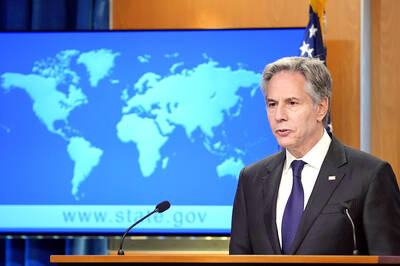
Beijing is continuing to commit genocide and crimes against humanity against Uyghurs and other Muslim minorities in its western Xinjiang province, U.S. Secretary of State Antony Blinken said in a report published on Monday, ahead of his planned visit to China this week. The State Department’s annual human rights report, which documents abuses recorded all over the world during the previous calendar year, repeated language from previous years on the treatment of Muslims in Xinjiang, but the publication raises the issue ahead of delicate talks, including on the war in Ukraine and global trade, between the top U.S. diplomat and Chinese
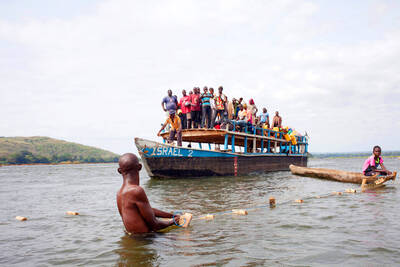
RIVER TRAGEDY: Local fishers and residents helped rescue people after the vessel capsized, while motorbike taxis evacuated some of the injured At least 58 people going to a funeral died after their overloaded river boat capsized in the Central African Republic’s (CAR) capital, Bangui, the head of civil protection said on Saturday. “We were able to extract 58 lifeless bodies,” Thomas Djimasse told Radio Guira. “We don’t know the total number of people who are underwater. According to witnesses and videos on social media, the wooden boat was carrying more than 300 people — some standing and others perched on wooden structures — when it sank on the Mpoko River on Friday. The vessel was heading to the funeral of a village chief in


 RSS
RSS