


Posters are up, images are being polished and the dirty tricks have started well before candidates are allowed to barrage voters in the Philippines.
Officially, campaigning cannot begin until Feb. 10, but in the media and on the luncheon speech circuit, President Gloria Macapagal Arroyo and her five rivals have been revving up their personalities and platforms for general elections in May.
Even critical business such as passing this year's national budget is mired in politics as lawmakers haggle about the size of the pork barrel for vote-winning public works projects.
The state election commission can disqualify candidates for premature campaigning, but it has problems of its own after the Supreme Court cancelled a deal for electronic ballot-counters due to bidding irregularities.
Votes for 17,000 elected officials -- from president and senator through to regional governor and town councillor -- must again be tallied by hand after the polls close on May 10.
In the past, it has taken weeks for final results to trickle in from a nation of 7,100 islands and nearly 40 million voters.
Elections in the Philippines are always raucous events, with the dead casting ballots, voters registering in multiple wards and politicians forming fluid alliances.
But there are signs this campaign could be particularly nasty -- from questions about the citizenship of front-running film star Fernando Poe Jr to rumors of a plot against Arroyo's government that sent the peso plunging last week.
"I am afraid that we will witness one of the most violent elections in our history," said political analyst Earl Parreno.
Some of Arroyo's critics cast doubt on the legitimacy of her mandate, saying her rise from vice president in early 2001 after a popular revolt toppled Joseph Estrada was a coup by the ruling elite against a leader with vast backing from the poor.
Stephen Wilford, the Singapore-based Southeast Asia analyst for the Control Risks Group, said he was concerned the election could be postponed by lack of preparation for a manual count or fail altogether because of widespread doubt about the outcome.
"If some kind of poll goes ahead, the most dangerous time for the Philippines could be after the elections are over from the point of view that the result will not have the respect it needs to give any new president any kind of mandate," Wilford said.
"Then your military challenges and your machinations among the oligarchs are really going to ratchet up."
The influence of generals and unhappiness in the ranks cannot be ignored after the military backed street protests and middle-class anger that ousted dictator Ferdinand Marcos in 1986 and Estrada three years ago.
Six months after Arroyo peacefully put down a mutiny by about 300 soldiers, several young captains demanded the resignation of Defence Secretary Eduardo Ermita last week, accusing him of ordering troops to spy on the president's challengers.
Police have filed minor flag-desecration charges against five junior officers and two civilians, as analysts saw dirty tricks rather than a serious threat of sedition behind the allegations.
Still, the willingness of either the government or the opposition to use tactics that ultimately hurt the country's image underscores the ruthlessness of the fight for power.
The battle can be even rougher at the local level, where town officials deliver blocks of support in return for a cut of neighborhood infrastructure projects. Power and influence often pass through certain families election after election.
"We really don't have a culture of public service," Parreno said. "We have a well-entrenched patron-client relationship that we have inherited from three centuries of Spanish colonization."
With the Philippines facing rampant corruption, huge national debts, pervasive poverty, rebel threats and an economy falling behind a global rebound, candidates have been talking up a storm without delving too deeply into specifics.
Poe leads Arroyo in opinion polls, capitalizing on his fame among the lower classes as the fist-swinging hero of few words in action movies since the 1950s.
But questions hang over his close friendship with Estrada, himself a former actor, and his ability to deal with the nation's problems without a high school diploma or political track record.
Arroyo, an economist, is playing up her achievements among only partly successful fiscal and anti-graft reforms.
Raul Roco, a former education secretary popular with students and professionals, is running in third place as an independent candidate but some analysts suspect his campaign may run out of gas without the support of a party machine.
Senator Panfilo Lacson, who accuses Arroyo's husband of salting away contributions from her 1998 campaign, enjoys support from the tiny but influential ethnic Chinese community for his no-nonsense stance on crime when he was national police chief.
But he has effectively pulled some of the opposition vote away from Poe by refusing to yield to the popular film star.
Eduardo Villanueva, a television evangelist known as "Brother Eddie," and businessman Eddie Gil also made the cut to run for president but languish at the bottom of voter surveys.
In a sign of early efforts to woo voters, Arroyo's running mate Noli de Castro, a senator and former newsreader, recently joined the president for her weekly radio address.
Personalities, not policies, tend to bring in the votes here.
But another maxim of Philippine politics -- there are no losers, only winners and those who were cheated -- is a reminder that victory must be achieved at almost any cost.
"Because things are quite close, the money is going to be running freely," Wilford said. "The problem is the Philippines has never had a political elite that has governed in the interests of the Philippines."

‘IN A DIFFERENT PLACE’: The envoy first visited Shanghai, where he attended a Chinese basketball playoff match, and is to meet top officials in Beijing tomorrow US Secretary of State Antony Blinken yesterday arrived in China on his second visit in a year as the US ramps up pressure on its rival over its support for Russia while also seeking to manage tensions with Beijing. The US diplomat tomorrow is to meet China’s top brass in Beijing, where he is also expected to plead for restraint as Taiwan inaugurates president-elect William Lai (賴清德), and to raise US concerns on Chinese trade practices. However, Blinken is also seeking to stabilize ties, with tensions between the world’s two largest economies easing since his previous visit in June last year. At the

UNSETTLING IMAGES: The scene took place in front of TV crews covering the Trump trial, with a CNN anchor calling it an ‘emotional and unbelievably disturbing moment’ A man who doused himself in an accelerant and set himself on fire outside the courthouse where former US president Donald Trump is on trial has died, police said yesterday. The New York City Police Department (NYPD) said the man was declared dead by staff at an area hospital. The man was in Collect Pond Park at about 1:30pm on Friday when he took out pamphlets espousing conspiracy theories, tossed them around, then doused himself in an accelerant and set himself on fire, officials and witnesses said. A large number of police officers were nearby when it happened. Some officers and bystanders rushed

Beijing is continuing to commit genocide and crimes against humanity against Uyghurs and other Muslim minorities in its western Xinjiang province, U.S. Secretary of State Antony Blinken said in a report published on Monday, ahead of his planned visit to China this week. The State Department’s annual human rights report, which documents abuses recorded all over the world during the previous calendar year, repeated language from previous years on the treatment of Muslims in Xinjiang, but the publication raises the issue ahead of delicate talks, including on the war in Ukraine and global trade, between the top U.S. diplomat and Chinese
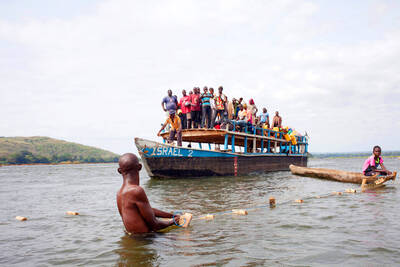
RIVER TRAGEDY: Local fishers and residents helped rescue people after the vessel capsized, while motorbike taxis evacuated some of the injured At least 58 people going to a funeral died after their overloaded river boat capsized in the Central African Republic’s (CAR) capital, Bangui, the head of civil protection said on Saturday. “We were able to extract 58 lifeless bodies,” Thomas Djimasse told Radio Guira. “We don’t know the total number of people who are underwater. According to witnesses and videos on social media, the wooden boat was carrying more than 300 people — some standing and others perched on wooden structures — when it sank on the Mpoko River on Friday. The vessel was heading to the funeral of a village chief in


 RSS
RSS