


Slobodan Milosevic is being upstaged. For the past two years, the former Yugoslav president has noisily challenged the international tribunal that is trying him for war crimes, by pontificating, denigrating his judges and dismissing his trial as a mere anti-Serb farce.
But now a fellow Serb, the ultranationalist politician and warlord Vojislav Seselj, is outdoing Milosevic in insolence. Taken together, their behavior illustrates some of the difficulties this court faces.
Frustratingly slow at times, it deals with Croat, Muslim and Serbian defendants accused of atrocities in the 1990s wars that broke up Yugoslavia. Seselj, who turned himself in a year ago, has sneered that the UN court is just an "American tool against Serbs," which he "will blast to pieces."
Known in Serbia for his rabble-rousing speeches and foul language, he has now brought these habits to the Hague. He has equated one judge with the Nazis and requested that all three of his judges be disqualified. He has accused the tribunal registrar of financial crimes, fired off motions that amount to insulting diatribes and managed to outwit his prison guards -- and his trial has not even begun.
Some court officials wonder how a proper and fair trial of such an obstructionist defendant can be conducted.
"Other accused have their ways of being difficult," said Jim Landale, the tribunal spokesman, "but we have not seen such extreme verbal assaults before."
Like Milosevic, Seselj, 49, is conducting his own defense, which allows him to hold the floor in court, even now at preparatory hearings for the trial that may begin later this year.
Seselj, a former Sarajevo University lecturer who founded an ultranationalist political party and his own armed militia, faces charges of crimes against humanity and war crimes in Bosnia and Croatia in the 1990s. His indictment states that he ordered persecutions, plunder and killings, and that he is accountable for the atrocities perpetrated by his gang, known as Seselj's Men. Prosecutors and witnesses contend that he often directed the fighters as they terrorized, robbed and killed non-Serbian civilians.
Seselj's latest move that aggravated court officials came in December, when he managed to use the jail telephone to campaign for his Radical Party in the parliamentary elections of Serbia. Milosevic did the same for his Socialist Party. When the tribunal discovered they were broadcasting on Belgrade radio, it imposed a temporary ban on all calls except to family and lawyers.
Milosevic reportedly respected the ban, a court official said, but Seselj gave another interview on Dec. 25 from a public phone near his cell. He told his listeners in Belgrade that he was able to trick his guards because "the fools are all busy celebrating Christmas."
Seselj's party won almost 28 percent of the vote, making it the largest political force in the country. He tried to deliver a victory speech by telephone until his guards cut him off.
The telephone episode points up the challenge of trying to stop these two seasoned politicians from exercising their influence from their cells.
Court officials are even more concerned about the plans of the two to use their trials as political platforms. Milosevic, for example, is entitled to hold the floor for many months once his defense begins in May.
Proceedings are regularly broadcast to the Balkans, and while Milosevic's influence at home has waned, his past defiance and now Seselj's courtroom histrionics draw applause or amusement in Serbia.
One such story involves a computer, which the court gave Seselj to try to stop him from filing his lengthy motions scribbled by hand. He announced to his judges he would not touch this laptop because, he said with evident sarcasm, he did not want to get electric shocks.
During one session he requested that the judges change their red-and-black courtroom robes because they caused him deep psychological problems. He said they reminded him of the Roman Catholic Inquisition.

‘IN A DIFFERENT PLACE’: The envoy first visited Shanghai, where he attended a Chinese basketball playoff match, and is to meet top officials in Beijing tomorrow US Secretary of State Antony Blinken yesterday arrived in China on his second visit in a year as the US ramps up pressure on its rival over its support for Russia while also seeking to manage tensions with Beijing. The US diplomat tomorrow is to meet China’s top brass in Beijing, where he is also expected to plead for restraint as Taiwan inaugurates president-elect William Lai (賴清德), and to raise US concerns on Chinese trade practices. However, Blinken is also seeking to stabilize ties, with tensions between the world’s two largest economies easing since his previous visit in June last year. At the

UNSETTLING IMAGES: The scene took place in front of TV crews covering the Trump trial, with a CNN anchor calling it an ‘emotional and unbelievably disturbing moment’ A man who doused himself in an accelerant and set himself on fire outside the courthouse where former US president Donald Trump is on trial has died, police said yesterday. The New York City Police Department (NYPD) said the man was declared dead by staff at an area hospital. The man was in Collect Pond Park at about 1:30pm on Friday when he took out pamphlets espousing conspiracy theories, tossed them around, then doused himself in an accelerant and set himself on fire, officials and witnesses said. A large number of police officers were nearby when it happened. Some officers and bystanders rushed
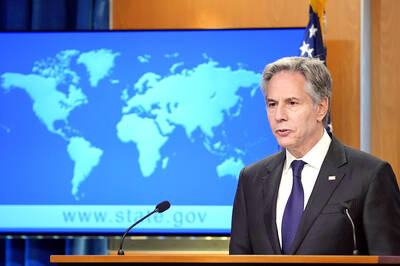
Beijing is continuing to commit genocide and crimes against humanity against Uyghurs and other Muslim minorities in its western Xinjiang province, U.S. Secretary of State Antony Blinken said in a report published on Monday, ahead of his planned visit to China this week. The State Department’s annual human rights report, which documents abuses recorded all over the world during the previous calendar year, repeated language from previous years on the treatment of Muslims in Xinjiang, but the publication raises the issue ahead of delicate talks, including on the war in Ukraine and global trade, between the top U.S. diplomat and Chinese

RIVER TRAGEDY: Local fishers and residents helped rescue people after the vessel capsized, while motorbike taxis evacuated some of the injured At least 58 people going to a funeral died after their overloaded river boat capsized in the Central African Republic’s (CAR) capital, Bangui, the head of civil protection said on Saturday. “We were able to extract 58 lifeless bodies,” Thomas Djimasse told Radio Guira. “We don’t know the total number of people who are underwater. According to witnesses and videos on social media, the wooden boat was carrying more than 300 people — some standing and others perched on wooden structures — when it sank on the Mpoko River on Friday. The vessel was heading to the funeral of a village chief in


 RSS
RSS