


Meeting in their first high-level talks, Kashmiri separatist leaders and top Indian officials have vowed to find a peaceful route to end the violence that has savaged the beautiful Himalayan region.
"The meeting has proved a very good beginning," India's deputy prime minister, Lal Krishna Advani, said Thursday after leading Indian negotiators in discussions with the All Parties Hurriyat Conference, an umbrella group of religious and political parties and Kashmir's most prominent separatist organization.
While little of substance had been expected from the meeting, the fact that the discussions concluded with such public amicability was a significant sign that things were moving along well in efforts to bring peace to Kashmir -- and in relations between India and longtime rival Pakistan.
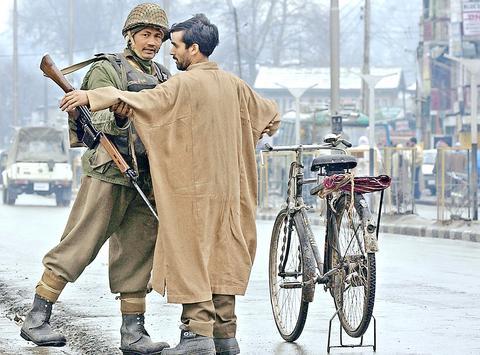
PHOTO: AP
In a joint statement, the two sides declared that "the only way forward is to ensure that all forms of violence at all levels should come to an end," and that "a step-by-step approach would lead to resolution of all outstanding issues relating to Jammu and Kashmir."
Advani also agreed to a "rapid review" of people held in detention in Kashmir without trial, a sore point for most Kashmiris, the joint statement said.
The Indian press had billed the talks as an icebreaker between longtime political foes, and in that respect they appeared to have gone very well.
During the talks, Hurriyat leaders asked to make a courtesy call on Prime Minister Atal Bihari Vajpayee, said Advani, who arranged that meeting for yesterday evening.
Advani is the most prominent hardline Hindu nationalist in the Indian government, and has long been distrusted by many Kashmiri separatists. While the Hurriyat is a legal organization, some of its members have ties to the myriad militant Islamic groups that have been fighting Indian security forces in Kashmir since 1989.
The Hurriyat appeared pleased with how things went.
Abdul Ghani Bhat, a top Hurriyat leader, said the meeting had been "a significant step in the process."
The talks reflected broader peace efforts between India and Pakistan, for whom Kashmir has long been the most divisive issue.
Advani said Thursday's meeting was the result of "a new atmosphere in which there is determination all around to see that violence comes to an end."
An easing of India-Pakistan relations began last April, when the often-ailing 79-year-old Vajpayee surprised the region by announcing he was ready to resume dialogue, saying: "This round of talks will be decisive, and at least for my life, these will be the last."
Since then, the two nuclear-armed rivals have traded envoys, opened transportation links and, most importantly, agreed to start talks on Kashmir. It was a significant shift from 2002, when the two nations had nearly gone to war again, after attacks that India blamed on Pakistan-backed militants.
Disagreements over Kashmir began as colonial India was given its freedom in 1947 and divided into modern India and Pakistan. During partition, the Hindu king of predominantly Muslim Kashmir chose to merge the region with India -- though most of his subjects almost certainly would have chosen to join overwhelmingly Muslim Pakistan.
The two nations have fought two of their three wars over the Himalayan region, once a tourist paradise known for its alpine forests, excellent skiing and golf courses. Today, though, it remains divided between them, cleaved along the so-called Line of Control, one of the world's most militarized boundaries.
India accuses Pakistan of supplying money and arms to the numerous rebel groups fighting for an independent Kashmir or a merger with Pakistan. Pakistan insists it offers them only diplomatic and moral support.
Some 65,000 people, most of them civilians, have died in the insurgency.

‘IN A DIFFERENT PLACE’: The envoy first visited Shanghai, where he attended a Chinese basketball playoff match, and is to meet top officials in Beijing tomorrow US Secretary of State Antony Blinken yesterday arrived in China on his second visit in a year as the US ramps up pressure on its rival over its support for Russia while also seeking to manage tensions with Beijing. The US diplomat tomorrow is to meet China’s top brass in Beijing, where he is also expected to plead for restraint as Taiwan inaugurates president-elect William Lai (賴清德), and to raise US concerns on Chinese trade practices. However, Blinken is also seeking to stabilize ties, with tensions between the world’s two largest economies easing since his previous visit in June last year. At the

UNSETTLING IMAGES: The scene took place in front of TV crews covering the Trump trial, with a CNN anchor calling it an ‘emotional and unbelievably disturbing moment’ A man who doused himself in an accelerant and set himself on fire outside the courthouse where former US president Donald Trump is on trial has died, police said yesterday. The New York City Police Department (NYPD) said the man was declared dead by staff at an area hospital. The man was in Collect Pond Park at about 1:30pm on Friday when he took out pamphlets espousing conspiracy theories, tossed them around, then doused himself in an accelerant and set himself on fire, officials and witnesses said. A large number of police officers were nearby when it happened. Some officers and bystanders rushed

Beijing is continuing to commit genocide and crimes against humanity against Uyghurs and other Muslim minorities in its western Xinjiang province, U.S. Secretary of State Antony Blinken said in a report published on Monday, ahead of his planned visit to China this week. The State Department’s annual human rights report, which documents abuses recorded all over the world during the previous calendar year, repeated language from previous years on the treatment of Muslims in Xinjiang, but the publication raises the issue ahead of delicate talks, including on the war in Ukraine and global trade, between the top U.S. diplomat and Chinese

RIVER TRAGEDY: Local fishers and residents helped rescue people after the vessel capsized, while motorbike taxis evacuated some of the injured At least 58 people going to a funeral died after their overloaded river boat capsized in the Central African Republic’s (CAR) capital, Bangui, the head of civil protection said on Saturday. “We were able to extract 58 lifeless bodies,” Thomas Djimasse told Radio Guira. “We don’t know the total number of people who are underwater. According to witnesses and videos on social media, the wooden boat was carrying more than 300 people — some standing and others perched on wooden structures — when it sank on the Mpoko River on Friday. The vessel was heading to the funeral of a village chief in


 RSS
RSS