


The wife of the leader of Liberia's most powerful rebel movement announced Tuesday she was taking charge, backed by dozens of guerrilla commanders in ousting a husband whose ambitions she said were endangering the nation's hard-won peace.
In a family feud with West Africa's stability in the balance, the regionally influential Asha Keita-Conneh flatly declared she was the "double boss" of her husband, and of the movement.
Husband Sekou Conneh frantically took to state radio, insisting it was only a marital squabble that was over, leaving him still in charge.
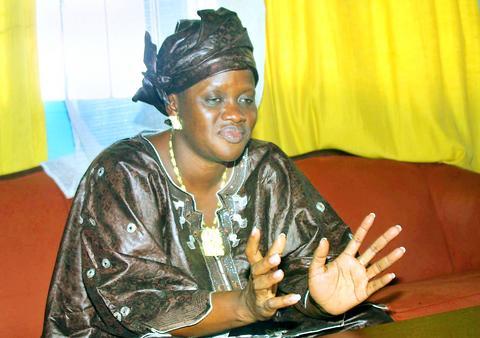
PHOTO: AP
"I put him there. If you open a big business and you put your husband in charge, if you see that things are not going the right way, you set him aside, and straighten things up," Keita-Conneh said as her nursing daughter lay beside her on a bed in the family home.
A powerfully built woman in brown caftan and head-wrap, Keita-Conneh promised she would put Liberia's six-month-old peace process on track.
"I will never agree for anybody to fight in this country again," she said.
Around her, fighters of the rebel Liberians United for Reconciliation and Democracy movement nodded assent. Dignitaries streamed in for consultations.
Unless rapidly resolved, the marital and militia dispute threatens to destabilize Liberia, where a UN force growing to the world's largest, at 15,000-strong, is backing a power-sharing government after 14 years of warlord power-struggles that killed a quarter-million people.
Peace came to Liberia only on Aug. 11, when longtime warlord president Charles Taylor fled into exile as the rebels laid siege to his capital, and international peacekeepers moved in.
The risk Tuesday: a lasting rift between loyalists of rebel husband and rebel wife, reviving factional fighting.
Divided, fighters weighed their allegiance.
"This lady can lead," declared one insurgent, rebel Lieutenant Colonel Mohammed Kanneh, at the Conneh compound.
Civilians voiced fears about the effects of the dispute.
"Women can lead better than men in many ways, but the situation in LURD is quite different," said Marie Johnson, a 26-year-old resident of Monrovia, where thousands died under rebel and government mortars and rockets just months ago.
"Sanity needs to be restored to the organization," the woman said. "This does not augur well for the peace process."
Ghana Ambassador Kwame Amoa-Awua and other diplomats shuttled between camps of husband and wife, hoping "to iron out whatever differences," Amoa-Awua said. "Whatever happens in LURD is of great significance to the peace process, because LURD is a major actor."
Keita-Conneh's claim to control, beyond the rarity of putting a woman in charge of an armed guerrilla movement with thousands of fighters, had a measure of credibility.
Keita-Conneh long has been seen as a hidden power behind the rebel movement, with her influence coming from her alleged position as spiritual adviser to President Lansana Conte of neighboring Guinea.
Keita-Conneh is widely said to have won the Guinea leader's loyalty with her correct prediction of a 1996 mutiny against Conte, which he withstood.
In gratitude, the Guinean president made her his adopted daughter.
Later, in the 1990s, Conte is alleged to have funded and armed the LURD uprising in anger at Taylor's armed incursions into his own country.
When the group launched its insurgency in 1999, Keita-Conneh's husband, a little-known former used-car salesman, emerged as the movement's civilian leader.
Conte's regime denies backing LURD, and Conneh denies his wife is Conte's medium. The Guinea leader and Keita-Conneh are only "very, very, very close," her husband said recently.
Under Liberia's Aug. 18 interim power-sharing deal, Conneh and other leaders on all sides in the war are prohibited from holding high office.
In recent weeks especially, Conneh has openly chafed at the restriction, complaining of having no job and accusing the current power-sharing government of bad faith.
The peace process has not run smoothly under Conneh's LURD. LURD was the last of Liberia's three armed factions -- two rebel movements and Taylor's former government -- to allow deployment of UN forces in a stronghold town.
Non-compliance from LURD also contributed to the breakdown of UN-sponsored disarmament nationwide, due to resume in stages this week.

‘IN A DIFFERENT PLACE’: The envoy first visited Shanghai, where he attended a Chinese basketball playoff match, and is to meet top officials in Beijing tomorrow US Secretary of State Antony Blinken yesterday arrived in China on his second visit in a year as the US ramps up pressure on its rival over its support for Russia while also seeking to manage tensions with Beijing. The US diplomat tomorrow is to meet China’s top brass in Beijing, where he is also expected to plead for restraint as Taiwan inaugurates president-elect William Lai (賴清德), and to raise US concerns on Chinese trade practices. However, Blinken is also seeking to stabilize ties, with tensions between the world’s two largest economies easing since his previous visit in June last year. At the

UNSETTLING IMAGES: The scene took place in front of TV crews covering the Trump trial, with a CNN anchor calling it an ‘emotional and unbelievably disturbing moment’ A man who doused himself in an accelerant and set himself on fire outside the courthouse where former US president Donald Trump is on trial has died, police said yesterday. The New York City Police Department (NYPD) said the man was declared dead by staff at an area hospital. The man was in Collect Pond Park at about 1:30pm on Friday when he took out pamphlets espousing conspiracy theories, tossed them around, then doused himself in an accelerant and set himself on fire, officials and witnesses said. A large number of police officers were nearby when it happened. Some officers and bystanders rushed

Beijing is continuing to commit genocide and crimes against humanity against Uyghurs and other Muslim minorities in its western Xinjiang province, U.S. Secretary of State Antony Blinken said in a report published on Monday, ahead of his planned visit to China this week. The State Department’s annual human rights report, which documents abuses recorded all over the world during the previous calendar year, repeated language from previous years on the treatment of Muslims in Xinjiang, but the publication raises the issue ahead of delicate talks, including on the war in Ukraine and global trade, between the top U.S. diplomat and Chinese

RIVER TRAGEDY: Local fishers and residents helped rescue people after the vessel capsized, while motorbike taxis evacuated some of the injured At least 58 people going to a funeral died after their overloaded river boat capsized in the Central African Republic’s (CAR) capital, Bangui, the head of civil protection said on Saturday. “We were able to extract 58 lifeless bodies,” Thomas Djimasse told Radio Guira. “We don’t know the total number of people who are underwater. According to witnesses and videos on social media, the wooden boat was carrying more than 300 people — some standing and others perched on wooden structures — when it sank on the Mpoko River on Friday. The vessel was heading to the funeral of a village chief in


 RSS
RSS