


International health experts said yesterday they are seeking a vaccine for the bird flu that has killed five people in Vietnam and millions of chickens across Asia, while China vowed to step up vigilance at its border with Vietnam to keep out the disease.
The World Health Organization (WHO) said that because of "mounting concern" over the five deaths, it is working on a new vaccine to protect people from the avian flu that has struck poultry farms in "unprecedented epidemics" in Vietnam, South Korea and Japan.
"This is in response to a threat we see and a threat we're still trying to assess," WHO spokesman Bob Dietz said in Hanoi yesterday.
Laboratories in Hong Kong and Japan are working with flu virus obtained from two of the victims in Vietnam. The WHO also oversaw production of a similar vaccine during last February's bird flu scare, which caused two cases and one death in Hong Kong.
However, making sure a vaccine is safe for public consumption could be a lengthy process.
"It could be several months to several years" before it's ready for the general public, Dietz said.
The outbreak has savaged Asia's giant poultry industry. Thailand, while maintaining its chicken stocks are safe, is the latest country to order a mass slaughter of fowl as a precaution against bird flu.
The Bangkok Post reported that 850,000 chickens had already been slaughtered and quoted agricultural officials as saying there would be more precautionary killings in 20 provinces.
Cambodia, which has temporarily banned imports of Vietnamese poultry, said yesterday it will destroy 159,000 duck eggs seized from traders who smuggled them illegally from Vietnam.
In Hong Kong, a dead falcon tested positive for bird flu yesterday, prompting officials to step up surveillance at local chicken farms, although they said the public was in no danger.
The peregrine falcon had the deadly H5N1 virus, which crossed over from chickens to humans in Hong Kong in 1997 and killed six people.
A WHO team plus six scientists from the US Centers for Disease Control were in Vietnam investigating how the same H5N1 virus jumped from poultry to people there, Dietz said.
Vietnam is the only country with confirmed cases this year of bird flu in people; at least five have died.
The scientists are trying to determine exactly how the flu is being transmitted from bird to human. Among the puzzles they need to solve is why the bulk of the bird infections have occurred in southern Vietnam, while all the human victims have been from the northern region around Hanoi.
Health officials believe patients contracted the disease through contact with sick birds, but have not confirmed that.
So far, there has been no evidence of person-to-person transmission. But health officials have warned that if the avian virus mutates to allow human transmission, it could make the disease a bigger health crisis than SARS, which killed nearly 800 people worldwide last year.
The spread of bird flu, along with the re-emergence of SARS -- with three recent cases confirmed in China -- has put Asia on a region-wide health alert.
It is the first such bird flu epidemic in Japan since 1925, and the first ever documented in Vietnam and South Korea.
China has banned chicken imports from Vietnam, South Korea and Japan, and on Tuesday, its southern province of Yunnan closed all 40 trade posts along its 1,200km border with Vietnam.
China's state-run media announced yesterday that the country's Cabinet was ordering agencies that deal with border areas to increase inspections. Prevention of bird flu must be considered an "imperative task," the official Xinhua News Agency said.
The government also has ordered inspections of fowl markets, storage facilities and processing factories, and told local inspectors to report to superiors daily.
If the disease is found, all poultry within 3km must be slaughtered and all poultry within 5km be vaccinated immediately, the government said.
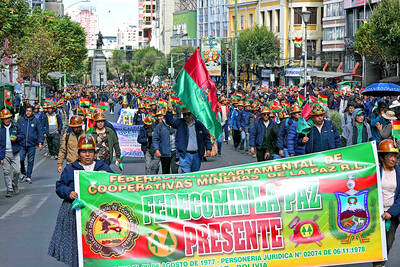
The Bolivian government on Friday struck a deal with protesting miners, but was still grappling with blockades and demonstrations by other workers across La Paz. Other groups are still blocking access roads into the city, which is also the seat of the government. Police on Thursday prevented the miners from entering the main square by using tear gas, while the demonstrators hurled stones and explosives with slingshots. Protests against the policies of Bolivian President Rodrigo Paz have convulsed the Andean nation since early this month, and roadblocks were choking routes into La Paz throughout Friday, the national road authority said. Miners demanded that Paz
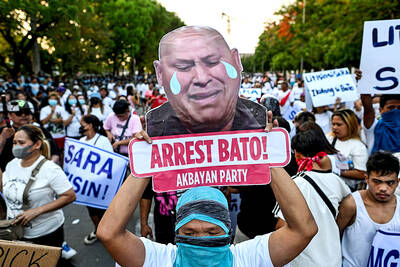
The Philippines said it has asked the country’s Supreme Court to allow it to arrest former Philippine president Rodrigo Duterte’s chief drug war enforcer to stand trial in an international tribunal. The International Criminal Court (ICC) last week unsealed an arrest warrant against Philippine Senator Ronald dela Rosa, accusing him along with Duterte and other “coperpetrators” of the “crime against humanity of murder.” Dela Rosa briefly sought refuge in the Philippine Senate last week while asking the Philippine Supreme Court to stop an ongoing attempt by government agents to arrest him. “By his own conduct, he has placed himself outside the protection of

A ship anchored off the United Arab Emirates (UAE) was seized and taken toward Iran and another — a cargo ship near Oman — sank after being attacked, authorities said on Thursday, as tensions escalated near the Strait of Hormuz. It was not immediately clear who was behind these incidents, but they happened as a senior Iranian official reiterated his country’s claim of control over the waterway and another said it had a right to seize oil tankers connected to the US. The turmoil in the strait has been a sticking point for weeks in talks between the US and Iran to
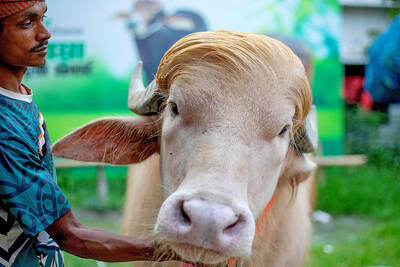
Crowds in Bangladesh are flocking to snap photographs with an unlikely social media star — an albino buffalo with flowing blond hair nicknamed “Donald Trump” that is due to be sacrificed within days. Owner Zia Uddin Mridha, 38, said his brother named the 700kg bull over its flowing helmet of hair resembling the signature look of the US president. “My younger brother picked this name because of the buffalo’s extraordinary hair,” he said at his farm in Narayanganj, just outside the capital, Dhaka. Mridha said that a constant stream of curious visitors — social media fans, onlookers and children — have come throughout


 RSS
RSS