


NASA's Spirit rover traveled 483 million kilometers to search for evidence that frozen, dry Mars was once a wetter planet capable of supporting life. But scientists now say their best chance for finding that evidence may be out of the robot's range.
Spirit landed in Gusev Crater, a 153km-wide depression thought by some to have contained a lake in the ancient past, but it has turned out to be far from a pristine dry lake bed. The broad depression appears to have been blanketed by volcanic debris and scoured by the wind, with the deposits of lake sediments that scientists had hoped to find either buried or erased by 4 billion years of vigorous geologic activity.
"Goodness knows what you might have stripped away," said Mars scientist Maria Zuber, of the Massachusetts Institute of Technology.
That means Spirit might have to roam farther than NASA expected to find the evidence scientists seek. The most promising place appears to be in a group of hills that NASA is not even sure the rover can reach.
"It might take a bit of searching to find," said Dave Des Marais, of NASA's Ames Research Center in Mountain View and a member of the mission science team.
Scientists say the hills, which rise hundreds of meters above the martian plain, represent a far bigger slice of the planet's history than the relatively shallow crater Spirit is visiting first.
But the hills are farther away than Spirit was designed to travel, even if the solar-powered rover outlasts its three-month lifetime. Still, mission engineers continue to calculate how much ground Spirit would have to cover to reach their slopes.
Scientists are also holding out hope that the rocks in Spirit's more immediate surroundings could be the smoking gun. Examples would include any carbonate rocks, such as limestone, that form in water.
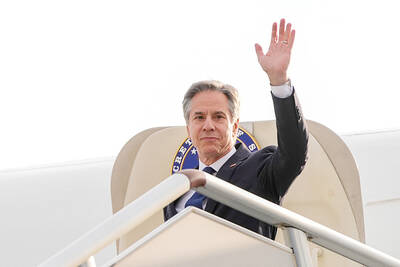
‘IN A DIFFERENT PLACE’: The envoy first visited Shanghai, where he attended a Chinese basketball playoff match, and is to meet top officials in Beijing tomorrow US Secretary of State Antony Blinken yesterday arrived in China on his second visit in a year as the US ramps up pressure on its rival over its support for Russia while also seeking to manage tensions with Beijing. The US diplomat tomorrow is to meet China’s top brass in Beijing, where he is also expected to plead for restraint as Taiwan inaugurates president-elect William Lai (賴清德), and to raise US concerns on Chinese trade practices. However, Blinken is also seeking to stabilize ties, with tensions between the world’s two largest economies easing since his previous visit in June last year. At the
Nearly half of China’s major cities are suffering “moderate to severe” levels of subsidence, putting millions of people at risk of flooding, especially as sea levels rise, according to a study of nationwide satellite data released yesterday. The authors of the paper, published by the journal Science, found that 45 percent of China’s urban land was sinking faster than 3mm per year, with 16 percent at more than 10mm per year, driven not only by declining water tables, but also the sheer weight of the built environment. With China’s urban population already in excess of 900 million people, “even a small portion

UNSETTLING IMAGES: The scene took place in front of TV crews covering the Trump trial, with a CNN anchor calling it an ‘emotional and unbelievably disturbing moment’ A man who doused himself in an accelerant and set himself on fire outside the courthouse where former US president Donald Trump is on trial has died, police said yesterday. The New York City Police Department (NYPD) said the man was declared dead by staff at an area hospital. The man was in Collect Pond Park at about 1:30pm on Friday when he took out pamphlets espousing conspiracy theories, tossed them around, then doused himself in an accelerant and set himself on fire, officials and witnesses said. A large number of police officers were nearby when it happened. Some officers and bystanders rushed

Beijing is continuing to commit genocide and crimes against humanity against Uyghurs and other Muslim minorities in its western Xinjiang province, U.S. Secretary of State Antony Blinken said in a report published on Monday, ahead of his planned visit to China this week. The State Department’s annual human rights report, which documents abuses recorded all over the world during the previous calendar year, repeated language from previous years on the treatment of Muslims in Xinjiang, but the publication raises the issue ahead of delicate talks, including on the war in Ukraine and global trade, between the top U.S. diplomat and Chinese


 RSS
RSS