


Silvio Berlusconi, Italy's epically wealthy and willful prime minister, has long boasted of being a self-made man.
Has he now taken his dauntless odyssey in personal improvement further, becoming a re-made man?
Fueled by Berlusconi's disappearance from public view for much of the last month, that question has been the subject of whispers here that grew louder on Thursday, when an Italian newspaper quoted one of his doctors as saying the prime minister had had some "plastic surgery around the eyes."
A nip? A tuck?
"Don't ask me anything more, because I do not speak of such private things," said the doctor, Umberto Scapagnini, who had just spoken of them, according to an article in the Turin daily La Stampa.
Scapagnini, who is also the mayor of the Sicilian metropolis of Catania and a member of Berlusconi's Forza Italia party, would not receive a telephone call on Thursday afternoon at his City Hall office.
An assistant to the doctor said all inquiries were being referred to Berlusconi's political aides here in Rome.
But one of those aides said he had no information on the matter and no time to investigate it.
Berlusconi's aides said he had spent most of the last month holed up in his villa on the island of Sardinia because it was time, after his tumultuous six-month stint as president of the EU, to take a break. They said he would re-emerge here within the next few days.
He will presumably look rested.
Or will it be more than that?
"He will be blond and tall," said one associate, mocking the current rumors while also seeming to acknowledge, ever so subtly, Berlusconi's tendency toward cosmetic gilding.
Without spending much time in the sun, the prime minister nonetheless manages to keep pastiness at bay.
He reliably looks either bronze or somewhat orange, depending on the moment and the lighting.
He also looks less short than he really is -- an estimated 1.67m tall -- thanks to special padding on his seats, sizable heels on his shoes and his aides' relentless patrol of the photographs taken of him.
Those aides regularly try to peel away some of Berlusconi's 67 years, often by having him travel back in time.
During his 2001 campaign for prime minister, for example, images of him on posters and in advertisements showed a younger, leaner man with a much fuller head of hair.
That was a matter not only of vanity, say his critics, but also of strategy.
He appeared to be trying to reassure Italian voters of his vim and vigor in light of news that he had battled prostate cancer.
His recent, nearly complete absence from public view since around Dec. 20 prompted speculation that he might again be ill, but aides and political allies have denied that.
Scapagnini's comments, as quoted in La Stampa, also seemed to have been prompted by a desire to quash that speculation.
Some of Berlusconi's political opponents privately floated the possibility that the doctor was operating in the realm of political spin and planting a fictive tidbit to divert Italians' attention from Berlusconi's numerous political woes.
But chatter about the prime minister's possible adventures in aggressive cosmetology preceded and transcended that tidbit.
It reached the point where another Italian newspaper simply took the surgery for granted and ran an interview with an expert on eye jobs.
That article, in Thursday's issue of the Milan-based daily Il Libero, talked about "a small surgical intervention" that had suddenly appeared "under the eyes of everyone, but mainly under the eyes of Prime Minister Silvio Berlusconi."
Whatever is happening, Berlusconi must indeed keep his eyes, altered or not, on an array of challenges, including June elections for the European Parliament that will test his and his party's appeal.
"He needs to look good," one associate said.

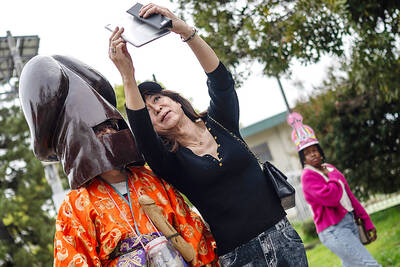
Showcasing phallus-shaped portable shrines and pink penis candies, Japan’s annual fertility festival yesterday teemed with tourists, couples and families elated by its open display of sex. The spring Kanamara Matsuri near Tokyo features colorfully dressed worshipers carrying a trio of giant phallic-shaped objects as they parade through the street with glee. The festival, as legend has it, honors a local blacksmith in the Edo Period (1603-1868) who forged an iron dildo to break the teeth of a sharp-toothed demon inhabiting a woman’s vagina that had been castrating young men on their wedding nights. A 1m black steel phallus sits in the courtyard of
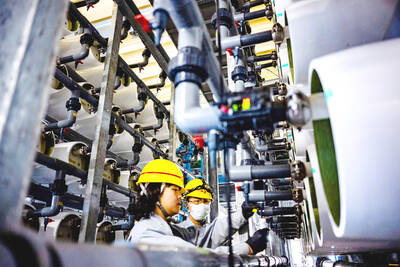
HIGH HOPES: The power source is expected to have a future, as it is not dependent on the weather or light, and could be useful for places with large desalination facilities A Japanese water plant is harnessing the natural process of osmosis to generate renewable energy that could one day become a common power source. The possibility of generating power from osmosis — when water molecules pass from a less salty solution to a more salty one — has long been known. However, actually generating energy from that has proved more complicated, in part due the difficulty of designing the membrane through which the molecules pass. Engineers in Fukuoka, Japan, and their private partners think they might have cracked it, and have opened what is only the world’s second osmotic power plant. It generates

JAN. 1 CLAUSE: As military service is voluntary, applications for permission to stay abroad for over three months for men up to age 45 must, in principle, be granted A little-noticed clause in sweeping changes to Germany’s military service policy has triggered an uproar after it emerged that the law requires men aged up to 45 to get permission from the armed forces before any significant stay abroad, even in peacetime. The legislation, which went into effect on Jan. 1 aims to bolster the military and demands all 18-year-old men fill out a questionnaire to gauge their suitability to serve in the armed forces, but stops short of conscription. If the “modernized” model fails to pull in enough recruits, parliament will be compelled to discuss the reintroduction of compulsory service, German
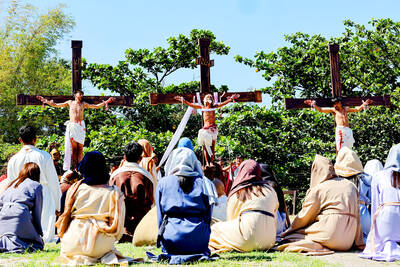
Hundreds of Filipinos and tourists flocked to a sun-bleached field north of Manila yesterday, on Good Friday, to witness one of the country’s most blood-soaked displays of religious fervor, undeterred by rising fuel prices. Scores of bare-chested flagellants with covered faces walked barefoot through the dusty streets of Pampanga Province’s San Fernando as they flogged their backs with bamboo whips in the scorching heat. Agence France-Presse (AFP) journalists said they saw devotees deliberately puncturing their skin with glass shards attached to a small wooden paddle to ensure their bleeding during the ritual, a way to atone for sins and seek miracles from


 RSS
RSS