


British Prime Minister Tony Blair was forced onto the defensive on Wednesday when he admitted that he would have to resign as prime minister if he lied to the British parliament over his role in the naming of the UK government scientist and weapons inspector, David Kelly, in the row over a UK government dossier on Iraq.
As Lord Hutton warned Britain's political classes against jumping to conclusions ahead of the publication of his report into the circumstances leading up to the death of Kelly, the British prime minister said he "of course" accepted that ministers who mislead members of parliament have to quit.
Blair's remarks came after the UK Opposition leader, Michael Howard, all but accused the prime minister of lying days after the death of Kelly. In their first House of Commons clash of the new year Howard asked Blair whether he stood by his statement of July 22, made on board a flight from Shanghai to Hong Kong, that he had "emphatically" not leaked the name of Kelly.
Howard believes the prime minister's declaration may be highly damaging after Sir Kevin Tebbit, the permanent secretary at the UK Ministry of Defence, told the Hutton inquiry in October that Blair chaired the key meetings during the "naming strategy" -- the convoluted process which led to the confirmation of the scientist's name. "Either the permanent secretary or the prime minister is not telling the truth," Howard said.
His hopes of coaxing the prime minister to repeat his inflight remarks in the Commons -- potentially endangering Blair's position if Lord Hutton rules against him -- were thwarted when the prime minister gave a careful reply: "I stand by the totality of what I said at that time -- but in relation to this issue and all the other issues, the Hutton inquiry is going to report shortly. I suggest you wait for that."
This gave the prime minister the confidence to tell another Opposition MP that he would resign if he was proved to have lied to the Commons.
The angry exchanges came hours before Lord Hutton signalled his determination to avoid being used as a political football by quashing speculation about a government decision to make a late submission to his inquiry, the issue that prompted the new row.
"There was nothing surprising or unexpected or of special significance in the making of these written submissions," Lord Hutton said.
Lord Hutton attempted to calm the atmosphere by saying that all the main players -- the government, the BBC and the Kelly family -- had accepted an invitation from the inquiry to submit further evidence, he said. "Contrary to the suggestions in some of the press reports today, there was nothing surprising or unexpected or of special significance in the making of these written submissions," Lord Hutton said.
His intervention came as a relief to Blair's office in Downing Street, London, which had been struggling to dampen speculation about its decision to submit evidence after Lord Hutton concluded his hearings.
But Lord Hutton, who is due to retire next week before he publishes his report, underlined his independence when he made clear that the evidence was being withheld at the request of the government.
His remarks may prove embarrassing for Downing Street, which had given the impression that it was opposed to publication of the documents out of respect to Lord Hutton. Inquiry sources were keen to point out that the law lord wanted to publish the documents but only changed his mind after representations from the government. Lord Hutton's statement also leaves it unclear whether No 10's final written submission refers to Sir Kevin's evidence.
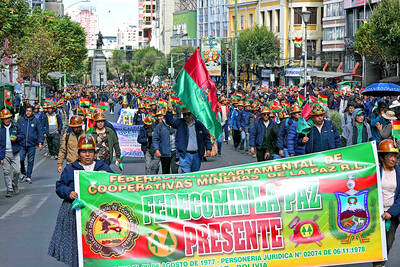
The Bolivian government on Friday struck a deal with protesting miners, but was still grappling with blockades and demonstrations by other workers across La Paz. Other groups are still blocking access roads into the city, which is also the seat of the government. Police on Thursday prevented the miners from entering the main square by using tear gas, while the demonstrators hurled stones and explosives with slingshots. Protests against the policies of Bolivian President Rodrigo Paz have convulsed the Andean nation since early this month, and roadblocks were choking routes into La Paz throughout Friday, the national road authority said. Miners demanded that Paz
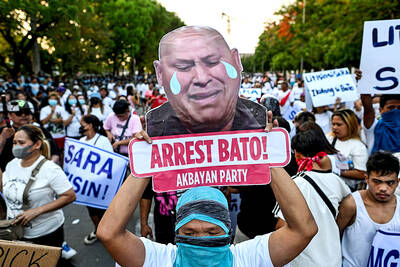
The Philippines said it has asked the country’s Supreme Court to allow it to arrest former Philippine president Rodrigo Duterte’s chief drug war enforcer to stand trial in an international tribunal. The International Criminal Court (ICC) last week unsealed an arrest warrant against Philippine Senator Ronald dela Rosa, accusing him along with Duterte and other “coperpetrators” of the “crime against humanity of murder.” Dela Rosa briefly sought refuge in the Philippine Senate last week while asking the Philippine Supreme Court to stop an ongoing attempt by government agents to arrest him. “By his own conduct, he has placed himself outside the protection of
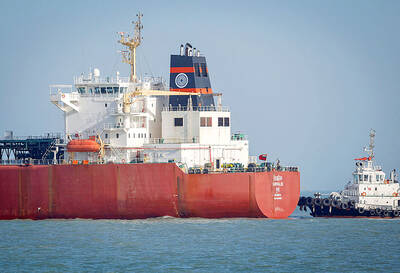
A ship anchored off the United Arab Emirates (UAE) was seized and taken toward Iran and another — a cargo ship near Oman — sank after being attacked, authorities said on Thursday, as tensions escalated near the Strait of Hormuz. It was not immediately clear who was behind these incidents, but they happened as a senior Iranian official reiterated his country’s claim of control over the waterway and another said it had a right to seize oil tankers connected to the US. The turmoil in the strait has been a sticking point for weeks in talks between the US and Iran to
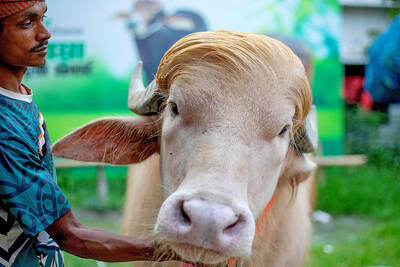
Crowds in Bangladesh are flocking to snap photographs with an unlikely social media star — an albino buffalo with flowing blond hair nicknamed “Donald Trump” that is due to be sacrificed within days. Owner Zia Uddin Mridha, 38, said his brother named the 700kg bull over its flowing helmet of hair resembling the signature look of the US president. “My younger brother picked this name because of the buffalo’s extraordinary hair,” he said at his farm in Narayanganj, just outside the capital, Dhaka. Mridha said that a constant stream of curious visitors — social media fans, onlookers and children — have come throughout


 RSS
RSS