


Millions of illegal migrant farmers, hotel maids and others working in the shadows of US society would be freed from the threat of deportation for at least three years and could get a chance -- although probably remote for most -- at permanent legal US status under an election-year proposal that US President George W. Bush is asking Congress to approve.
Bush was to promote a major overhaul of US immigration policy -- and break a virtual silence on the issue since the Sept. 11, 2001, attacks -- before scores of immigration-rights advocates in the East Room on Wednesday.
The president was to argue that his plan would make the US safer by giving the government a better idea of who was crossing US borders, bolster the economy by meeting employers' need for willing low-wage workers and fulfill a mandate for compassion by guaranteeing the rights and legitimacy of illegal workers, according to senior administration officials who briefed reporters Tuesday.
Likely to be left unsaid during the president's speech were the political dividends White House advisers hoped the proposal would pay.
By dangling the prospect of legal status to some 8 million illegal immigrants now estimated to be in the country, about half of them Mexican, Bush was granting a top priority of the business community while making his most aggressive move yet to court Latino voters. He won just over one-third of that constituency in 2000 but wants to expand his support in the community to better his chances for re-election in November.
The proposal would provide a way for illegal immigrants who can show they have employment to work legally, although temporarily, in the US. The new ``temporary worker program,'' which also would include people still in their native countries who have a job lined up in the US, would not, like the temporary visa programs already in existence that involve mostly technical experts, apply only to a certain sector of the economy or industry.
Much of the detail of president's proposal was to be worked out by Congress in future negotiations with the White House.
For instance, Bush wants to increase the nation's yearly allotment of green cards that allow for permanent US residency, but won't say by how much, the officials said. Approximately 140,000 green cards a year are issued now.
Bush also wants the workers' first three-year term in the program to be renewable but won't say for how long; he won't set the amount workers should pay to apply for the program; and he won't specify how to enforce the requirement that no US worker wants the job the foreign worker is taking.

‘IN A DIFFERENT PLACE’: The envoy first visited Shanghai, where he attended a Chinese basketball playoff match, and is to meet top officials in Beijing tomorrow US Secretary of State Antony Blinken yesterday arrived in China on his second visit in a year as the US ramps up pressure on its rival over its support for Russia while also seeking to manage tensions with Beijing. The US diplomat tomorrow is to meet China’s top brass in Beijing, where he is also expected to plead for restraint as Taiwan inaugurates president-elect William Lai (賴清德), and to raise US concerns on Chinese trade practices. However, Blinken is also seeking to stabilize ties, with tensions between the world’s two largest economies easing since his previous visit in June last year. At the

UNSETTLING IMAGES: The scene took place in front of TV crews covering the Trump trial, with a CNN anchor calling it an ‘emotional and unbelievably disturbing moment’ A man who doused himself in an accelerant and set himself on fire outside the courthouse where former US president Donald Trump is on trial has died, police said yesterday. The New York City Police Department (NYPD) said the man was declared dead by staff at an area hospital. The man was in Collect Pond Park at about 1:30pm on Friday when he took out pamphlets espousing conspiracy theories, tossed them around, then doused himself in an accelerant and set himself on fire, officials and witnesses said. A large number of police officers were nearby when it happened. Some officers and bystanders rushed
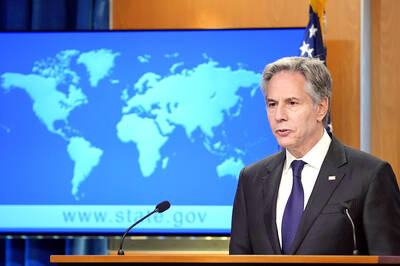
Beijing is continuing to commit genocide and crimes against humanity against Uyghurs and other Muslim minorities in its western Xinjiang province, U.S. Secretary of State Antony Blinken said in a report published on Monday, ahead of his planned visit to China this week. The State Department’s annual human rights report, which documents abuses recorded all over the world during the previous calendar year, repeated language from previous years on the treatment of Muslims in Xinjiang, but the publication raises the issue ahead of delicate talks, including on the war in Ukraine and global trade, between the top U.S. diplomat and Chinese

RIVER TRAGEDY: Local fishers and residents helped rescue people after the vessel capsized, while motorbike taxis evacuated some of the injured At least 58 people going to a funeral died after their overloaded river boat capsized in the Central African Republic’s (CAR) capital, Bangui, the head of civil protection said on Saturday. “We were able to extract 58 lifeless bodies,” Thomas Djimasse told Radio Guira. “We don’t know the total number of people who are underwater. According to witnesses and videos on social media, the wooden boat was carrying more than 300 people — some standing and others perched on wooden structures — when it sank on the Mpoko River on Friday. The vessel was heading to the funeral of a village chief in


 RSS
RSS