


The first color photography of the Spirit mission, made public on Tuesday, showed that the robotic rover was resting on a broad, ruddy plain of Mars among gray rocks of all sizes and shapes, streaks of windblown dust tracks, a patch of cohesive soil that looks like mud but cannot be and hills set against a pink sky on the distant horizon.
Scientists used words like "bizarre" and "shock and awe" to describe the scene. Planners of the exploring excursions, set to begin early next week, saw nothing on the landscape to impede the 180kg, six-wheel rover's wide-ranging maneuvers.
"We don't think we are going to have problems driving there," said Jennifer Trosper, the Jet Propulsion Laboratory manager for the Spirit's surface operations, at a news conference.
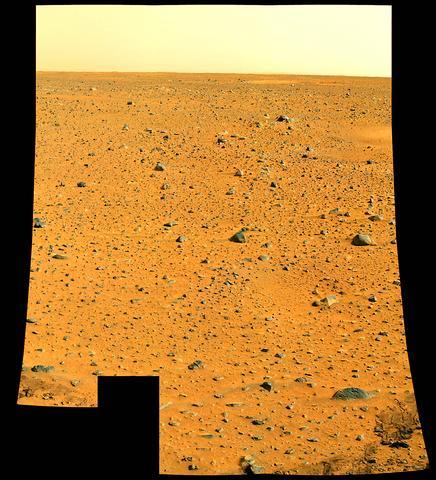
PHOTO: AFP
"We can easily drive over or around the rocks, and be able to drive long distances," she said.
Although smooth and angular rocks littered the surface everywhere, nearly all of them appeared to range in size from pebbles to chunks no more than a few centimeters wide. The only imposing one in the distance, scientists said, could be the size of a Volkswagen.
Projecting the color picture on a large screen, Jim Bell, who directed the panorama camera operations, said, "This is spectacular, but not the best this camera can do."
Bell said that the mosaic of pictures represented only one-eighth of the 360-degree panorama of the site at Gusev crater, an arid basin that scientists think held a lake in an ancient epoch when Mars presumably had an abundance of liquid water. The full panorama is expected to be completed in about four days. The later transmissions of picture data will be enhanced, he said, for even greater definition and clarity.
The first picture encompassed the view south from the Spirit, and one of the most intriguing and puzzling aspects so far was right at the Spirit's front door, so to speak.
Steven Squyres, the mission's principal science investigator, pointed to a patch of apparently cohesive soil that is "very, very strange, not like anything I have seen before."
From all evidence, the Martian surface is bone dry, though there is indirect evidence for subsurface water, possibly in the form of permafrost. So one possibility, Squyres suggested, was that the cohesive soil was created by moisture rising from the depths and evaporating at the surface, leaving a kind of salty crust.
But he and other scientists cautioned against speculation about the nature of the crustlike spot until the rover could dig in and conduct scientific tests.
"It looks like mud, but it can't be mud," Squyres said.
"It holds together well. I don't know what it is. I'm not even prepared to speculate," he said.
The photography produced evidence that Gusev is a windswept site.
Scientists said high winds apparently deposited the tails of red dust that accumulated behind many of the rocks. Martian dust is generally a fine-grained, iron-rich material.
Scientists also said winds could account for the smooth and clean surfaces of most of the rocks. The exposed surfaces, they said, may make the rover's geological investigations easier.
The hills on the horizon are estimated to rise about 460m above the surrounding landscape and be 20km to 32km from the Spirit, beyond its traveling range.
"We will have to settle for a wistful look," Bell said.
As far as scientists can tell, the hills are well within the Gusev crater, evidence of major topographical changes in the 4-billion-year history of the site.
There could have been several episodes when water filled the crater, leaving deposits of sediment. Subsequent periods of water flow, geologists said, could have eroded the previous sedimentary layers and left high bluffs and hills.
Flight engineers said that preparations for the rover's rollout continued at a methodical pace, with only a couple of problems. They were troubleshooting a spike in the electric current that occurred during movements of the main antenna; the anomaly, however, has not affected the fine pointing of the antenna.
Temperatures in the craft have been somewhat warmer than expected during the rover's daytime operations, engineers said. They planned to reduce the heating from the craft's electronics by switching off much of its communications for a "siesta" each afternoon.
"We aren't too worried about the thermal issue," Trosper said at the end of the Spirit's third full day on Mars.
NASA announced on Tuesday, meanwhile, that the Spirit carries a plaque at the base of its main antenna commemorating the astronauts who died in the breakup of the space shuttle Columbia in February last year. The rover's landing site will be called the Columbia Memorial Station.

‘IN A DIFFERENT PLACE’: The envoy first visited Shanghai, where he attended a Chinese basketball playoff match, and is to meet top officials in Beijing tomorrow US Secretary of State Antony Blinken yesterday arrived in China on his second visit in a year as the US ramps up pressure on its rival over its support for Russia while also seeking to manage tensions with Beijing. The US diplomat tomorrow is to meet China’s top brass in Beijing, where he is also expected to plead for restraint as Taiwan inaugurates president-elect William Lai (賴清德), and to raise US concerns on Chinese trade practices. However, Blinken is also seeking to stabilize ties, with tensions between the world’s two largest economies easing since his previous visit in June last year. At the

UNSETTLING IMAGES: The scene took place in front of TV crews covering the Trump trial, with a CNN anchor calling it an ‘emotional and unbelievably disturbing moment’ A man who doused himself in an accelerant and set himself on fire outside the courthouse where former US president Donald Trump is on trial has died, police said yesterday. The New York City Police Department (NYPD) said the man was declared dead by staff at an area hospital. The man was in Collect Pond Park at about 1:30pm on Friday when he took out pamphlets espousing conspiracy theories, tossed them around, then doused himself in an accelerant and set himself on fire, officials and witnesses said. A large number of police officers were nearby when it happened. Some officers and bystanders rushed

Beijing is continuing to commit genocide and crimes against humanity against Uyghurs and other Muslim minorities in its western Xinjiang province, U.S. Secretary of State Antony Blinken said in a report published on Monday, ahead of his planned visit to China this week. The State Department’s annual human rights report, which documents abuses recorded all over the world during the previous calendar year, repeated language from previous years on the treatment of Muslims in Xinjiang, but the publication raises the issue ahead of delicate talks, including on the war in Ukraine and global trade, between the top U.S. diplomat and Chinese
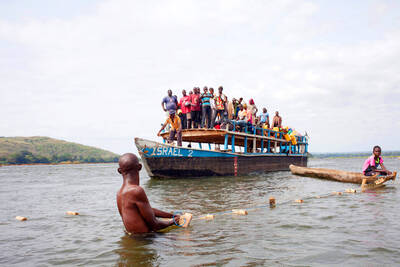
RIVER TRAGEDY: Local fishers and residents helped rescue people after the vessel capsized, while motorbike taxis evacuated some of the injured At least 58 people going to a funeral died after their overloaded river boat capsized in the Central African Republic’s (CAR) capital, Bangui, the head of civil protection said on Saturday. “We were able to extract 58 lifeless bodies,” Thomas Djimasse told Radio Guira. “We don’t know the total number of people who are underwater. According to witnesses and videos on social media, the wooden boat was carrying more than 300 people — some standing and others perched on wooden structures — when it sank on the Mpoko River on Friday. The vessel was heading to the funeral of a village chief in


 RSS
RSS