


The leaders of Iraq's neighbors, Syria and Turkey, insisted that Iraq remain united, issuing a warning to Kurds who may aspire to create an independent state in the north of the country.
The statements came Tuesday as Iraq's Governing Council hammered out details of a new government for Iraq. Iraqi Kurdish leaders are asking for greater autonomy for the oil-rich north and a federal Iraq based on two ethnic states.
Although Iraqi Kurdish leaders are not asking for independence, Turkey fears that increased autonomy and states based on ethnic identity will encourage separatism.
Turkish Kurdish rebels fought a 15-year war for autonomy in southeastern Turkey that claimed some 37,000 lives.
Turkish leaders have repeatedly said they will not tolerate Kurdish independence in Iraq, which they say will lead to the disintegration of the country and the destabilization of the region. Iran, Syria and Turkey all have large Kurdish minorities in regions bordering Iraq.
`territorial integrity'
"We condemn all approaches that pose a threat to Iraq's territorial integrity," Syrian President Bashar Assad said after flying to Ankara in the first visit to Turkey by a Syrian head of state and meeting with his Turkish counterpart, Ahmet Necdet Sezer.
Sezer added that Syria and Turkey "share the same views on the protection of Iraq's territorial integrity and of its national unity ... . We confirmed that Turkey and Syria, as two countries of the region that neighbor Iraq, are determined to effectively watch over these goals."
Earlier, Assad told CNN Turk television that "if there is no territorial integrity in Iraq, we cannot talk about stability in Iraq or in our countries. ... We are not only against a Kurdish state, but any state that would break the integrity of Iraq."
The warnings came in statements delivered at the end of a ceremony to mark the signing of agreements to promote mutual cooperation.
Northern Iraq is a largely autonomous area that is one of the relatively stable regions of the country with few US troops.
Turkey is particularly worried about Kurdish control over the oil-rich northern city of Kirkuk. Iraqi Kurdish fighters moved into the city after the fall of former Iraqi president Saddam Hussein, and control over its resources would make a possible state more economically viable.
As the leaders met in Ankara, US Secretary of State Colin Powell emphasized Washington's commitment to keeping Iraq unified.
consultation
"The Kurds wish, in some way, to preserve their historic identity and to link it in some way to geography," Powell said Tuesday in Washington. "But I think it's absolutely clear that that part of Iraq must remain part of Iraq.
"We'll be in close consultation not only with Turkey, but with the other neighbors in the region who have an interest as well," he added.
The Turkish-Syrian meeting came just a few days before a weekend visit to Tehran by Turkish Foreign Minister Abdullah Gul. Iran, one of Iraq's other neighbors, also opposes any moves toward Iraqi Kurdish independence.
"Turkey has been increasing dialogue with Syria and Iran," said Soner Cagaptay, an analyst with the Washington Institute for Near East Policy. "All of these three have ongoing anxieties over northern Iraq. The war has moved Syria, Turkey and Iran closer to each other on this issue."
Turkish Prime Minister Recep Tayyip Erdogan is expected to raise the issue of northern Iraq this month when he meets with US President George W. Bush in Washington.
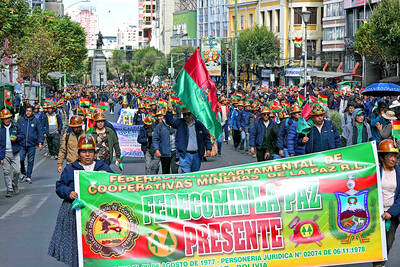
The Bolivian government on Friday struck a deal with protesting miners, but was still grappling with blockades and demonstrations by other workers across La Paz. Other groups are still blocking access roads into the city, which is also the seat of the government. Police on Thursday prevented the miners from entering the main square by using tear gas, while the demonstrators hurled stones and explosives with slingshots. Protests against the policies of Bolivian President Rodrigo Paz have convulsed the Andean nation since early this month, and roadblocks were choking routes into La Paz throughout Friday, the national road authority said. Miners demanded that Paz
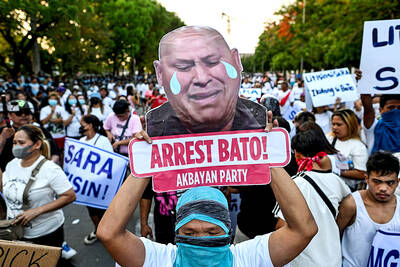
The Philippines said it has asked the country’s Supreme Court to allow it to arrest former Philippine president Rodrigo Duterte’s chief drug war enforcer to stand trial in an international tribunal. The International Criminal Court (ICC) last week unsealed an arrest warrant against Philippine Senator Ronald dela Rosa, accusing him along with Duterte and other “coperpetrators” of the “crime against humanity of murder.” Dela Rosa briefly sought refuge in the Philippine Senate last week while asking the Philippine Supreme Court to stop an ongoing attempt by government agents to arrest him. “By his own conduct, he has placed himself outside the protection of
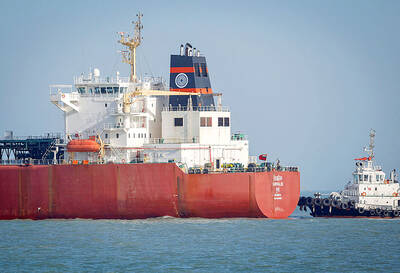
A ship anchored off the United Arab Emirates (UAE) was seized and taken toward Iran and another — a cargo ship near Oman — sank after being attacked, authorities said on Thursday, as tensions escalated near the Strait of Hormuz. It was not immediately clear who was behind these incidents, but they happened as a senior Iranian official reiterated his country’s claim of control over the waterway and another said it had a right to seize oil tankers connected to the US. The turmoil in the strait has been a sticking point for weeks in talks between the US and Iran to
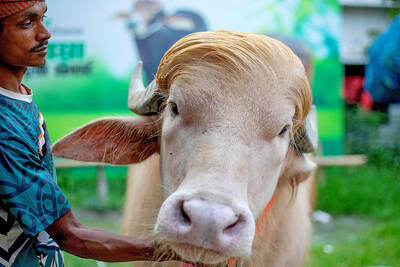
Crowds in Bangladesh are flocking to snap photographs with an unlikely social media star — an albino buffalo with flowing blond hair nicknamed “Donald Trump” that is due to be sacrificed within days. Owner Zia Uddin Mridha, 38, said his brother named the 700kg bull over its flowing helmet of hair resembling the signature look of the US president. “My younger brother picked this name because of the buffalo’s extraordinary hair,” he said at his farm in Narayanganj, just outside the capital, Dhaka. Mridha said that a constant stream of curious visitors — social media fans, onlookers and children — have come throughout


 RSS
RSS