


Letter bombs sent to prominent European Parliament members exploded in Brussels and the British city of Manchester on Monday, and Belgium said a further seven suspect packages were intercepted.
Both bombs that went off were posted in Bologna, Italy, as was another suspected bomb intercepted in Brussels, leading to immediate assumptions of a link with a string of letter bombs sent from there last month to European figures and institutions.
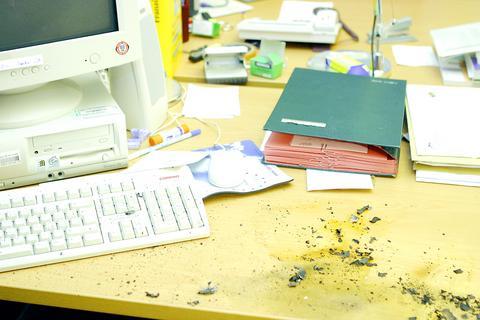
PHOTO: AFP
No one was injured in Monday's two blasts.
The Italian Interior Ministry said Rome will lead a multinational task force to investigate the spate of letter bombs which have been sent from Italy's central city of Bologna.
After a meeting in Rome with anti-terrorism experts from Europol and six European countries, the ministry said the task force would be created to probe anarchist movements in countries such as Spain, Italy and Greece for the next two months and make recommendations to police.
Italian police suspect anarchists opposed to what they called the "new European order" were behind the letter bomb campaign which began last month when a parcel exploded in the hands of European Commission President Romano Prodi.
The bombs that exploded on Monday were sent to Hans-Gert Poettering, head of the largest political group in the parliament, in Brussels, and to Gary Titley, leader of British Labour Party members of the parliament, in Manchester.
Another package was delivered to a Spanish member of Poetter-ing's European People's Party, Jose Ignacio Salafranca Sanchez-Neyra, and sent for tests by Belgian police.
"It is not to be excluded that there may be other packages," said David Harley, spokesman for the President of the European Parliament.
Belgian Interior Minister Patrick Dewael said in a statement that five suspect envelopes were discovered on different floors of the parliament building in Brussels on Monday, while two more suspect packages were intercepted at a post office in Antwerp.
Harley said in a statement that Belgian police were working with parliament's security services to rescan tens of thousands of packages received in recent weeks.
It was not immediately clear when the packages arrived. EU institutions have been closed for Christmas and New Year, and Harley said they arrived during the last few days.
A series of letter bombs were sent to European officials late last month. On Dec. 31, an Italian prosecutor said authorities had blocked mail sent from the Bologna region of northern Italy and addressed to EU bodies.
He was speaking after four devices in four days were mailed from Bologna -- to European Commission President Romano Prodi, European Central Bank head Jean-Claude Trichet and the EU police agencies Europol and Eurojust, which help fight cross-border crime. No one was injured by any of them.
An Italian group calling itself the Informal Anarchist Federation had threatened a campaign against the "new European order" just days before the first device targeted Prodi on Dec. 27.
Harley said the bomb that went off in Poettering's office "sounded very like the one sent to Prodi's home."
Bologna's chief attorney said he was not surprised by Monday's bombs. "Just yesterday I said the only thing that was missing was [a bomb] against the legislative power. We were expecting it," Enrico Di Nicola told Radio 24.
Chief European Commission spokesman Reijo Kemppinen, speaking shortly before news of the device at Poettering's office was confirmed, said security was sufficient.
But Poettering told German mass circulation daily Bild that security would have to be stepped up.
"Until now only post to EU President Prodi was checked. Now it's clear that as of straight away all mail to EU deputies must be checked," he said.

South Korea’s air force yesterday apologized for a 2021 midair collision involving two fighter jets, a day after auditors said the pilots were taking selfies and filming during the flight and held them responsible for the accident. “We sincerely apologize to the public for the concern caused by the accident that occurred in 2021,” an air force spokesman told a news conference, adding that one of the pilots involved had been suspended from flying duties, received severe disciplinary action and has since left the military. The apology followed a report released on Wednesday by the South Korean Board of Audit and Inspection,

Indonesian police have arrested 13 people after shocking images of alleged abuse against small children at a daycare center went viral, sparking outrage across the nation, officials said on Monday. Police on Friday last week raided Little Aresha, a daycare center in Yogyakarta on Java island, following a report from a former employee. CCTV footage circulating on social media showed children, most younger than two, lying on the floor wearing only diapers, their hands and feet bound with rags. The police have confirmed that the footage is authentic. Police said they also found 20 children crammed into a room just 3m by 3m. “So

About 240 Indians claiming descent from a Biblical tribe landed at Tel Aviv airport on Thursday as part of a government operation to relocate them to Israel. The newcomers passed under a balloon arch in blue and white, the colors of the Israeli flag, as dozens of well-wishers welcomed them with a traditional Jewish song. They were the first “bnei Menashe” (“sons of Manasseh”) to arrive in Israel since the government in November last year announced funding for the immigration of about 6,000 members of the community from the states of Manipur and Mizoram in northeast India. The community claims to descend from

‘TROUBLING’: The firing of Phelan, who was an adviser to a nonprofit that supported the defense of Taiwan, was another example of ‘dysfunction’ under Trump, a US senator said US Secretary of the Navy John Phelan has been fired, a US official and a person familiar with the matter said on Wednesday, in another wartime shakeup at the Pentagon coming just weeks after US Secretary of Defense Pete Hegseth ousted the Army’s top general. The Pentagon announced his departure in a brief statement, saying he was leaving the administration “effective immediately,” but it did not provide a reason or say whether it was his decision to go. The sources, who spoke on condition of anonymity, said Phelan was dismissed in part because he was moving too slowly to implement reforms to


 RSS
RSS