


Indian and Pakistani leaders met for the first time in two-and-a-half years yesterday, a day after the opening of the South Asian Association for Regional Cooperation (SAARC) summit that many hope will jump start long-stalled talks between the nuclear rivals.
Indian Prime Minister Atal Behari Vajpayee met Pakistani President Pervez Musharraf for just over an hour Monday for talks that followed Sunday's meeting of Vajpayee and Pakistani Prime Minister Zafarullah Jamali.
"Both leaders welcomed the recent steps towards the normalization of relations between the two countries and expressed the hope that the process would continue," Indian foreign minister Yashwant Sinha told a news conference yesterday.
The last time the nuclear-capable neighbors held talks was in July 2001 in the Indian city of Agra, where Vajpayee met Musharraf.
Talks broke down and the two countries plunged into a bitter political conflict, coming close to war after Islamic militants attacked New Delhi's parliament in December 2001, until serious fence-mending began in April 2003.
Here is a brief chronology of events since their last formal meeting:
July 16, 2001: Vajpayee and Musharraf hold a historic summit in Agra in an effort to bring peace between the two countries. The talks break down over a decades-old dispute over Kashmir, the Himalayan region claimed by both.
December 13, 2001: Islamic militants stage a suicide attack on the Indian parliament, 14 people die including the five gunmen.
New Delhi says Pakistan masterminded the attack, prompting the deployment of hundreds of thou-sands of troops to the border, the cutting of transport links and the recall of India's high commissioner from Pakistan.
Jan. 6, 2002: Vajpayee and Mu-sharraf meet in Nepal's capital Kath-mandu at the last SAARC summit. In a dramatic move, Musharraf shakes Vajpayee's hand, but the Indian prime minister says he is waiting for concrete actions.
May 14, 2002: Islamic militants attack an Indian army camp at Kaluchak, near Kashmir's winter capital Jammu, killing 35 people, mostly women and children. Military tensions escalate again.
June 4, 2002: Vajpayee and Musharraf meet at a regional summit in Kazhakstan's capital Almaty, but avoid each other.
Aug. 21, 2002: Indian Foreign Minister Yashwant Sinha and Pakistani Deputy Foreign Minister Inamul Haq attend a SAARC meeting in Kathmandu. No talks are held.
Nov. 14, 2002: India pulls back troops from all border areas except Kashmir, leading to a de-escalation of tension with Pakistan.
Dec. 9, 2002: Pakistan postpones a SAARC summit set for January in Islamabad, blaming India for equivocating on whether it will attend.
Feb. 24, 2003: Musharraf and Vajpayee attend a summit of the Non-Aligned Movement (NAM) in the Malaysian capital Kuala Lumpur. They attack each other's stands over Kashmir.
April 18, 2003: During a tour of Kashmir, Vajpayee offers to "open the doors for talks" with Pakistan, but links it to the end of cross border infiltration of militants. Vajpayee later holds telephone talks with Pakistani counterpart Zafarullah Jamali, the first high-level contact in a year with Pakistan.
May 6, 2003: Prime Minister Zafarullah Jamali matches Vajpayee's gesture with offers to resume transport links severed by New Delhi in January 2002, release jailed Indian fishermen, reappoint an ambassador and restore sports links.
Dec. 1, 2003: India and Pakistan agree to resume flights from Jan. 1, 2004.
Dec. 4: Vajpayee writes to Jamali confirming he will travel to Islamabad for the SAARC summit. Pakistan publicly welcomes his confirmed participation.
Dec. 25: Vajpayee says the SAARC summit could result in a "good beginning" of closer ties between India and Pakistan.
Dec. 31: India proposes expanding transport and diplomatic links with Pakistan in a new confidence-building measure.
Jan. 4, 2004: SAARC summit opening crowned by first meeting of leaders from rivals India and Pakistan as Vajpayee holds talks with his Pakistani counterpart Jamali.

As the sun sets on another scorching Yangon day, the hot and bothered descend on the Myanmar city’s parks, the coolest place to spend an evening during yet another power blackout. A wave of exceptionally hot weather has blasted Southeast Asia this week, sending the mercury to 45°C and prompting thousands of schools to suspend in-person classes. Even before the chaos and conflict unleashed by the military’s 2021 coup, Myanmar’s creaky and outdated electricity grid struggled to keep fans whirling and air conditioners humming during the hot season. Now, infrastructure attacks and dwindling offshore gas reserves mean those who cannot afford expensive diesel

Does Argentine President Javier Milei communicate with a ghost dog whose death he refuses to accept? Forced to respond to questions about his mental health, the president’s office has lashed out at “disrespectful” speculation. Twice this week, presidential spokesman Manuel Adorni was asked about Milei’s English Mastiff, Conan, said to have died seven years ago. Milei, 53, had Conan cloned, and today is believed to own four copies he refers to as “four-legged children.” Or is it five? In an interview with CNN this month, Milei referred to his five dogs, whose faces and names he had engraved on the presidential baton. Conan,

French singer Kendji Girac, who was seriously injured by a gunshot this week, wanted to “fake” his suicide to scare his partner who was threatening to leave him, prosecutors said on Thursday. The 27-year-old former winner of France’s version of The Voice was found wounded after police were called to a traveler camp in Biscarrosse on France’s southwestern coast. Girac told first responders he had accidentally shot himself while tinkering with a Colt .45 automatic pistol he had bought at a junk shop, a source said. On Thursday, regional prosecutor Olivier Janson said, citing the singer, that he wanted to “fake” his suicide
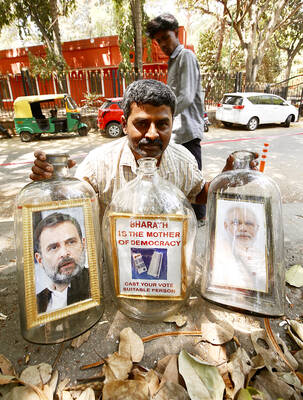
Indian Prime Minister Narendra Modi reaffirmed his pledge to replace India’s religion-based marriage and inheritance laws with a uniform civil code if he returns to office for a third term, a move that some minority groups have opposed. In an interview with the Times of India listing his agenda, Modi said his government would push for making the code a reality. “It is clear that separate laws for communities are detrimental to the health of society,” he said in the interview published yesterday. “We cannot be a nation where one community is progressing with the support of the Constitution while the other


 RSS
RSS