


Christopher Suazo was in the jungle, wearing torn jogging pants and cradling an M-1 rifle. At 18, he had managed only three years of schooling when he joined the Communist Party last fall.
Like many others, Suazo was motivated by a perceived injustice. His father and uncle, both farmers, were gunned down last March, he said, by the hired hands of a town mayor whom the military protects.
The Communist rebellion in the Philippines began 35 years ago. It foundered but has regained strength and, according to military estimates, now counts 10,000 fighters in its armed wing, the New People's Army.
The Communists "are our utmost security concern at present," even though they have been overshadowed by Muslim insurgents, said Colonel Daniel Lucero, a military spokesman. "We consider them a much bigger threat than the Abu Sayyaf, the Moro Islamic Liberation Front or the Jemaah Islamiyah," he said.
Since September, Suazo has been moving around in the mountains here on the southern island of Mindanao, always alert for enemies who lurk in the jungles below, but happy with his decision to join. "I can only be safe here with the New People's Army," he said. "One day I and my family will have justice."
In their foggy camp high in the mountains of Compostela Valley province, the Communists go about their business: training cadres in military tactics and martial arts, organizing the residents below, helping peasants on their farms and studying what they call the "evils of US imperialism."
"The US is a brutal enemy," a guerrilla leader known as Richard told a dozen rebels during a class about the invasion of Iraq. "It will not hesitate to use or kill its own people."
Rubi del Mundo, a guerrilla spokeswoman, said: "US interventionism is even more blatant nowadays. It used to just influence the passing of Philippine laws to benefit the business interests of American companies here. Now the US is directly involved in counterrevolutionary activities" in the Philippines.
The number of rebels peaked at more than 25,000 in the 1980s, according to military estimates, but government spies began to penetrate the ranks of the New People's Army. Party officials purged the movement, torturing and killing hundreds of suspected spies.
The purges nearly destroyed the movement, but it began to creep back once the Communists sent guerrillas in the cities back to the countryside. In many remote parts of the country, the party functions as the government, providing services and a basic livelihood.
Hardly a week goes by without two or three gunbattles, and the military has responded with tough measures that have been roundly criticized.
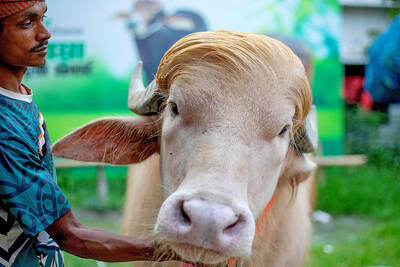
Crowds in Bangladesh are flocking to snap photographs with an unlikely social media star — an albino buffalo with flowing blond hair nicknamed “Donald Trump” that is due to be sacrificed within days. Owner Zia Uddin Mridha, 38, said his brother named the 700kg bull over its flowing helmet of hair resembling the signature look of the US president. “My younger brother picked this name because of the buffalo’s extraordinary hair,” he said at his farm in Narayanganj, just outside the capital, Dhaka. Mridha said that a constant stream of curious visitors — social media fans, onlookers and children — have come throughout

It began as a satirical online project. Now millions of young people in India are flocking to it as an outlet for their frustration. A parody political party called the Cockroach Janta Party, with the insect as its symbol, has exploded across India’s social media by turning absurdist humor into protest. Memes and short videos mocking corruption, joblessness and political dysfunction have flooded social media sites, where millions of users are embracing the cockroach — known for its ability to survive harsh conditions — as a tongue-in-cheek symbol of endurance. The online movement’s rise has been unusually rapid. The Cockroach Janta Party (CJP)
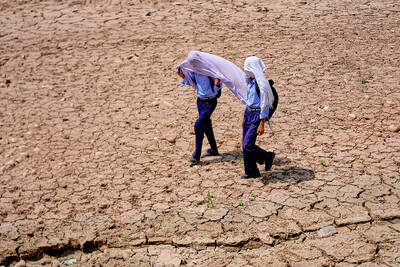
HOTTER: While Indians are accustomed to summer heat, climate change has caused northwestern India to warm faster than other parts of the country, an academic said Roads and markets have emptied during afternoons and some farmers have switched to nighttime work to avoid scorching temperatures as a heat wave grips large parts of India. The India Meteorological Department forecast maximum temperatures for yesterday of about 45°C in the capital, New Delhi, where authorities have opened temporary “cooling zones” to help people cope. The weather department warned that conditions would likely persist across several northern regions in the coming days, with temperatures staying well above seasonal averages. Authorities urged people to stay indoors during the hottest hours and take precautions against heat-related illnesses. India declares a heat wave whenever maximum temperatures

A Hong Kong astronaut is to join a Chinese space mission for the first time as part of a three-person crew launching today, as Beijing edges closer to its goal of landing people on the moon. The Tiangong space station — crewed by teams of three astronauts that are typically rotated every six months — is the crown jewel of China’s space program, boosted by billions in state investment in a bid to catch up with the US and Russia. The Shenzhou-23 mission is to blast off at 11:08pm from the Jiuquan Satellite Launch Center in northwestern China, carrying three astronauts to


 RSS
RSS