


US President George W. Bush said on Thursday that Pakistan's nuclear arsenal was "secure" following two failed assassination attempts on President Pervez Musharraf in the last three weeks.
Bush also said he emerged from a recent telephone conversation with Musharraf convinced that the "friend of the United States" and ally in the global war on terrorism had the situation under control.
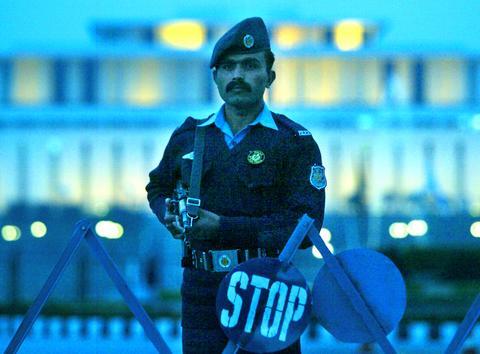
PHOTO: REUTERS
"Obviously terrorists are after him and he sounded very confident that his security forces would be able to deal with the threat," Bush said. "He sounded confident and therefore I feel confident about his security situation."
In response to a reporter's question, the US leader said that Pakistan's nuclear weapons "are secure and that's important. It's also important that India as well have a secure nuclear weapons program."
Bush praised the atomic rivals for working to resolve longstanding disputes peacefully, and said they appeared to be making headway "slowly but surely" on defusing simmering rows like the one over the disputed territory of Kashmir.
"I commend the leaders of both countries for taking steps toward a peaceful reconciliation of major issues that have divided them," he said. "It looks like they're making progress towards reconciling differences, slowly but surely."
India stunned the world in 1998 by conducting five nuclear tests and declaring itself a nuclear power. Pakistan, which has fought three full-fledged wars with India, conducted its own tests within days.
The two countries have undertaken a series of tie-mending moves since April and took another step closer to normal relations on Thursday by resuming commercial flights after a two-year ban.
The flights resumed three days before Indian Prime Minister Atal Behari Vajpayee was due to make his first visit to Pakistan in four years for a seven-nation South Asian leader summit.
"We're hopeful that the Indians and Pakistanis, in upcoming meetings, will be able to begin a dialogue on a variety of issues," Bush said after an afternoon hunting quail with his father, former president George Bush, in Falfurrias, Texas.
Bush also praised Musharraf for his help in the war on terrorism, launched after members of Osama bin Laden's al-Qaeda network carried out the Sept. 11, 2001 attacks on the World Trade Center and the Pentagon.
"President Musharraf has been a friend of the United States. He's been a stand-up guy when it comes to dealing with terrorists," he said.
"We are making progress against al-Qaeda because of his cooperation. We need to do more, particularly on the Pakistan-Afghan border," said Bush, who later returned to his ranch in Crawford, Texas.
US officials have expressed concern that members of al-Qaeda and the Taliban Islamic militia have been staging cross-border attacks meant to destabilize the fragile rule of Afghanistan's fledgling government.
Musharraf, who appointed himself to the presidency in June 2001 after toppling an elected government in a bloodless army coup in 1999, has escaped two near-miss assassination attempts in the past three weeks.
He claimed a mandate for another five years in a flawed May 2002 referendum.

SPEAKING OUT: After Siranudh Scott’s allegations surfaced, celebrities and public figures took to social media to share their own experiences of sexual misconduct and abuse A high-profile alleged sexual abuse case within a wealthy Thai beer brewing family has prompted a wave of painful accounts from survivors of unconnected abuse in the conservative nation. Siranudh Scott, a member of the billionaire Thai family that founded the ubiquitous Singha beer brand, posted an emotional video this month accusing his elder brother Sunit of repeatedly abusing him when he was a teenager. Sunit, who is in his 30s, later denied the allegations in a video posted online, but Singha parent Boonrawd dismissed him from his executive role with the company on Tuesday last week. “I felt I needed to speak

‘CROSSING THE LINE’: China’s embassy in Seoul criticized US Forces Korea Commander General Xavier Brunson, asking if his ‘hostile’ remarks were authorized by Washington South Korea and the US are in talks over recent public remarks by the commander of US Forces Korea, Seoul’s presidential office said yesterday, after the comments drew sharp criticism from China. In a recent podcast interview, US Forces Korea Commander General Xavier Brunson described South Korea as “the dagger in the heart of Asia” from China’s east coast, prompting the Chinese embassy in Seoul to say that he had “truly crossed the line.” The interview came amid growing speculation that Washington might seek to expand the role of US Forces Korea in countering the growing regional influence of China, a key

SEEKING ORDER: Rodrigo Paz said that ‘anyone who wants to destroy the nation will have to deal with this president and the full force of the constitution’ Bolivian President Rodrigo Paz on Wednesday said that the nation was at a “breaking point” after nearly a month of protests that have caused shortages of food, fuel and medicine. Paz, who took office six months ago amid the worst economic crisis there in four decades, is battling a groundswell of fury over his policies. The political capital, La Paz, has been besieged by low-income workers and members of the indigenous majority calling for his resignation. “The country needs order and is reaching breaking point,” the 58-year-old said at a public event in La Paz, renewing his appeal for dialogue. On Tuesday, the Bolivian
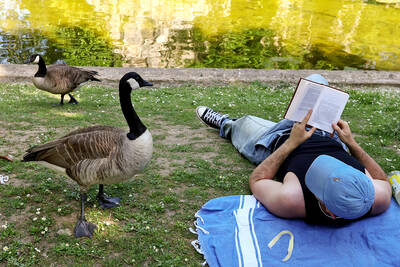
Forecasters in Europe yesterday warned of exceptional heat as record temperatures driven by a “heat dome” push temperatures well above seasonal norms across the continent. The surge follows a record-breaking Monday, with France logging its hottest day in the month of May on record, its weather agency said, and the UK also posting unprecedented highs. A so-called “heat dome” of warm air from northern Africa trapped under a high-pressure system over western Europe is behind the high temperatures not usually seen until high summer. Restrictions on outdoor work were imposed in parts of Italy, beaches in southwest France filled earlier than usual and


 RSS
RSS