


■ Pakistan
Ruler wins vote
Pakistan's military ruler won a vote of confidence from both houses of parliament and the country's four provincial assemblies yesterday in a carefully orchestrated process that empowers him to finish out his five-year term as president. The opposition walked out in protest and denounced the proceedings as a sham. The balloting on President General Pervez Musharraf's future follows a surprise deal with a coalition of hardline Islamic parties that agreed to support his claim to the presidency in return for a promise that he step down as army chief by the end of this year.
■ Australia
Tourists bite the dust
Visiting Australia is fatal to nearly 400 tourists a year. A report by the government's statistics agency shows that 363 tourists died last year, 377 in 2000 and 371 in 1998. It says that deaths were most common in over-55s suffering heart attacks. Men are twice as likely to die as women, and visitors are most at risk between the ages of 25 and 34 and over the age of 55. Younger visitors are liable to suicide as well, with 45 occurring in the past six years, mostly among people younger than 24, in the drab winter months of July and August. Nearly 100 people drowned in the same period, and 283 were killed in traffic accidents and 22 by assault.
■ Bhutan
Military crackdown a success
Bhutan voiced hope yesterday of an early end to its military crackdown against Indian rebels, whom it said were disorganized after troops destroyed their illegal camps in the kingdom. A Bhutanese army official said that the operations, launched on Dec. 15, had "almost reached the last leg with our troops destroying all the 30 militant camps. Quite a large number of rebels are still inside the jungles of Bhutan, although we are zeroing in on them." The Indian army, which helps train the Bhutanese army, says more than 140 rebels have died along with eight Bhutanese troops and support personnel since the offensive started.
■ China
SARS case still unconfirmed
Medical detectives targeted drains and sewers as they scoured a residential block, a drug store and a private home in southern China, searching for where a sickened man's illness -- which may or may not be SARS -- was contracted. The possible infection remained "a suspected case only," the official Xinhua News Agency reported yesterday, and the World Health Organization concurred. The male patient, still hospitalized, was reportedly improving. "A question mark continues to hang over the suspected SARS case in southern China, but more tests are planned in an effort to reach a definite conclusion," the WHO said in a statement.
■ China
World's oldest primate found
The oldest ancestor of humankind found so far ate beetles, weighed little more than a box of matches, and lived in China 55 million years ago. Ni Xijun of the Chinese Academy of Science in Beijing and two colleagues reported in Nature yesterday that they have unearthed the partial skull and jaws of the most primitive specimen yet of the mammalian line which gave rise to modern primates. The discovery throws fresh light on primate evolution. Although humans -- and their nearest relatives, the chimpanzees and gorillas -- clearly emerged in Africa in the last 7 million years or so, the origins of the primate group have been less certain.
■ United States
Heart attack no big deal
Dorothy Penman would probably have preferred not to have a heart attack as she flew towards Florida at 11,000m. She would have been quite happy if just one doctor had sprinted down the airplane aisle to her
aid; she certainly was not expecting 15 cardiologists
to form an orderly queue. "When the cabin crew put out an announcement to
ask if there was a doctor
on board, lights started appearing above seats
all over the plane," said Penman, 67, on Wednesday. "There were so many of them that many went and sat down again because they were not needed. I think there were about five of them with me," she said. Penman, from Liverpool in England, had reserved a seat on a flight that was carrying a group of cardiologists bound for a conference in Orlando.
■ Colombia
Scores dead in clash
Soldiers were on their
way to a remote northern Colombian town to confirm reports that 40 people were killed in a clash between leftist rebels and right-wing paramilitary fighters, Army General German Galvis said on Wednesday. If confirmed, it would be the highest death toll in months in the four decade-long civil war. Some 500 rebels from Colombia's two main guerrilla groups reportedly joined forces to attack paramilitaries at a camp near the town of San Pablo, in the Caribbean department of Bolivar. Up to now local officials have said that at least one civilian was killed and seven wounded.
■ Liberia
UN forces set up camp
UN peacekeepers set up camp on Wednesday in Liberia's rebel-held second city, extending the reach of a swelling international force charged with ushering the traumatized nation towards peace. A convoy of 250 Bangladeshi peacekeepers rumbled into Buchanan, some 120km southeast of the capital Monrovia, and which is in the hands of the rebel Movement for Democracy in Liberia, known as Model. The troops set up camp in the port city, which was seized by Model fighters at the end of July and largely cut off, until the departure of former president Charles Taylor paved the way for an August peace deal and an end to fighting.
■ Ivory Coast
Peacekeeping clash eases
French Defense Minister Michele Alliot-Marie visited French troops in Ivory Coast on Wednesday amid growing signs of a peaceful outcome to the crisis in the former French colony. Ivory Coast slid into civil war last year after a failed attempt to oust President Laurent Gbagbo.
A month ago, Gbagbo hardliners in the army clashed with French troops monitoring a ceasefire line and thousands of pro-Gbagbo youths laid siege to a French base in Abidjan. However, relations seemed on the mend on Wednesday as Gbagbo thanked the French and decorated the defense minister.
■ European Union
Ireland gains top post
Ireland took over the six-month rotating presidency of the EU on Thursday, inheriting the immediate task of dealing with uncertainties over a new constitution. Ireland
will attempt to find a compromise among members over the new constitution before March. The Irish presidency also faces differences over the completion of the Euro stability pact. It will oversee the EU's historic expansion into the Mediterranean
and eastern Europe starting from May 1.

As the sun sets on another scorching Yangon day, the hot and bothered descend on the Myanmar city’s parks, the coolest place to spend an evening during yet another power blackout. A wave of exceptionally hot weather has blasted Southeast Asia this week, sending the mercury to 45°C and prompting thousands of schools to suspend in-person classes. Even before the chaos and conflict unleashed by the military’s 2021 coup, Myanmar’s creaky and outdated electricity grid struggled to keep fans whirling and air conditioners humming during the hot season. Now, infrastructure attacks and dwindling offshore gas reserves mean those who cannot afford expensive diesel

Does Argentine President Javier Milei communicate with a ghost dog whose death he refuses to accept? Forced to respond to questions about his mental health, the president’s office has lashed out at “disrespectful” speculation. Twice this week, presidential spokesman Manuel Adorni was asked about Milei’s English Mastiff, Conan, said to have died seven years ago. Milei, 53, had Conan cloned, and today is believed to own four copies he refers to as “four-legged children.” Or is it five? In an interview with CNN this month, Milei referred to his five dogs, whose faces and names he had engraved on the presidential baton. Conan,

French singer Kendji Girac, who was seriously injured by a gunshot this week, wanted to “fake” his suicide to scare his partner who was threatening to leave him, prosecutors said on Thursday. The 27-year-old former winner of France’s version of The Voice was found wounded after police were called to a traveler camp in Biscarrosse on France’s southwestern coast. Girac told first responders he had accidentally shot himself while tinkering with a Colt .45 automatic pistol he had bought at a junk shop, a source said. On Thursday, regional prosecutor Olivier Janson said, citing the singer, that he wanted to “fake” his suicide
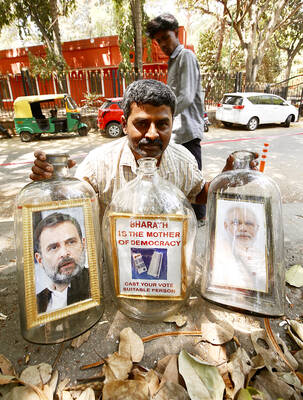
Indian Prime Minister Narendra Modi reaffirmed his pledge to replace India’s religion-based marriage and inheritance laws with a uniform civil code if he returns to office for a third term, a move that some minority groups have opposed. In an interview with the Times of India listing his agenda, Modi said his government would push for making the code a reality. “It is clear that separate laws for communities are detrimental to the health of society,” he said in the interview published yesterday. “We cannot be a nation where one community is progressing with the support of the Constitution while the other


 RSS
RSS