


Thousands of people, mainly Muslim women shouting "The veil, my choice," marched through Paris on Sunday against presidential proposals to ban Islamic head scarves from public schools and maybe at work, too.
The protest, a cry of anguish from a rarely heard section of French society, was the first in Paris against President Jacques Chirac's announcement on Wednesday that head scarves and other conspicuous religious symbols, including Jewish skullcaps and large Christian crosses, should be banned from schools to protect France's secular foundations.
Chirac urged parliament to pass the law before the 2004 to 2005 school year starts next September. He also proposed giving company bosses the right to decide whether religious symbols can be worn at work and said a law should stop patients from refusing care from doctors of the opposite sex -- aimed at Muslim women who have rebuffed male medical workers.
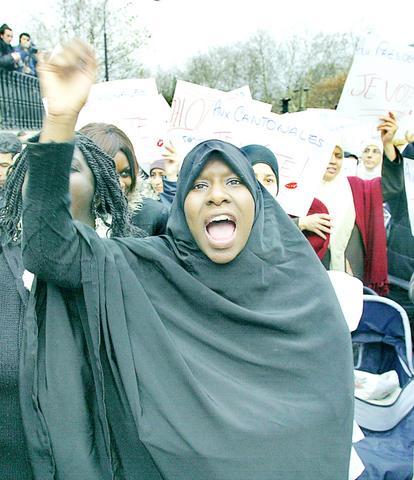
PHOTO: AFP
Paris police put the number of marchers at 3,000. More than half were women, girls and even young children wearing head scarves. They marched in a boisterous, flag-waving column hundreds of meters long through rain to the Place de la Bastille, where the prison stormed at the start of the French revolution in 1789 once stood.
Protesters said Chirac's proposed measures stigmatized France's estimated 5 million Muslims, the largest Muslim community in Western Europe, and made a mockery of cherished French values.
"Liberty, equality, fraternity -- apart from for women who wear the veil," said Fatima Boicha, a housewife and mother of two from Mantes-la-Jolie west of Paris whose head and neck were covered with a brown scarf.
"The French state wants us to submit, to tell us what to wear and what not to wear," she added. "None of these women here will take their veils off."
Protesters sang the Marseillaise, the stirring French anthem, waved French tricolors and shouted "Beloved France, where is my liberty?" and other slogans. Some held their identity cards above their heads or pinned enlarged photocopies of their voter cards on their chests to show their French citizenship.
"Proud to be French Muslims," read one banner. "I vote!" said other placards.
Protesters said they were furious that a report commissioned by Chirac and released this month suggested that some Muslim women are forced to wear head scarves by male relatives or to avoid being insulted by men in public.
"Ni frere, ni mari, le foulard on l'a choisi," the demonstrators shouted in a rhyming slogan that translates as "I chose the head scarf, not my brother or husband."
Some women said they would shift their children from public to private schools where the ban would not be implemented if the law is passed.

Through the noise of rushing papers and whirring belts at a print factory in Kyoto, two creators watch their photo essay come to life in broadsheet form — part of an effort to win new audiences in the age of artificial intelligence (AI). Despite the decline of the publishing industry, self-publication and handmade “zine” magazines are growing in popularity in Japan, reflecting the nation’s enduring love of paper in the digital era. While speaking to Agence France-Presse at the plant, his hands black with ink, one of the creators, Kazuma Obara, said: “I think [paper] is a medium that engages all five
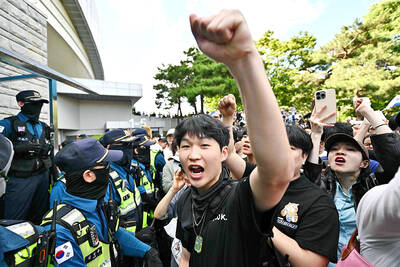
‘ABSURD MISTAKE’: The election commission said that there had been a failure to anticipate turnout after 14 polling stations ran short of ballot papers South Korean riot police yesterday cleared protesters from a Seoul polling station after a 35-hour blockade sparked by a shortage of ballot papers during local elections earlier this week. Wednesday’s election was the first nationwide vote since South Korean President Lee Jae-myung took office following the ouster of Yoon Suk-yeol over his short-lived martial law declaration. Lee’s ruling Democratic Party swept most races, but failed to flip the crucial Seoul mayoral seat. The South Korean National Election Commission apologized, blaming a failure to anticipate turnout after 14 polling stations in Seoul ran short of ballot papers. Some polling stations stayed open until 10pm to

Australian researchers have trained lab-grown brain cells on a silicon computer chip to play the 1990s shooter game Doom and said they are just scratching the surface of what the neurons could be capable of doing. It is the science-fiction work of biotech boffins at Cortical Labs, who researched and developed the technology that harnesses the workings of the brain’s networking system. Each so-called “biological computer” contains about 200,000 living human brain cells, grown from stem cells that were harvested from blood donations. Having mastered the simple computer game Pong, where a paddle is moved up and down to send a ball

France experienced its hottest spring on record, the French weather service said on Tuesday, after an exceptional early heat wave that also broke highs for the season in England and Wales. Meteo-France said the average nationwide temperature over March to May was 13.8°C — about 1.7°C above the norm, and surpassing records set in 2011 and 2020. “The warmest spring since records began in 1900,” it said in a bulletin. All three months were warmer than average, but the onset of an “unprecedented heatwave” late last month pushed the mercury to highs typically seen at the height of the summer. “Our country had never


 RSS
RSS