


Turkish Cypriot opposition parties that favor a UN-backed plan for reunifying the island made huge gains on Sunday in crucial balloting on the future of the island, but failed to win a majority of the seats in parliament.
Elections ended in a deadlock with the pro-EU opposition and pro-government parties splitting the 50 parliamentary seats.
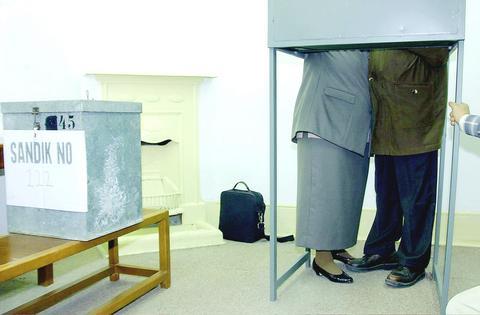
PHOTO: AFP
The opposition, which had only 11 seats in the outgoing parliament, has been growing in strength as a May date for Cyprus to enter the EU -- divided or unified -- approaches. If Cyprus is not unified by May, EU laws and benefits will only apply to the Greek Cypriot south.
But the opposition failed to capture a majority in parliament, which left critics of the UN-backed reunification plan celebrating.
"Long live the status quo," supporters of the National Unity Party, the largest of the governing parties chanted after the election.
With all of the 554 ballot boxes counted early yesterday morning, the pro-EU Republican Turkish Party and the Peace and Democracy Movement together had 48 percent of the vote and took 25 seats in parliament. The two parties have vowed to form an alliance if they win.
Meanwhile, the National Unity Party and the Democrat Party had 46 percent of the vote in the elections, according to the High Elections Board. Both parties oppose a UN-sponsored reunification plan and are currently serving in a co-alition government. They also had 25 seats.
"It is of course disappointing that we don't have a clear majority," said Serdil Sabit Soyer, general secretary of the Republican Turkish Party.
Opposition parties support a UN-backed plan to reunify the island. The governing parties argue that the plan would lead to domination by the richer Greek Cypriot south of the island.
With Turkish Cypriot leader Rauf Denktash and the Turkish military both opposing the UN talks, the opposition is believed to have needed a strong mandate for change.
"The people seem to be divided into camps," said Serdar Denktash, son of the Turkish Cypriot leader and head of the Democrat Party.
The next step will be for Rauf Denktash to name a party leader to form a new government. Denktash has already said that he would not nominate the opposition unless they won an outright majority.
If no party can form a coalition, new elections will have to be held in 60 days.
Parliament seats are divided according to a complicated formula that takes into account the population of the district casting the votes.
The future of Cyprus is key for Turkey's own EU bid. EU members have said that Turkey must help reunite the island before it can realize its own membership aspirations.
With some 40,000 troops deployed in the north, Turkey could technically be considered to occupy EU soil after Cyprus enters the bloc, EU members have warned.
Vedat Oktunc said he feared Greek Cypriot domination and voted for the National Unity Party of Dervis Eroglu, who serves as prime minister.
"A win [by pro-Denktash parties] will provide protection," he said.
Some 140,000 people were eligible to vote. About half of the 200,000 people on the Turkish Cypriot side of the island are Turkish settlers who moved to Cyprus after the island's division in 1974. They are expected to largely oppose reunification.
The opposition has pledged to axe Denktash as head negotiator in peace talks with Greek Cypriots.
Denktash will not be standing for re-election until 2005.
The island has been split between a Greek Cypriot south and a Turkish Cypriot north since Turkish troops invaded in 1974 amid intercommunal fighting that left some 3,000 dead and a short-lived coup by supporters of union with Greece.
A strong vote for the opposition would make it easier for Turkish leaders to press to reunite the island.
Turkish Prime Minister Recep Tayyip Erdogan spoke of the need to solve the Cyprus problem after coming to power last year.
The powerful military, however, considers Cyprus to be of strategic importance and favors Denktash.

‘IN A DIFFERENT PLACE’: The envoy first visited Shanghai, where he attended a Chinese basketball playoff match, and is to meet top officials in Beijing tomorrow US Secretary of State Antony Blinken yesterday arrived in China on his second visit in a year as the US ramps up pressure on its rival over its support for Russia while also seeking to manage tensions with Beijing. The US diplomat tomorrow is to meet China’s top brass in Beijing, where he is also expected to plead for restraint as Taiwan inaugurates president-elect William Lai (賴清德), and to raise US concerns on Chinese trade practices. However, Blinken is also seeking to stabilize ties, with tensions between the world’s two largest economies easing since his previous visit in June last year. At the

UNSETTLING IMAGES: The scene took place in front of TV crews covering the Trump trial, with a CNN anchor calling it an ‘emotional and unbelievably disturbing moment’ A man who doused himself in an accelerant and set himself on fire outside the courthouse where former US president Donald Trump is on trial has died, police said yesterday. The New York City Police Department (NYPD) said the man was declared dead by staff at an area hospital. The man was in Collect Pond Park at about 1:30pm on Friday when he took out pamphlets espousing conspiracy theories, tossed them around, then doused himself in an accelerant and set himself on fire, officials and witnesses said. A large number of police officers were nearby when it happened. Some officers and bystanders rushed

Beijing is continuing to commit genocide and crimes against humanity against Uyghurs and other Muslim minorities in its western Xinjiang province, U.S. Secretary of State Antony Blinken said in a report published on Monday, ahead of his planned visit to China this week. The State Department’s annual human rights report, which documents abuses recorded all over the world during the previous calendar year, repeated language from previous years on the treatment of Muslims in Xinjiang, but the publication raises the issue ahead of delicate talks, including on the war in Ukraine and global trade, between the top U.S. diplomat and Chinese

RIVER TRAGEDY: Local fishers and residents helped rescue people after the vessel capsized, while motorbike taxis evacuated some of the injured At least 58 people going to a funeral died after their overloaded river boat capsized in the Central African Republic’s (CAR) capital, Bangui, the head of civil protection said on Saturday. “We were able to extract 58 lifeless bodies,” Thomas Djimasse told Radio Guira. “We don’t know the total number of people who are underwater. According to witnesses and videos on social media, the wooden boat was carrying more than 300 people — some standing and others perched on wooden structures — when it sank on the Mpoko River on Friday. The vessel was heading to the funeral of a village chief in


 RSS
RSS