


Delegates reassembled yesterday at a landmark convention to debate Afghanistan's first post-Taliban constitution after an early victory for its US-backed leader increased the chances they will put their fractious, war-scarred country under a strong presidency.
The 500 Afghans -- including 100 women -- attending the Loya Jirga, or grand council, are finalizing a new charter seen as a vital step in the UN-sponsored drive to stabilize the country two years after the fall of the Taliban's hardline regime.

PHOTO: AFP
Hundreds of soldiers are guarding the event, which began Sunday in a huge tent on a city college campus, after warnings from the US military that militants might try to attack it.
Helicopters whirred overhead yesterday morning as the delegates filed past sniffer dogs and metal detectors.
The council must decide vital issues such as just how Islamic Afghanistan should be and the role of its women. But it risks being overshadowed by a struggle over how to share power in a nation used to fighting for it.
President Hamid Karzai, whose power barely extends beyond the capital because of the continued sway of warlords in the provinces, pressed Sunday for a strong presidential system that officials hope will be able to stand up to the resurgent Taliban and make the country safe enough for aid workers and foreign investors.
The 160-article draft constitution put before the Loya Jirga foresees no post of prime minister in a highly centralized government and would allow the president to appoint top officials in the provinces too. Karzai this week said he would not stand in elections slated for June next year if a strong prime minister's post is created.
On Sunday, a leader of the 1980s resistance against the Soviet occupation viewed as a close Karzai ally was elected chairman of the council. Sibghatullah Mujaddedi, an Islamic moderate and former president, secured 252 votes.
Karzai supporters said Mujaddedi's appointment was a good omen.
"He is a real scholar and a longtime holy warrior. He's the right man for the job," Rohul Amin Basher, an ethnic Pashtun from Nangarhar province, said yesterday. "Of course it will also help Karzai."
Still, Mujaddedi's selection came only after a bruising debate that saw opponents line up to challenge Karzai's right to appoint 50 of the delegates and accuse him of imposing unfair procedures for the gathering.
Yesterday, delegates were preparing to elect Mujaddedi's two deputies. Children read out poems to keep them entertained during the long pauses in proceedings extended by delegates' appeals from the floor.
"For no longer can the gun rule this country," said Dawlat Mohammed from northeastern Badakhshan province. "We have passed through very hard times. Now we need a push for peace."
Karzai heads an interim government that includes several ministers from the Northern Alliance, an uneasy coalition dominated by ethnic Tajiks which helped the US drive the Taliban from power in late 2001.
The alliance's commander in chief, Mohammed Fahim, is Karzai's deputy and the country's defense minister. But analysts say alliance leaders are worried they could be marginalized by Karzai, a Pashtun from the south. Pashtuns make up the country's largest ethnic group.
Human rights groups warn that the draft constitution is too weakly worded to guarantee the rights of women or limit the power of Islamic hardliners in the judiciary, and that Karzai may offer too much to religious fundamentalists in order to secure their support.
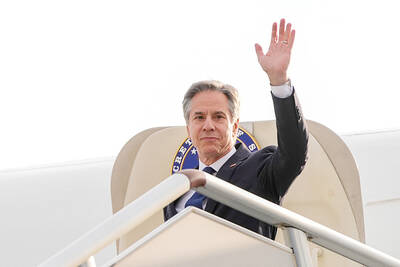
‘IN A DIFFERENT PLACE’: The envoy first visited Shanghai, where he attended a Chinese basketball playoff match, and is to meet top officials in Beijing tomorrow US Secretary of State Antony Blinken yesterday arrived in China on his second visit in a year as the US ramps up pressure on its rival over its support for Russia while also seeking to manage tensions with Beijing. The US diplomat tomorrow is to meet China’s top brass in Beijing, where he is also expected to plead for restraint as Taiwan inaugurates president-elect William Lai (賴清德), and to raise US concerns on Chinese trade practices. However, Blinken is also seeking to stabilize ties, with tensions between the world’s two largest economies easing since his previous visit in June last year. At the
Nearly half of China’s major cities are suffering “moderate to severe” levels of subsidence, putting millions of people at risk of flooding, especially as sea levels rise, according to a study of nationwide satellite data released yesterday. The authors of the paper, published by the journal Science, found that 45 percent of China’s urban land was sinking faster than 3mm per year, with 16 percent at more than 10mm per year, driven not only by declining water tables, but also the sheer weight of the built environment. With China’s urban population already in excess of 900 million people, “even a small portion

UNSETTLING IMAGES: The scene took place in front of TV crews covering the Trump trial, with a CNN anchor calling it an ‘emotional and unbelievably disturbing moment’ A man who doused himself in an accelerant and set himself on fire outside the courthouse where former US president Donald Trump is on trial has died, police said yesterday. The New York City Police Department (NYPD) said the man was declared dead by staff at an area hospital. The man was in Collect Pond Park at about 1:30pm on Friday when he took out pamphlets espousing conspiracy theories, tossed them around, then doused himself in an accelerant and set himself on fire, officials and witnesses said. A large number of police officers were nearby when it happened. Some officers and bystanders rushed

Beijing is continuing to commit genocide and crimes against humanity against Uyghurs and other Muslim minorities in its western Xinjiang province, U.S. Secretary of State Antony Blinken said in a report published on Monday, ahead of his planned visit to China this week. The State Department’s annual human rights report, which documents abuses recorded all over the world during the previous calendar year, repeated language from previous years on the treatment of Muslims in Xinjiang, but the publication raises the issue ahead of delicate talks, including on the war in Ukraine and global trade, between the top U.S. diplomat and Chinese


 RSS
RSS