


The US Justice Department has sharply increased prosecution of terrorism-related cases since the September 11 attacks but many fizzled and few produced significant prison time, a new study finds.
About 6,400 people were referred by investigators for criminal charges involving terror in the two years after the attacks, but fewer than one-third were actually charged and only 879 were convicted, according to government records reviewed by Syracuse University's Transactional Records Access Clearinghouse.
The median prison sentence was just 14 days, according to the study by clearinghouse co-directors David Burnham and Susan P. Long, which was released on Sunday. Only five people were sentenced to 20 years or more.
Critics seized on the numbers to question whether Attorney General John Ashcroft and other top law-enforcement officials have been overstating the success of their anti-terrorism efforts.
Nearly every time Ashcroft talks about the subject, he reads a long list of statistics on arrests and convictions to buttress his contention that great progress is being made.
Senator Charles Grassley, a senior member of the Senate Judiciary Committee with oversight of the FBI and Justice Department, said the report "raises questions about the accuracy of the department's claims about terrorism enforcement."
"This report shows that despite the focus on terrorism-related crimes, most of the people accused of terrorism involvement are getting little jail time, if at all," said Grassley.
Justice Department and FBI officials said the study is rooted in past conceptions of crime and punishment and does not reflect the reality that would-be terrorists seek to blend into society until they are ready to strike.
Lack of lengthy prison terms in many cases can be explained by the effort by prosecutors to stop would-be terrorists long before they are ready to attack, often charging them with lesser offenses, such as identity theft, document fraud and immigration violations.
Prosecutors feel it is better to get suspects off the streets and press them for information than wait for events that could produce harsher penalties.
They also said the study makes no mention of the value of intelligence collection and the need to reward cooperation with lesser sentences.
"The whole point is to disrupt terrorism at an early stage instead of letting the conspiracy fully hatch," said Viet Dinh, a former top Justice Department official under Attorney General John Ashcroft who now teaches law at Georgetown University.
"We cannot take the risk of the conspiracy taking place. What you get is shorter sentences but greater prevention," he said.
In other words, for every would-be "shoe bomber" such as Richard Reid -- serving a life sentence for trying to light an explosive on a Paris-to-Miami flight last year -- there are many more suspects such as the group of Yemeni-Americans from Lackawanna, New York, who were convicted of supporting terrorism by briefly attending al-Qaeda camps in Afghanistan.
"This administration's strategy of preventing terrorism has helped protect Americans for over two years," Justice Department spokesman Mark Corallo said.
According to the study, about 874 cases were pending as of Sept. 30, including some that might produce longer sentences.
In October, for example, two members of an Oregon group were sentenced to 18 years each in prison for attempting to travel to Afghanistan and fight US forces there.
Still, critics of Justice Department anti-terrorism policies say the study lifts the veil on what they consider to be large-scale government deception aimed at reassuring an American public fearful of more attacks.
"This punches a huge hole in the hype the Justice Department has been engaged in," said Timothy Edgar, legislative counsel for the American Civil Liberties Union.
"They are calling people terrorists, on a massive scale, who aren't terrorists," he said.
According to the study, charges were filed against 2,001 of the 6,400 people recommended for prosecution since the attacks. Authorities declined to prosecute 1,554. Some 2,845 of the referrals were pending as of Sept. 30.
Of the 879 people convicted, 373 went to prison and 506 did not. Of those sentenced to prison, 250 got less than a year, 100 got less than five years and just 23 were sentenced to five years or more.
During the two years before Sept. 11, 2001, 24 people were sentenced to five or more years in prison on comparable terror-related offenses, the study said.
The study found that prosecutions of individuals suspected of ties to one category, international terrorism, jumped from 142 in the two years before Sept. 11, 2001, to 748 in the two years after. Yet only three people in that category since the attacks have drawn sentences of five years or more, compared with six during the earlier period.
It also showed that more than 260 people convicted since September 11 of terrorism-related offenses were sentenced to the time that had already spent in jail awaiting disposition of their case.
Finally, the study said that 35 percent of criminal referrals made by investigators were declined by prosecutors because of lack of evidence or because no obvious federal crime had been committed.

‘IN A DIFFERENT PLACE’: The envoy first visited Shanghai, where he attended a Chinese basketball playoff match, and is to meet top officials in Beijing tomorrow US Secretary of State Antony Blinken yesterday arrived in China on his second visit in a year as the US ramps up pressure on its rival over its support for Russia while also seeking to manage tensions with Beijing. The US diplomat tomorrow is to meet China’s top brass in Beijing, where he is also expected to plead for restraint as Taiwan inaugurates president-elect William Lai (賴清德), and to raise US concerns on Chinese trade practices. However, Blinken is also seeking to stabilize ties, with tensions between the world’s two largest economies easing since his previous visit in June last year. At the

UNSETTLING IMAGES: The scene took place in front of TV crews covering the Trump trial, with a CNN anchor calling it an ‘emotional and unbelievably disturbing moment’ A man who doused himself in an accelerant and set himself on fire outside the courthouse where former US president Donald Trump is on trial has died, police said yesterday. The New York City Police Department (NYPD) said the man was declared dead by staff at an area hospital. The man was in Collect Pond Park at about 1:30pm on Friday when he took out pamphlets espousing conspiracy theories, tossed them around, then doused himself in an accelerant and set himself on fire, officials and witnesses said. A large number of police officers were nearby when it happened. Some officers and bystanders rushed
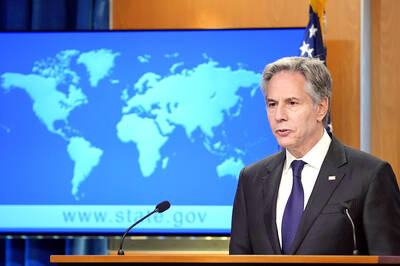
Beijing is continuing to commit genocide and crimes against humanity against Uyghurs and other Muslim minorities in its western Xinjiang province, U.S. Secretary of State Antony Blinken said in a report published on Monday, ahead of his planned visit to China this week. The State Department’s annual human rights report, which documents abuses recorded all over the world during the previous calendar year, repeated language from previous years on the treatment of Muslims in Xinjiang, but the publication raises the issue ahead of delicate talks, including on the war in Ukraine and global trade, between the top U.S. diplomat and Chinese

RIVER TRAGEDY: Local fishers and residents helped rescue people after the vessel capsized, while motorbike taxis evacuated some of the injured At least 58 people going to a funeral died after their overloaded river boat capsized in the Central African Republic’s (CAR) capital, Bangui, the head of civil protection said on Saturday. “We were able to extract 58 lifeless bodies,” Thomas Djimasse told Radio Guira. “We don’t know the total number of people who are underwater. According to witnesses and videos on social media, the wooden boat was carrying more than 300 people — some standing and others perched on wooden structures — when it sank on the Mpoko River on Friday. The vessel was heading to the funeral of a village chief in


 RSS
RSS