


After months of acrimony, Europe and the US are modulating their tone and struggling to work more cooperatively on the divisive issues of Iraq, Afghanistan and European defense cooperation.
The conciliatory stance on the American side is motivated at least in part by the urgent need to have NATO countries contribute more troops and money to Iraq and to deliver promised and much needed troops and equipment to Afghanistan. But there is a universal recognition among NATO members that the rift both within the Atlantic alliance and between Europe and the US has to be repaired if the alliance is to remain viable.
"I won't say everybody is pretending that everything is fine, but people are really trying to be more constructive, less emotional and, well, diplomatic," said one senior NATO military official who took part in meetings of the group's defense and foreign ministers in Brussels, Belgium, last week.
The most obvious evidence of the new tone was the public posture of US Secretary of Defense Donald Rumsfeld at the alliance defense ministers' meeting last week.
"Maybe we ought to try to do a better job of communicating," he said at one point, much to the surprise of European defense ministers and military officers.
When reporters asked him about a EU plan for defense cooperation separate from the Atlantic alliance, he did not repeat his past criticisms, but ducked the question.
"You're egging me on -- you're trying to get me in trouble," he said, virtually admitting he was under instructions to hold his fire. He added, "I'm plucky but I'm not stupid."
Instead, Rumsfeld praised the Europeans for developing military capacity that they could deploy rapidly in emergencies.
More surprisingly, perhaps, he did not criticize France and Germany, the two most important allies who opposed the Iraq war, for refusing to send troops or give financial support to help stabilize Iraq.
Rumsfeld's message was followed later in the week by Secretary of State Colin Powell's call to NATO at its foreign ministers meeting to consider expanding its role in Iraq, a clear admission that the US needs to internationalize its Iraq mission if it is to succeed. No one embraced the idea, but no one said no.
"That was a sea change -- that there wasn't the derision and hostility toward the US on Iraq that's been here since the beginning of the year," said a senior official who attended the meetings.
Finally, on Afghanistan, suggestions by both Rumsfeld and Powell that the US would like the alliance to assume more responsibility, perhaps eventually taking over the entire US-led operation, would not only put more of a burden on the Europeans but would also underscore the centrality of the alliance.
On the European side, even French President Jacques Chirac, the staunchest opponent of the Iraq war effort, is looking for ways to play a more active role in the Atlantic alliance and even in Iraq.
In a 90-minute meeting last week with Senator Joseph Biden, the ranking Democrat on the Senate Foreign Relations Committee, Chirac laid out situations in which France might be willing to help out in Iraq, according to an official familiar with the meeting.
Biden declined to comment on the substance of his conversation with Chirac, but confirmed in an interview that Chirac was seeking ways to repair the relationship with Washington.
Chirac also told Biden that France had requested the appointment of two French one-star generals to NATO's command structure, one at the alliance headquarters in Mons, Belgium, the other in Norfolk, Virginia, as a sign of willingness to work more closely with Washington on security matters.
Although France is not part of the military command of NATO, it has the second-largest contingent in alliance's new rapid-response force, which was inaugurated in October to respond quickly to long-range crisis missions.
In Afghanistan, US and French soldiers are training the new Afghan army, and American and French Special Forces conduct joint anti-terrorist operations near the Pakistani border.
A senior NATO military officer confirmed the French request but said it was uncertain whether the Pentagon would approve any move that would appear France-friendly.
For their part, the US armed forces consider the French military the most expeditionary army in Europe, and are eager to expand military cooperation in the alliance, the officer added.
France still has a contingency plan on the shelf to send 8,000 to 10,000 troops to Iraq under the right political circumstances, senior NATO officials said.
Concerning a European defense identity, the Europeans have abandoned a plan to create a EU military headquarters that would be separate from NATO.
That move followed an agreement among British Prime Minister Tony Blair, Chirac and German Chancellor Gerhard Schroeder that the EU be allowed to plan and run its own military operations.
Despite deep divisions within the British government on how tightly to embrace France and Germany on European defense, Blair is convinced that by joining them he has been able to help shape the debate and that he can control the outcome in a way that will be acceptable to Washington.

As the sun sets on another scorching Yangon day, the hot and bothered descend on the Myanmar city’s parks, the coolest place to spend an evening during yet another power blackout. A wave of exceptionally hot weather has blasted Southeast Asia this week, sending the mercury to 45°C and prompting thousands of schools to suspend in-person classes. Even before the chaos and conflict unleashed by the military’s 2021 coup, Myanmar’s creaky and outdated electricity grid struggled to keep fans whirling and air conditioners humming during the hot season. Now, infrastructure attacks and dwindling offshore gas reserves mean those who cannot afford expensive diesel

Does Argentine President Javier Milei communicate with a ghost dog whose death he refuses to accept? Forced to respond to questions about his mental health, the president’s office has lashed out at “disrespectful” speculation. Twice this week, presidential spokesman Manuel Adorni was asked about Milei’s English Mastiff, Conan, said to have died seven years ago. Milei, 53, had Conan cloned, and today is believed to own four copies he refers to as “four-legged children.” Or is it five? In an interview with CNN this month, Milei referred to his five dogs, whose faces and names he had engraved on the presidential baton. Conan,

French singer Kendji Girac, who was seriously injured by a gunshot this week, wanted to “fake” his suicide to scare his partner who was threatening to leave him, prosecutors said on Thursday. The 27-year-old former winner of France’s version of The Voice was found wounded after police were called to a traveler camp in Biscarrosse on France’s southwestern coast. Girac told first responders he had accidentally shot himself while tinkering with a Colt .45 automatic pistol he had bought at a junk shop, a source said. On Thursday, regional prosecutor Olivier Janson said, citing the singer, that he wanted to “fake” his suicide
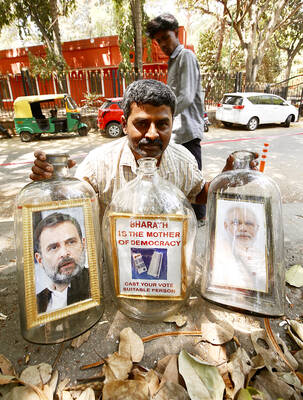
Indian Prime Minister Narendra Modi reaffirmed his pledge to replace India’s religion-based marriage and inheritance laws with a uniform civil code if he returns to office for a third term, a move that some minority groups have opposed. In an interview with the Times of India listing his agenda, Modi said his government would push for making the code a reality. “It is clear that separate laws for communities are detrimental to the health of society,” he said in the interview published yesterday. “We cannot be a nation where one community is progressing with the support of the Constitution while the other


 RSS
RSS