


Zimbabwe said on Sunday it was quitting the Commonwealth after the organization extended its suspension of the southern African country for violating its democratic principles.
President Robert Mugabe's information minister said the suspension, renewed at a summit on Sunday in Nigeria, proved that "racist leaders in Britain and Australia" had taken over the group whose members are mainly former British colonies.
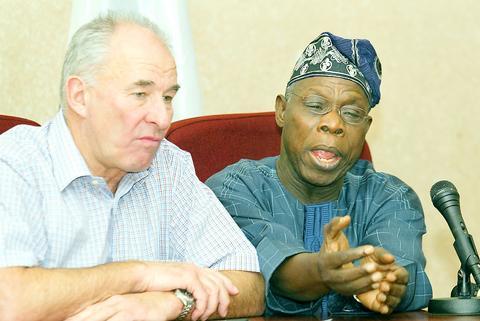
PHOTO: AP
Talks on Zimbabwe had dominated a four-day Commonwealth summit in the Nigerian capital Abuja, causing the worst split since South Africa's apartheid in the 1970s and 1980s and dividing its 54 members largely on color lines.
Zimbabwe was suspended early last year on the grounds Mugabe, who has ruled the country since independence in 1980, rigged his re-election last year and persecuted his opponents.
Some African Commonwealth members lobbied hard for its readmission but failed to win the day.
British Prime Minister Tony Blair, who had led the drive to keep Harare suspended, said it would send "a clear message to people in Zimbabwe that the Commonwealth is on the side of democracy and human rights."
The government in Harare said the leaders of Jamaica, Nigeria and South Africa called Mugabe on Sunday to urge him not to pull out, but to no avail.
"Accordingly, Zimbabwe has withdrawn its membership from the Commonwealth with immediate effect," it said.
"Our problem with Britain and Australia is over the land we took over from their white kith and kin to redistribute to the indigenous black people of this country," Information Minister Jonathan Moyo said.
"These racist leaders are using the Commonwealth to try to punish us," he said.
Mugabe accuses Britain and its allies of punishing him for land reforms that have given white-owned farms to landless blacks, an argument that finds resonance with other Africans.
Blair said it was wrong to "muddle" that issue with questions of Zimbabwean democracy and rights violations.
A divided Commonwealth had decided to extend Zimbabwe's suspension, but opened the way for a possible return if Harare engaged in reconciliation with the opposition.
After a contentious debate, host Nigerian President Olusegun Oba-sanjo said the suspension was maintained to protect the Commonwealth's core pro-democracy principles, but he put a positive face on the decision.
"The process that will lead to the lifting of Zimbabwe's suspension has started," he told a news conference, saying it was probably a matter of months not years.
Harare had stopped listening.
"President Mugabe indicated ... the decision was unacceptable, as the Republic of Zimbabwe would settle for nothing short of its removal from the Commonwealth suspension and agenda," the government said.
Political analysts said Mugabe had isolated himself further, but Zimbabwe's withdrawal had also robbed the Commonwealth of a formal platform to influence Mugabe's government.
Commonwealth leaders knew that President Robert Mugabe would pull Zimbabwe out of the world body before they took their decision to extend his suspension from the body, an Australian spokesman said yesterday.
The spokesman for Australian Prime Minister John Howard said the leaders had acted with their eyes open.
"I understand that that was the decision conveyed to the Commonwealth before taking its decision," he said.
"The Commonwealth has taken a stand on principle which is very welcome, but ultimately [withdrawal] is a decision for the Zimbabwe government," he said.
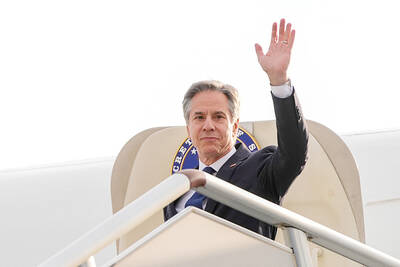
‘IN A DIFFERENT PLACE’: The envoy first visited Shanghai, where he attended a Chinese basketball playoff match, and is to meet top officials in Beijing tomorrow US Secretary of State Antony Blinken yesterday arrived in China on his second visit in a year as the US ramps up pressure on its rival over its support for Russia while also seeking to manage tensions with Beijing. The US diplomat tomorrow is to meet China’s top brass in Beijing, where he is also expected to plead for restraint as Taiwan inaugurates president-elect William Lai (賴清德), and to raise US concerns on Chinese trade practices. However, Blinken is also seeking to stabilize ties, with tensions between the world’s two largest economies easing since his previous visit in June last year. At the
Nearly half of China’s major cities are suffering “moderate to severe” levels of subsidence, putting millions of people at risk of flooding, especially as sea levels rise, according to a study of nationwide satellite data released yesterday. The authors of the paper, published by the journal Science, found that 45 percent of China’s urban land was sinking faster than 3mm per year, with 16 percent at more than 10mm per year, driven not only by declining water tables, but also the sheer weight of the built environment. With China’s urban population already in excess of 900 million people, “even a small portion

UNSETTLING IMAGES: The scene took place in front of TV crews covering the Trump trial, with a CNN anchor calling it an ‘emotional and unbelievably disturbing moment’ A man who doused himself in an accelerant and set himself on fire outside the courthouse where former US president Donald Trump is on trial has died, police said yesterday. The New York City Police Department (NYPD) said the man was declared dead by staff at an area hospital. The man was in Collect Pond Park at about 1:30pm on Friday when he took out pamphlets espousing conspiracy theories, tossed them around, then doused himself in an accelerant and set himself on fire, officials and witnesses said. A large number of police officers were nearby when it happened. Some officers and bystanders rushed
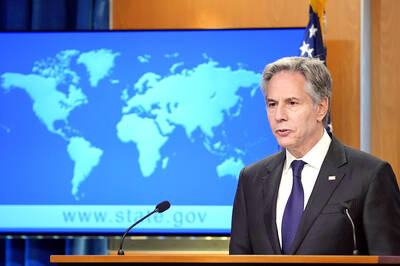
Beijing is continuing to commit genocide and crimes against humanity against Uyghurs and other Muslim minorities in its western Xinjiang province, U.S. Secretary of State Antony Blinken said in a report published on Monday, ahead of his planned visit to China this week. The State Department’s annual human rights report, which documents abuses recorded all over the world during the previous calendar year, repeated language from previous years on the treatment of Muslims in Xinjiang, but the publication raises the issue ahead of delicate talks, including on the war in Ukraine and global trade, between the top U.S. diplomat and Chinese


 RSS
RSS