


A political party that did not exist in Russia's last election, that offered only the vaguest prescriptions for the country's ills and that did not bother to take part in debates against its rivals appeared to be headed to a resounding victory in yesterday's parliamentary races on the basis of nothing more -- and nothing less -- than the power and popularity of President Vladimir Putin.
The party, United Russia, through a coalition with smaller parties and independent lawmakers loyal to Putin, already controls a slight majority of the 450 seats in Russia's lower house of Parliament, or Duma.
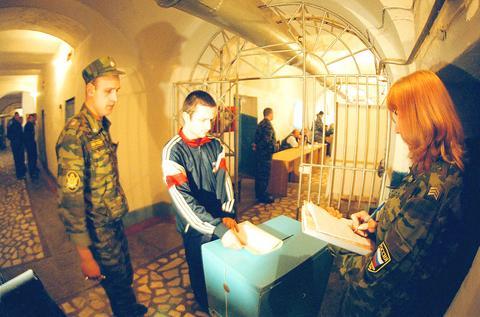
PHOTO: REUTERS
Now United Russia, which is loyal to the Kremlin, is projected to win its own majority outright for the first time since the collapse of the Soviet Union. It has overwhelmed the badly diminished Communist Party, which emerged from each of the last two parliamentary elections with the largest single bloc of seats.
Depending on the success of smaller parties, analysts and candidates said, the Kremlin could hold sway over a two-thirds majority, giving Putin the freedom to enact sweeping legislative changes, including, perhaps, some in the constitution itself.
Putin, who officially eschews membership in any party, has made no effort to disguise his support for United Russia.
"If the Duma is capable of functioning, then the president will also be capable of accomplishing much together with the Parliament," Putin said in an interview broadcast on state television networks on Nov. 28, in which he lavishly praised United Russia for rising above "a certain level of populism."
"And if the Duma composition is of a kind that engages in internal squabbles, and the deputies mainly pose before the cameras and say things pleasant for their voters but more or less useless for them," he went on, "then the president will have his hands and feet tied."
In case the point was lost on anyone, state television rebroadcast his remarks on Friday night.
The outcome of yesterday's vote will profoundly influence Russia's course over the next four years. The war in Chechnya, the increasing influence of the security services and the arrest of Mikhail Khodorkovsky, the country's richest man and a potential political rival, have all raised concerns about Putin's commitment to the country's democratic transition.
With Putin's re-election considered a given in March, yesterday's election could turn his already considerable power into something close to absolute. While Putin has repeatedly outlined his vision of a democratic Russia devoted to free markets, his critics have pointed to a steady erosion of basic freedoms that they say can only accelerate after the parliamentary elections.
"Managed democracy was installed four years ago with the election of Putin," said Andrei Piontovsky, an analyst from the Center for Strategic Studies who is often critical of the Russian president. "Now we are sliding step by step from a managed democracy to an authoritarian state."
United Russia's political juggernaut has provoked dire warnings from the Communists and the country's two liberal parties, Yabloko and the Union of Right Forces. The liberal parties face the possibility of falling short of the 5 percent of votes required to secure a bloc of seats.
Leaders of the Union of Right Forces recently pleaded with voters to turn out or risk the Parliament becoming what Irina Khakamada, the deputy speaker, called "a branch of power subservient to the executive branch."
"It means that the next Duma may approve any laws, including constitutional laws, including amendments to the constitution, and a certain part of civil society will have no say," she said.
United Russia has benefited not only from Putin's political support, but also from the vast resources of state and regional authorities, according to rival candidates, analysts and international election observers.
The state television networks have given United Russia lavish coverage, while deriding other parties, especially the Communists, or ignoring them altogether. Aides in the Kremlin have coordinated the party's strategy, while the party's leaders serve as the interior and emergency situations ministers under Putin.
The interior minister, Boris Gryzlov, has appeared on television more than any other politician except for Putin himself, often in a capacity that blurred the line between party leader and government official. After a suicide bomber destroyed a commuter train on Friday, killing more than 40 people, Gryzlov delivered an angry denunciation of the attack, vowing to punish "these animals" responsible.
The Organization for Security and Cooperation in Europe, which has sent a delegation to observe the election, has issued a stinging report citing "a clear bias" in media coverage and abuses of government resources on behalf of United Russia's candidates.
At least two dozen candidates from other parties have been thrown off ballots by regional authorities loyal to United Russia. Others have reported harassment by the police and other government officials.
Municipal workers in Moscow and other cities have repeatedly removed posters and seized campaign materials of rivals.
Mikhail Zadornov, a deputy from Yabloko running for re-election in southwest Moscow, said government workers from the mayor to street cleaners had been deployed on behalf of United Russia.
"This is my fourth campaign for the Duma," he said, "and I have never come across such use of administrative resources."
Boris Fyodorov, who is campaigning in another district in Moscow, said he became so frustrated by official harassment that he conducted a "sting operation." From his car, he videotaped police officers detaining two of his campaigners after telling them -- wrongly -- that they needed permission to leaflet.
It was a small victory, he lamented. "I can't be everywhere."
Some candidates have openly warned that the authorities could manipulate the results. The veteran Communist Party chief, Gennady Zhuganov, filed a protest with the Central Election Committee on Friday after 800,000 forged ballots were discovered in Bashkortostan, a region on the Volga River whose governor is a leader of United Russia.
With 28 governors or mayors on United Russia's ticket, "there are grounds to presume that the printing of forged ballots and preparations for rigging are assuming a large-scale character," Zhuganov wrote in his protest.
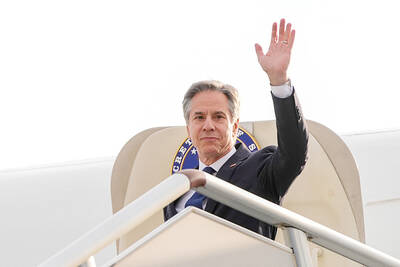
‘IN A DIFFERENT PLACE’: The envoy first visited Shanghai, where he attended a Chinese basketball playoff match, and is to meet top officials in Beijing tomorrow US Secretary of State Antony Blinken yesterday arrived in China on his second visit in a year as the US ramps up pressure on its rival over its support for Russia while also seeking to manage tensions with Beijing. The US diplomat tomorrow is to meet China’s top brass in Beijing, where he is also expected to plead for restraint as Taiwan inaugurates president-elect William Lai (賴清德), and to raise US concerns on Chinese trade practices. However, Blinken is also seeking to stabilize ties, with tensions between the world’s two largest economies easing since his previous visit in June last year. At the

UNSETTLING IMAGES: The scene took place in front of TV crews covering the Trump trial, with a CNN anchor calling it an ‘emotional and unbelievably disturbing moment’ A man who doused himself in an accelerant and set himself on fire outside the courthouse where former US president Donald Trump is on trial has died, police said yesterday. The New York City Police Department (NYPD) said the man was declared dead by staff at an area hospital. The man was in Collect Pond Park at about 1:30pm on Friday when he took out pamphlets espousing conspiracy theories, tossed them around, then doused himself in an accelerant and set himself on fire, officials and witnesses said. A large number of police officers were nearby when it happened. Some officers and bystanders rushed

Beijing is continuing to commit genocide and crimes against humanity against Uyghurs and other Muslim minorities in its western Xinjiang province, U.S. Secretary of State Antony Blinken said in a report published on Monday, ahead of his planned visit to China this week. The State Department’s annual human rights report, which documents abuses recorded all over the world during the previous calendar year, repeated language from previous years on the treatment of Muslims in Xinjiang, but the publication raises the issue ahead of delicate talks, including on the war in Ukraine and global trade, between the top U.S. diplomat and Chinese
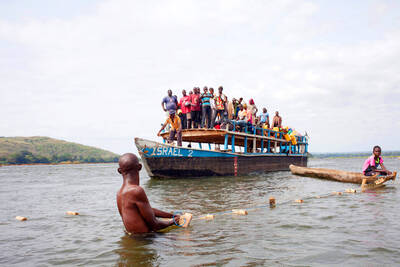
RIVER TRAGEDY: Local fishers and residents helped rescue people after the vessel capsized, while motorbike taxis evacuated some of the injured At least 58 people going to a funeral died after their overloaded river boat capsized in the Central African Republic’s (CAR) capital, Bangui, the head of civil protection said on Saturday. “We were able to extract 58 lifeless bodies,” Thomas Djimasse told Radio Guira. “We don’t know the total number of people who are underwater. According to witnesses and videos on social media, the wooden boat was carrying more than 300 people — some standing and others perched on wooden structures — when it sank on the Mpoko River on Friday. The vessel was heading to the funeral of a village chief in


 RSS
RSS