


The leaders of three secessionist regions in Georgia have been meeting with Russian officials in Moscow, raising questions about Russia's intentions and fueling concerns about possible instability.
"When such meetings are conducted without notifying Georgia's central authorities, which were ignored, Tbilisi is, naturally, very irritated," the interim president, Nino Burdzhanadze, said on Saturday.
Only a week ago, the Russian foreign minister, Igor Ivanov, helped broker a peaceful transfer of power in this former Soviet republic.
The Russians have sent mixed signals in recent days, saying they want to help stabilize Georgia but questioning the legitimacy of the new leadership.
The new team came to power through what it called a revolution when Eduard Shevardnadze was forced from office by huge but peaceful demonstrations.
Georgia has announced that a presidential election will be held on Jan. 4.
But Russia has voiced concern about US backing for the former opposition.
While Shevardnadze was once a member of the Soviet Politburo, his likely successor, Mikhail Saakashvili, studied law in the US.
"Time will show whose interests will be guiding the new Georgian leadership -- the interests of the United States or the Georgian people," said Sergei Prikhodko, deputy presidential chief of staff in Moscow, the Interfax news agency reported.
On Monday, Burdzhanadze met with Ivanov at an international conference in the Netherlands, after which the Russian foreign minister said the two nations were looking forward to resolving their problems and improving relations.
Ghia Nodia, a leading Georgian political analyst, said it was not yet clear which path Russia would take in its relations with Georgia.
Georgia's past relations with Russia have been, in the words of Russian President Vladimir Putin, "very complicated."
Russia could choose to enlarge on the statesman's role it played during the transition of power, positioning itself as the international authority on the affairs of the Caucasus, said Nodia, who heads an independent Georgian policy institute, the Caucasus Institute for Peace, Democracy and Development.
"But if Russia follows its usual paranoia about America and its usual instinct to use the internal problems of Georgia to apply pressure, it could try to keep Georgia unstable," he said.
The three separatist regions are already responsible for a degree of instability.
All look to Moscow for support, and the Kremlin could use its influence to calm or complicate the situation.
Two of the regions, Abkhazia and South Ossetia, have behaved like separate states for a decade since they broke from Georgia with covert Russian backing.
Neither is recognized internationally. They border on Russia and for the most part are not ethnically Georgian.
Abkhazia, on the Black Sea, broke away in 1993 after a 13-month war in which 10,000 people were killed.
Its prime minister, Raul Khadzhimba, says that of 320,000 people living in the region, 120,000 are Russian citizens.
He said while in Moscow that his armed forces stood ready to repel any attack by Georgia.
He also said the Russian base on his territory should stay to guard Abkhazia's de facto autonomy.
South Ossetia has sought to unite with the adjoining Russian republic of North Ossetia, which was separated from it by Stalin. Its president, Eduard Koity, said 60 percent of its people carry Russian passports.
The most restive and potentially active of the leaders of these regions is Aslan Abashidze, who recently proclaimed himself president of the third secessionist area, Adzharia.
Adzharia has not declared independence but has operated as an autonomous region on the coast of the Black Sea.
Abashidze, who gave last-minute help to Shevardnadze in a failed tactical move, is now struggling to maintain his fief, having closed its border with Georgia and declared a state of emergency.
"There can be no discussion of contacting those who have taken power unconstitutionally," he said after Shevardnadze was ousted.
Abashidze could complicate parliamentary elections if he manipulates Adzharia's vote as he did in the previous election on Nov. 2, when more votes were cast than there were registered voters.
At a news conference last week, Saakashvili, sometimes as intemperate in his words as Abashidze.
"He hates me and I hate his policies," he said.
Burdzhanadze sounded a diplomatic note, saying she would travel to Adzharia to meet with its leader after he returns from Moscow.
"Problems should be sought [out] not only in the regions but also in the capital," she said, sounding a conciliatory note.
"It is not the time now to try to find out who is more to blame but to find the compromise necessary for the country," she said.

‘IN A DIFFERENT PLACE’: The envoy first visited Shanghai, where he attended a Chinese basketball playoff match, and is to meet top officials in Beijing tomorrow US Secretary of State Antony Blinken yesterday arrived in China on his second visit in a year as the US ramps up pressure on its rival over its support for Russia while also seeking to manage tensions with Beijing. The US diplomat tomorrow is to meet China’s top brass in Beijing, where he is also expected to plead for restraint as Taiwan inaugurates president-elect William Lai (賴清德), and to raise US concerns on Chinese trade practices. However, Blinken is also seeking to stabilize ties, with tensions between the world’s two largest economies easing since his previous visit in June last year. At the

UNSETTLING IMAGES: The scene took place in front of TV crews covering the Trump trial, with a CNN anchor calling it an ‘emotional and unbelievably disturbing moment’ A man who doused himself in an accelerant and set himself on fire outside the courthouse where former US president Donald Trump is on trial has died, police said yesterday. The New York City Police Department (NYPD) said the man was declared dead by staff at an area hospital. The man was in Collect Pond Park at about 1:30pm on Friday when he took out pamphlets espousing conspiracy theories, tossed them around, then doused himself in an accelerant and set himself on fire, officials and witnesses said. A large number of police officers were nearby when it happened. Some officers and bystanders rushed

Beijing is continuing to commit genocide and crimes against humanity against Uyghurs and other Muslim minorities in its western Xinjiang province, U.S. Secretary of State Antony Blinken said in a report published on Monday, ahead of his planned visit to China this week. The State Department’s annual human rights report, which documents abuses recorded all over the world during the previous calendar year, repeated language from previous years on the treatment of Muslims in Xinjiang, but the publication raises the issue ahead of delicate talks, including on the war in Ukraine and global trade, between the top U.S. diplomat and Chinese
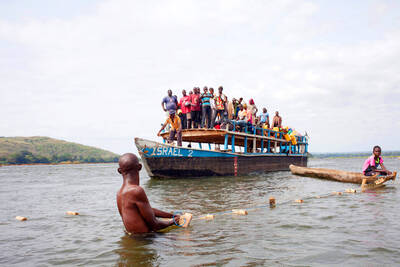
RIVER TRAGEDY: Local fishers and residents helped rescue people after the vessel capsized, while motorbike taxis evacuated some of the injured At least 58 people going to a funeral died after their overloaded river boat capsized in the Central African Republic’s (CAR) capital, Bangui, the head of civil protection said on Saturday. “We were able to extract 58 lifeless bodies,” Thomas Djimasse told Radio Guira. “We don’t know the total number of people who are underwater. According to witnesses and videos on social media, the wooden boat was carrying more than 300 people — some standing and others perched on wooden structures — when it sank on the Mpoko River on Friday. The vessel was heading to the funeral of a village chief in


 RSS
RSS