


Senior Defense Department officials said on Sunday that the military may soon release scores of detainees to their home countries, perhaps more than 100, who are being held in Guantanamo Bay, Cuba.
One senior official said negotiations were under way with the nations of dozens of the detainees over the terms of transferring custody from the US military to their home governments and eventual repatriation.
"We've identified a number that we think could be released to their home or host countries," one senior Pentagon official said. "We are negotiating with these countries" over the specific terms under which the prisoners might be transferred to the custody of their home countries.
The negotiations, a second senior official said, have been over issues like whether the detainees will be freed once they return home or just reimprisoned locally.
The first official declined to give the exact number of prisoners being considered for repatriation and cautioned that no decisions had been made.
The possibility of an impending large-scale release from Guantanamo -- which currently houses about 660 prisoners, most of whom were captured during and after the war in Afghanistan -- was first reported by Time Magazine. Time quoted US officials as saying that some of the detainees being considered for release had been captured by Afghan warlords and sold for the bounty offered by Washington for al-Qaida and Taliban fighters.
The detention of people captured in Afghanistan has been a major irritant in relations between the US and several of its allies.
The captives are imprisoned at the US naval base at Guantanamo Bay, on the southeastern tip of Cuba, and have remained in legal and political limbo for nearly two years.
The issue of these captives was a major item on the agenda when President George W. Bush conferred in London recently with Prime Minister Tony Blair of Britain. Nine Britons are detained at Guantanamo, and the British government, which has faced public pressure over the situation, has sought a series of concessions.
The US has declined to give the detainees access to lawyers, and it has not charged any of them with crimes.
Officials have said the detainees were not entitled to prisoner-of-war status, which would confer some rights, because the prisoners were "illegal combatants." The officials have said that when the men were captured they were not adhering to some requirements of the Geneva Conventions, like wearing clearly marked uniforms.
These arguments by the US have not proved convincing with its allies.
In a speech on Nov. 25, one of Britain's most senior judges, Johan Steyn, offered a scathing criticism of the US' continued detention of prisoners at Guantanamo, the latest of several protests from top international lawyers.
"The question is whether the quality of justice envisaged for the prisoners at Guantanamo Bay complies with the minimum international standards for the conduct of fair trials," Steyn said. "The answer can be given quite shortly. It is a resounding `No.'"
The speech was notable because it is extraordinary for sitting judges to comment on current situations.
He also said that "authoritarian regimes with dubious human rights records" have seized upon Washington's example to justify their own behavior.
While a large release of detainees from Guantanamo could lessen some of the international criticism, it might also provide support for those who have said the US held the prisoners for a long time with no evidence of any wrongdoing.
Defense Secretary Donald Rums-feld has said that military officials have been trying to determine which prisoners should face char-ges before military commissions.

‘IN A DIFFERENT PLACE’: The envoy first visited Shanghai, where he attended a Chinese basketball playoff match, and is to meet top officials in Beijing tomorrow US Secretary of State Antony Blinken yesterday arrived in China on his second visit in a year as the US ramps up pressure on its rival over its support for Russia while also seeking to manage tensions with Beijing. The US diplomat tomorrow is to meet China’s top brass in Beijing, where he is also expected to plead for restraint as Taiwan inaugurates president-elect William Lai (賴清德), and to raise US concerns on Chinese trade practices. However, Blinken is also seeking to stabilize ties, with tensions between the world’s two largest economies easing since his previous visit in June last year. At the

UNSETTLING IMAGES: The scene took place in front of TV crews covering the Trump trial, with a CNN anchor calling it an ‘emotional and unbelievably disturbing moment’ A man who doused himself in an accelerant and set himself on fire outside the courthouse where former US president Donald Trump is on trial has died, police said yesterday. The New York City Police Department (NYPD) said the man was declared dead by staff at an area hospital. The man was in Collect Pond Park at about 1:30pm on Friday when he took out pamphlets espousing conspiracy theories, tossed them around, then doused himself in an accelerant and set himself on fire, officials and witnesses said. A large number of police officers were nearby when it happened. Some officers and bystanders rushed

Beijing is continuing to commit genocide and crimes against humanity against Uyghurs and other Muslim minorities in its western Xinjiang province, U.S. Secretary of State Antony Blinken said in a report published on Monday, ahead of his planned visit to China this week. The State Department’s annual human rights report, which documents abuses recorded all over the world during the previous calendar year, repeated language from previous years on the treatment of Muslims in Xinjiang, but the publication raises the issue ahead of delicate talks, including on the war in Ukraine and global trade, between the top U.S. diplomat and Chinese
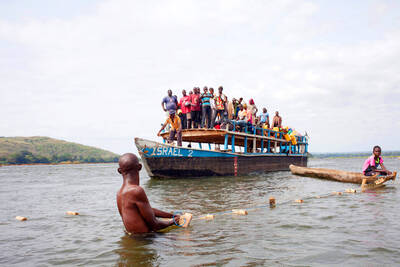
RIVER TRAGEDY: Local fishers and residents helped rescue people after the vessel capsized, while motorbike taxis evacuated some of the injured At least 58 people going to a funeral died after their overloaded river boat capsized in the Central African Republic’s (CAR) capital, Bangui, the head of civil protection said on Saturday. “We were able to extract 58 lifeless bodies,” Thomas Djimasse told Radio Guira. “We don’t know the total number of people who are underwater. According to witnesses and videos on social media, the wooden boat was carrying more than 300 people — some standing and others perched on wooden structures — when it sank on the Mpoko River on Friday. The vessel was heading to the funeral of a village chief in


 RSS
RSS