


Voters in Northern Ireland were yesterday choosing new members of the recently peaceful province's local parliament, with pundits tipping hardliners on both sides of the sectarian divide to profit from a campaign marked by widespread public cynicism.
The 1.1 million electors will choose 108 members of the Northern Ireland Assembly, created in 1998 as part of the Good Friday agreement, which delivered the British territory from 30 years of bloodshed.
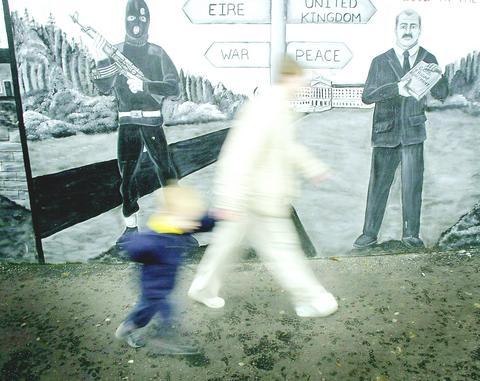
PHOTO: EPA
But since the heady days of the peace deal and the creation of an unprecedented semi-autonomous government grouping parties from all spectrums of Catholic and Protestant views, optimism and co-operation alike have flagged.
Just over a year ago London suspended the assembly after a total breakdown of relations in the legislature following the discovery of a spy ring linked to the Irish Republican Army (IRA).
That breach has yet to be repaired, meaning that there is little chance of any of the newly-elected assembly representatives doing any meaningful work in the foreseeable future.
"Whatever happens on Wednesday, there is not going to be a government set up in the short term," said Henry Patterson, professor of politics at the University of Ulster.
This fact, according to analysts, coupled with bitterly cold weather for a poll held unusually deep into winter, could see voters stay away in droves -- benefiting more extreme groups whose supporters are generally very committed.
The result is that bookmakers are heavily backing both the Democratic Unionist Party (DUP), led by firebrand Protestant minister Ian Paisley and which opposes the Good Friday deal, and Sinn Fein, the IRA's political arm, to make strong gains.
The DUP is odds-on to win more votes than the previously dominant Ulster Unionist Party led by David Trimble, Northern Ireland's "first minister" until the government was suspended.
Similarly, the moderate Social Democratic and Labour Party is widely expected to be pushed into second place among Catholic voters by Sinn Fein.
Given that direct rule from London looks set to continue at least until a fresh round of negotiations between British and Irish ministers and Northern Ireland's parties, the immediate effect of this should be minimal.
However, the dangers of letting the province's peace efforts slip are clear.
Two thousand extra police were mobilized on Tuesday for the election after a bomb partially exploded at an army base in the western town of Dungannon.
Also, it appears that some voters are growing tired of inter-party squabbling, which would seem certain to increase if Sinn Fein and the DUP lock horns armed with increased power bases.
"There's no trust any more in the politicians. Everybody has had it up to here, especially among the young people," was the view of Scott Morrison, sitting in the cafeteria of Belfast's Queens University on election eve.
"All they see is the old inter-party feuding. They are childish," he said.

‘IN A DIFFERENT PLACE’: The envoy first visited Shanghai, where he attended a Chinese basketball playoff match, and is to meet top officials in Beijing tomorrow US Secretary of State Antony Blinken yesterday arrived in China on his second visit in a year as the US ramps up pressure on its rival over its support for Russia while also seeking to manage tensions with Beijing. The US diplomat tomorrow is to meet China’s top brass in Beijing, where he is also expected to plead for restraint as Taiwan inaugurates president-elect William Lai (賴清德), and to raise US concerns on Chinese trade practices. However, Blinken is also seeking to stabilize ties, with tensions between the world’s two largest economies easing since his previous visit in June last year. At the
Nearly half of China’s major cities are suffering “moderate to severe” levels of subsidence, putting millions of people at risk of flooding, especially as sea levels rise, according to a study of nationwide satellite data released yesterday. The authors of the paper, published by the journal Science, found that 45 percent of China’s urban land was sinking faster than 3mm per year, with 16 percent at more than 10mm per year, driven not only by declining water tables, but also the sheer weight of the built environment. With China’s urban population already in excess of 900 million people, “even a small portion

UNSETTLING IMAGES: The scene took place in front of TV crews covering the Trump trial, with a CNN anchor calling it an ‘emotional and unbelievably disturbing moment’ A man who doused himself in an accelerant and set himself on fire outside the courthouse where former US president Donald Trump is on trial has died, police said yesterday. The New York City Police Department (NYPD) said the man was declared dead by staff at an area hospital. The man was in Collect Pond Park at about 1:30pm on Friday when he took out pamphlets espousing conspiracy theories, tossed them around, then doused himself in an accelerant and set himself on fire, officials and witnesses said. A large number of police officers were nearby when it happened. Some officers and bystanders rushed
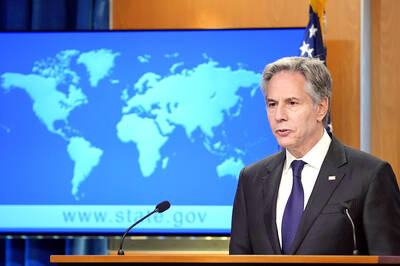
Beijing is continuing to commit genocide and crimes against humanity against Uyghurs and other Muslim minorities in its western Xinjiang province, U.S. Secretary of State Antony Blinken said in a report published on Monday, ahead of his planned visit to China this week. The State Department’s annual human rights report, which documents abuses recorded all over the world during the previous calendar year, repeated language from previous years on the treatment of Muslims in Xinjiang, but the publication raises the issue ahead of delicate talks, including on the war in Ukraine and global trade, between the top U.S. diplomat and Chinese


 RSS
RSS