


Following the devastation of SARS, unprecedented pro-democracy marches and controversy over a costly international music festival, Hong Kong is feeling a little fragile at the moment.
Just the right time, then, to launch a biting satirical magazine that takes no prisoners in its demolition of Hong Kong's straitened establishment.
Spike appeared on the bookstands for the first time on Friday as the territory's first mainstream publication with a mission statement to rub the authorities up the wrong way.
On a front page that belittled embattled Chief Executive Tung Chee-hwa's (董建華) record on democratic reform -- or lack thereof -- the first edition spelt out in no uncertain terms Spike's aims to test the limits of the city's tolerance of criticism of the establishment.
"My attitude is that we have a fairly free media in Hong Kong and certainly in law there's a lot of toleration of free expression and my view is that that will whither away unless it is tested to its outer limits," says Spike publisher Steve Vines. "That's where we're intending to test it."
Spike's arrival couldn't have been more timely. Earlier this year the former British territory was in turmoil over the imminent passage of a national security law.
Public opposition to the bill was so great that 500,000 people took to the streets in protest on July 1, the day the city should have been celebrating its handover of sovereignty to China six years earlier. Opponents feared the law would lead to a loss of free speech and press.
The public outcry at the so-called Article 23 law prompted the government to postpone the bill indefinitely.
"What crystallized the idea of Spike most was the July 1 demo and the feeling that there were all these angry, politically-aware and cynical people there and they might want a magazine that reflected those sentiments," said Vines, a veteran Hong Kong journalist and former editor of the now defunct Eastern Express daily newspaper.
Spike's first edition blended satirical articles, cartoons and diaries similar in style to those found in Britain's notorious Private Eye magazine, with commentary on political and business issues.
Among the targets of its many barbs was the American Chamber of Commerce's chairman, James Thompson, and the Harbour Fest music festival he organized.
The event was supposed to have reinvigorated Hong Kong's image abroad after the SARS outbreak badly dented commerce and confidence in the territory.
While the festival managed to pull in heavyweight rockers like the Rolling Stones as well as big Asian bands, poor ticket sales and a swirling political scandal over its almost US$100 million public subsidy meant it was criticized as an embarrassing failure.
Others who suffered Spike's venom include Tung's wife, Betty, and former security minister Regina Ip (葉劉淑儀).
A column entitled Media Follies devotes most of its space to attacking the city's main English-language daily newspaper, the South China Morning Post, which is portrayed as boring, staid and complacent.
"There's a feeling that there wasn't a good weekend read in English-language publications here," said Vines, whose magazine is supported by Chinese media mogul Jimmy Lai, publisher of the racy tabloid-style Apple Daily and Next magazines.
One of the biggest questions Vines has faced since Spike's launch is whether he thinks there is a big enough market in Hong Kong for a satire magazine.
Hong Kong is often regarded, particularly by expatriate residents, as humorless and too money- and self-obsessed to appreciate anything as flippant as a satirical magazine.
Before Spike, only a sporadically published underground free-sheet called Specific Rim attempted to satirize the city's establishment. But it only had a print run of a few thousand, compared to Spike's initial run of 15,000 with a full distribution deal to sell weekly out of Hong Kong's newsstands, supermarkets and convenience stores.
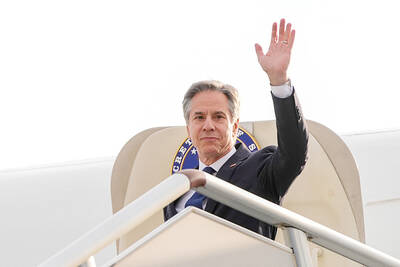
‘IN A DIFFERENT PLACE’: The envoy first visited Shanghai, where he attended a Chinese basketball playoff match, and is to meet top officials in Beijing tomorrow US Secretary of State Antony Blinken yesterday arrived in China on his second visit in a year as the US ramps up pressure on its rival over its support for Russia while also seeking to manage tensions with Beijing. The US diplomat tomorrow is to meet China’s top brass in Beijing, where he is also expected to plead for restraint as Taiwan inaugurates president-elect William Lai (賴清德), and to raise US concerns on Chinese trade practices. However, Blinken is also seeking to stabilize ties, with tensions between the world’s two largest economies easing since his previous visit in June last year. At the
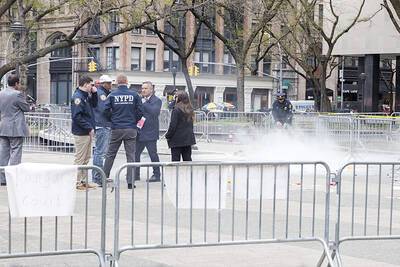
UNSETTLING IMAGES: The scene took place in front of TV crews covering the Trump trial, with a CNN anchor calling it an ‘emotional and unbelievably disturbing moment’ A man who doused himself in an accelerant and set himself on fire outside the courthouse where former US president Donald Trump is on trial has died, police said yesterday. The New York City Police Department (NYPD) said the man was declared dead by staff at an area hospital. The man was in Collect Pond Park at about 1:30pm on Friday when he took out pamphlets espousing conspiracy theories, tossed them around, then doused himself in an accelerant and set himself on fire, officials and witnesses said. A large number of police officers were nearby when it happened. Some officers and bystanders rushed
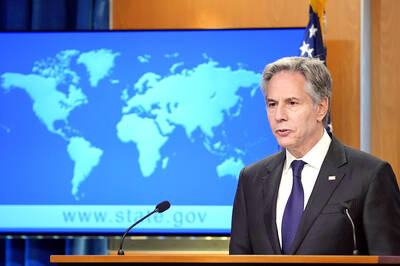
Beijing is continuing to commit genocide and crimes against humanity against Uyghurs and other Muslim minorities in its western Xinjiang province, U.S. Secretary of State Antony Blinken said in a report published on Monday, ahead of his planned visit to China this week. The State Department’s annual human rights report, which documents abuses recorded all over the world during the previous calendar year, repeated language from previous years on the treatment of Muslims in Xinjiang, but the publication raises the issue ahead of delicate talks, including on the war in Ukraine and global trade, between the top U.S. diplomat and Chinese
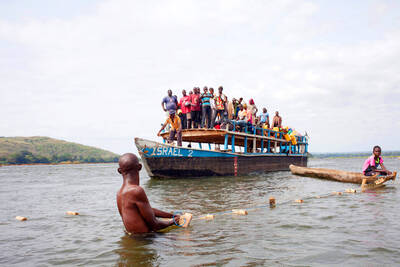
RIVER TRAGEDY: Local fishers and residents helped rescue people after the vessel capsized, while motorbike taxis evacuated some of the injured At least 58 people going to a funeral died after their overloaded river boat capsized in the Central African Republic’s (CAR) capital, Bangui, the head of civil protection said on Saturday. “We were able to extract 58 lifeless bodies,” Thomas Djimasse told Radio Guira. “We don’t know the total number of people who are underwater. According to witnesses and videos on social media, the wooden boat was carrying more than 300 people — some standing and others perched on wooden structures — when it sank on the Mpoko River on Friday. The vessel was heading to the funeral of a village chief in


 RSS
RSS