


The US said on Wednesday a report by the UN's nuclear watchdog confirmed Washington's belief in a secret Iranian nuclear program, while Tehran insisted its nuclear policy was peaceful.
In the first US reaction to a confidential report by the International Atomic Energy Agency (IAEA), Undersecretary of State John Bolton said its finding that there was no evidence of a nuclear weapons program was "impossible to believe."
Bolton said the report circulated on Monday actually reaffirmed the US contention that "the massive and covert Iranian effort to acquire sensitive nuclear capabilities make sense only as part of a nuclear weapons program."
Some arms experts also said the report by the Vienna-based IAEA supported US claims Tehran had a secret atomic weapons program. Iran's President Mohammad Khatami insisted its nuclear policy was purely peaceful.
The former UN chief weapons inspector in Iraq, Hans Blix, said there was no direct evidence Iran was engaged in a civilian energy program to make a nuclear bomb.
But Israeli Defense Minister Shaul Mofaz said in an address in Washington Iran's nuclear program could reach "the point of no return" within a year unless there was strong international pressure to stop it.
The IAEA report criticized Iran's nuclear policy, but said there was no proof it had a weapons program. The agency said it needed more time to establish whether its research was for peaceful purposes, as Iran said it was.
The report said Iran had had a centrifuge uranium enrichment program for 18 years and a high-tech laser enrichment program for 12 years, both of which it had hidden from the UN.
It also said Iran admitted producing small amounts of plutonium, useable in a bomb and with virtually no civilian uses, and had conducted secret tests of its enrichment centrifuges using nuclear material.
In Tehran, Khatami said Tehran's nuclear plans were purely peaceful.
"It's not important what machinery we have, it's important that we are not pursuing nuclear weapons," he said.
He was optimistic Iran would avoid being reported to the UN Security Council for possible sanctions despite the IAEA report, if its case was studied technically and legally, rather than in political terms.
But some arms experts said the report backed US claims of a secret nuclear weapons program.
Diplomats have said the IAEA findings proved Iran, at the very least, developed the know-how to build nuclear weapons.
"The report is a stunning revelation of how far a country can get in making The Bomb, while pretending to comply with international inspections," said Gary Milhollin of the Wisconsin Project on Nuclear Arms Control, a Washington-based think-tank. "This is a classic case of a bomb in the basement."
"Iran has secretly enriched uranium, made plutonium, and hidden the evidence of it from the world," he said. "There's only one reason why anybody would do that -- because they want to make the bomb."
"The Iranians are ... following the textbook written by the late Shah" -- who wanted the option of producing nuclear weapons -- Harald Mueller of Germany's Frankfurt Peace Research Institute said.
In a bid to head off international concern, Iran has in recent days submitted a comprehensive report to the IAEA on its past nuclear activity, agreed to allow snap UN inspections of its nuclear sites and suspended uranium enrichment.
Former UN weapons inspector Blix, who now heads a new Swedish-backed international commission on weapons of mass destruction, said Iran's civilian reactors were not themselves a worry and it was uncertain whether Tehran wanted to build a nuclear bomb.
"I haven't any evidence of that," he said in an interview at his Stockholm home. "I don't think these two reactors or a civilian nuclear program are a danger per se."

As the sun sets on another scorching Yangon day, the hot and bothered descend on the Myanmar city’s parks, the coolest place to spend an evening during yet another power blackout. A wave of exceptionally hot weather has blasted Southeast Asia this week, sending the mercury to 45°C and prompting thousands of schools to suspend in-person classes. Even before the chaos and conflict unleashed by the military’s 2021 coup, Myanmar’s creaky and outdated electricity grid struggled to keep fans whirling and air conditioners humming during the hot season. Now, infrastructure attacks and dwindling offshore gas reserves mean those who cannot afford expensive diesel

Does Argentine President Javier Milei communicate with a ghost dog whose death he refuses to accept? Forced to respond to questions about his mental health, the president’s office has lashed out at “disrespectful” speculation. Twice this week, presidential spokesman Manuel Adorni was asked about Milei’s English Mastiff, Conan, said to have died seven years ago. Milei, 53, had Conan cloned, and today is believed to own four copies he refers to as “four-legged children.” Or is it five? In an interview with CNN this month, Milei referred to his five dogs, whose faces and names he had engraved on the presidential baton. Conan,

French singer Kendji Girac, who was seriously injured by a gunshot this week, wanted to “fake” his suicide to scare his partner who was threatening to leave him, prosecutors said on Thursday. The 27-year-old former winner of France’s version of The Voice was found wounded after police were called to a traveler camp in Biscarrosse on France’s southwestern coast. Girac told first responders he had accidentally shot himself while tinkering with a Colt .45 automatic pistol he had bought at a junk shop, a source said. On Thursday, regional prosecutor Olivier Janson said, citing the singer, that he wanted to “fake” his suicide
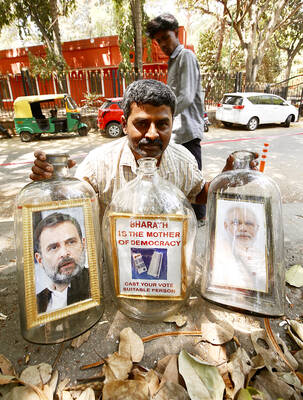
Indian Prime Minister Narendra Modi reaffirmed his pledge to replace India’s religion-based marriage and inheritance laws with a uniform civil code if he returns to office for a third term, a move that some minority groups have opposed. In an interview with the Times of India listing his agenda, Modi said his government would push for making the code a reality. “It is clear that separate laws for communities are detrimental to the health of society,” he said in the interview published yesterday. “We cannot be a nation where one community is progressing with the support of the Constitution while the other


 RSS
RSS