


To hear President Vladimir Putin's allies tell it, the arrest of Russia's richest oil baron and the resignation of his top Kremlin backer have swept away years of corrupt ties between business and bureaucracy, ushering in a new era of fair play.
"Byzantium is over," Finance Minister Alexei Kudrin told the newspaper Izvestia in a comment on the departure of Kremlin chief of staff Alexander Voloshin, who resigned over the jailing of Yukos oil company chief Mikhail Khodorkovsky -- the wealthiest of the men who won control over rich Russian resources in allegedly rigged 1990s privatization deals.
Listen to Putin's sharpest critics and you'll hear a different story -- a sinister warning that Stalin's ghost is haunting Russia under Putin, a former KGB agent. Vladimir Bukovsky, a Soviet-era dissident who lives in Britain, called Khodorkovsky's arrest part of a new "wave of political repression."
The opinion of Ilya Vainshteyn, a real-estate office director, lies in between. "In my view it's a struggle for power -- and finances," said Vainshteyn, 54, walking his dog in a Moscow park a few days after Khodorkovsky resigned as Yukos chief in a bid to spare the company more pressure after a four-month campaign of arrests and accusations.
Vainshteyn said the attack on Yukos and the shift behind the Kremlin walls "will not promote the development of democracy -- and even less so of the economy."
Setbacks
He raised a widespread concern that the Yukos affair could bring serious setbacks for democracy and economic reform -- a chokehold on the processes many say must occur if Russia is to thrive after a past marred by Czarist autocracy, Communist rule and the corrupt capitalism that flourished following the Soviet collapse 12 years ago.
"They are telling us that oligarchic capitalism is over," said Andrei Piontkovsky, director of Moscow's Strategic Studies Center think tank. However, he warned that "the medicine being offered ... could turn out to be far more dangerous than the illness."
Khodorkovsky was arrested Oct. 25, pulled from a chartered plane in Siberia and put in a Moscow jail where he remains, the now unseen figure in the eye of the strongest political storm to hit the country since Putin came to power four years ago. A court is to decide Tuesday whether he should remain in jail pending trial.
Putin has defended the prosecutors and cast Khodorkovsky's arrest as a straightforward case, saying that "everyone must learn live in accordance with the law."
"Our aim is not to sting particular people, but to bring order to the country," Putin said Thursday in Rome.
But critics scoff at the notion that prosecutors are working evenhandedly, saying they targeted Khodorkovsky for his clout, his cheek and his refusal to keep his pocketbook out of politics -- a field dominated by the president, who has consolidated his power and quieted dissent.
Hated oligarghs
Since millions of citizens revile the so-called oligarchs -- tycoons who wielded string influence over Boris Yeltsin's Kremlin and helped engineer Putin's own rise -- the president's aides may hope Khodorkovsky's arrest will increase his already strong popularity ahead of the March presidential election, in which he is widely expected to win a second four-year term.
Behind Khodorkovsky's arrest, many analysts see a shadowy group of former KGB colleagues Putin brought into the Kremlin, where they say it gained the upper hand with Voloshin's departure. Critics of the group say it is bent on increasing state control over business, politics and society.
Many analysts said they hope Putin will form a new balance of power within the Kremlin, as he has shown signs of doing with the appointment of a new chief of staff, Dmitry Medvedev, who swiftly criticized prosecutors for freezing a large chunk of Yukos shares. "The supremacy of a single group is extraordinarily dangerous," Piontkovsky said.
Mark Urnov, who heads the Expertise Foundation think tank, said he fears the Yukos affair could mark a step toward an "absolute monopoly of the state on the economy and politics."
"If the situation doesn't change, in four years we risk getting an ineffective economy, because an effective economy cannot be built by entrepreneurs under the control of a corrupt state," he said.
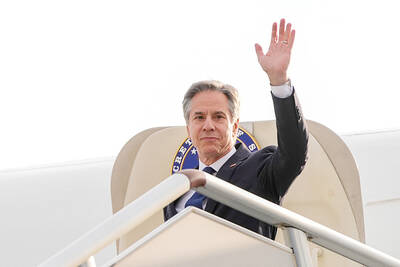
‘IN A DIFFERENT PLACE’: The envoy first visited Shanghai, where he attended a Chinese basketball playoff match, and is to meet top officials in Beijing tomorrow US Secretary of State Antony Blinken yesterday arrived in China on his second visit in a year as the US ramps up pressure on its rival over its support for Russia while also seeking to manage tensions with Beijing. The US diplomat tomorrow is to meet China’s top brass in Beijing, where he is also expected to plead for restraint as Taiwan inaugurates president-elect William Lai (賴清德), and to raise US concerns on Chinese trade practices. However, Blinken is also seeking to stabilize ties, with tensions between the world’s two largest economies easing since his previous visit in June last year. At the
Nearly half of China’s major cities are suffering “moderate to severe” levels of subsidence, putting millions of people at risk of flooding, especially as sea levels rise, according to a study of nationwide satellite data released yesterday. The authors of the paper, published by the journal Science, found that 45 percent of China’s urban land was sinking faster than 3mm per year, with 16 percent at more than 10mm per year, driven not only by declining water tables, but also the sheer weight of the built environment. With China’s urban population already in excess of 900 million people, “even a small portion

UNSETTLING IMAGES: The scene took place in front of TV crews covering the Trump trial, with a CNN anchor calling it an ‘emotional and unbelievably disturbing moment’ A man who doused himself in an accelerant and set himself on fire outside the courthouse where former US president Donald Trump is on trial has died, police said yesterday. The New York City Police Department (NYPD) said the man was declared dead by staff at an area hospital. The man was in Collect Pond Park at about 1:30pm on Friday when he took out pamphlets espousing conspiracy theories, tossed them around, then doused himself in an accelerant and set himself on fire, officials and witnesses said. A large number of police officers were nearby when it happened. Some officers and bystanders rushed
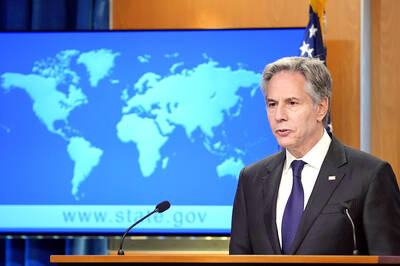
Beijing is continuing to commit genocide and crimes against humanity against Uyghurs and other Muslim minorities in its western Xinjiang province, U.S. Secretary of State Antony Blinken said in a report published on Monday, ahead of his planned visit to China this week. The State Department’s annual human rights report, which documents abuses recorded all over the world during the previous calendar year, repeated language from previous years on the treatment of Muslims in Xinjiang, but the publication raises the issue ahead of delicate talks, including on the war in Ukraine and global trade, between the top U.S. diplomat and Chinese


 RSS
RSS