


Wildlife experts battling a mystery disease which has killed half the world's population of Tasmanian devils said yesterday that the illness could prove as hard to eliminate as HIV or SARS.
Devil Facial Tumor Disease (DFTD) has nearly eliminated the marsupial predators from the eastern half of Tasmania and there are signs it is spreading to populations in the west, said Nick Mooney, a wildlife management officer with the island state's conservation department.
The disease manifests itself as small lesions and lumps around devils' mouths which grow into cancerous tumors on the face and eventually spread throughout the entire body.
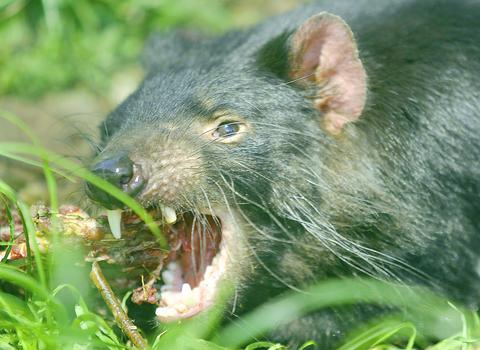
PHOTO: AFP
Death occurs within three to five months, usually from starvation as weakened animals lose the ability to compete for food.
Mooney estimated that from a high of about 150,000 in the mid-1990s, the population of Tasmanian devils has been slashed to 75,000 by DFTD, an illness about which pathologists know little.
"The state population has halved already," he said.
Devils -- muscular, short-legged animals the size of a small dog but with jaws powerful enough to crush bones -- live wild only in Tasmania. There are only about 120 of the animals in captivity, all but one of them in Australia.
The threat to Tasmanian devils is such that the Hollywood entertainment giant Warner Brothers -- which made the feisty creatures internationally famous through the cartoon character "Taz" -- approached state officials to learn more about the crisis.
Experts from around Australia and beyond gathered in the Tasmanian city of Launceston earlier this month to develop a strategy for finding the causes of DFTD and battling the disease.
"Our big problem is that we don't even know for sure if this is an infectious disease or not," Mooney said.
"A retrovirus seems the most obvious suspect, but not all the cancers are caused by these," he said.
"The thing which seems clear is that there is a suppression of the animals' immune system for dealing with cancer, but the pathologists say we might be years away from finding the answer," he said.
Mooney says it is unlikely DFTD will wipe out the iconic Australian marsupial.
"There have been no clear examples of infectious diseases wiping out whole populations of animals because as the animals become rarer, the rate of transmission falls and the population recovers," Mooney said.

‘CROSSING THE LINE’: China’s embassy in Seoul criticized US Forces Korea Commander General Xavier Brunson, asking if his ‘hostile’ remarks were authorized by Washington South Korea and the US are in talks over recent public remarks by the commander of US Forces Korea, Seoul’s presidential office said yesterday, after the comments drew sharp criticism from China. In a recent podcast interview, US Forces Korea Commander General Xavier Brunson described South Korea as “the dagger in the heart of Asia” from China’s east coast, prompting the Chinese embassy in Seoul to say that he had “truly crossed the line.” The interview came amid growing speculation that Washington might seek to expand the role of US Forces Korea in countering the growing regional influence of China, a key

Through the noise of rushing papers and whirring belts at a print factory in Kyoto, two creators watch their photo essay come to life in broadsheet form — part of an effort to win new audiences in the age of artificial intelligence (AI). Despite the decline of the publishing industry, self-publication and handmade “zine” magazines are growing in popularity in Japan, reflecting the nation’s enduring love of paper in the digital era. While speaking to Agence France-Presse at the plant, his hands black with ink, one of the creators, Kazuma Obara, said: “I think [paper] is a medium that engages all five

Australian researchers have trained lab-grown brain cells on a silicon computer chip to play the 1990s shooter game Doom and said they are just scratching the surface of what the neurons could be capable of doing. It is the science-fiction work of biotech boffins at Cortical Labs, who researched and developed the technology that harnesses the workings of the brain’s networking system. Each so-called “biological computer” contains about 200,000 living human brain cells, grown from stem cells that were harvested from blood donations. Having mastered the simple computer game Pong, where a paddle is moved up and down to send a ball

A surprising gut feeling may help pigeons find their way home. Animals use various techniques to navigate, including following the stars and remembering key landmarks. Birds, fish and turtles orient themselves using Earth’s magnetic field as a compass, but it is not yet clear how exactly they do this. Pigeons are a well-known group of frequent flyers that can traverse hundreds of kilometers in a single day. For thousands of years, humans have used them to carry news, notes and military messages. Scientists have long tried to untangle how pigeons travel without getting lost. Some think the birds detect magnetic cues using light-sensitive


 RSS
RSS