


A Soyuz space capsule carrying an American, a Russian and a Spaniard to Earth from the International Space Station landed smoothly and on target yesterday in Kazakhstan, but bad weather delayed the crew's return to Moscow.
The three-and-a-half hour trip to Earth was only the second time that a US astronaut has come home in a Russian craft and landed on foreign soil. Because the disintegration of the space shuttle Columbia in February put NASA manned space flights on hold, the Russian Soyuz capsules have been the linchpin of the space station program.
American Ed Lu and Russian Yuri Malenchenko, who flew to the space station nearly six months ago in the same Soyuz, and Spaniard Pedro Duque, who arrived at the station eight days ago on a different capsule, emerged smiling and appeared healthy.
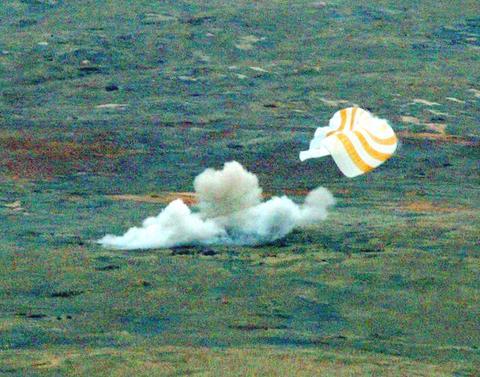
PHOTO: REUTERS
``Everything went great. We were very fortunate. It was as smooth a landing as could have been hoped for,'' said General Vladimir Popov, who heads the team responsible for Russia's space search-and-rescue operations.
NASA spokesman Ron Navias agreed.
``It was a dream landing. It is almost as if they hit the x-mark on the ground,'' he said.
Bad weather in the Kazakh capital Astana forced helicopters carrying the crew, officials and journalists to turn back to the landing site near Arkalyk. They were hoping for the skies to clear so they could make their way back to Moscow, where top space officials and family members were waiting for them.
Duque was presented with an apple, the symbol of Kazakhstan, after the landing. Malenchenko received tea. All three space travelers appeared tired but happy.
``It is great to be back home. The landing went just fine,'' Lu said, smiling.
The Spaniard, speaking Russian, said the landing ``was very soft, almost like training,'' adding that he would have loved to have stayed up in space longer.
Space officials were pleased that the wild ride of the last Soyuz descent in May, which ended with the American and Russian crew straying some 400km off-course due to a computer error, was avoided.
Russian aerospace engineers had said there was only a slim chance that this crew would suffer from the same computer malfunction that sent the station's previous inhabitants on such a steep trajectory home that their tongues rolled back in their mouths.
The May landing was so far off-target that more than two gut-wrenching hours passed before rescuers knew the men were safe.
The May landing rattled Russian space officials and NASA, which had sent their top administrators to Mission Control outside of Moscow to monitor the maiden return of the new model Soyuz with its first-ever US and Russian crew. It came just three months after Columbia broke apart during re-entry, killing all seven astronauts.
Malenchenko returned to Earth a married man, having wedded Texas resident Ekaterina Dmitriev by proxy while in space. The new bride watched video footage of the landing at Mission Control.

‘IN A DIFFERENT PLACE’: The envoy first visited Shanghai, where he attended a Chinese basketball playoff match, and is to meet top officials in Beijing tomorrow US Secretary of State Antony Blinken yesterday arrived in China on his second visit in a year as the US ramps up pressure on its rival over its support for Russia while also seeking to manage tensions with Beijing. The US diplomat tomorrow is to meet China’s top brass in Beijing, where he is also expected to plead for restraint as Taiwan inaugurates president-elect William Lai (賴清德), and to raise US concerns on Chinese trade practices. However, Blinken is also seeking to stabilize ties, with tensions between the world’s two largest economies easing since his previous visit in June last year. At the
Nearly half of China’s major cities are suffering “moderate to severe” levels of subsidence, putting millions of people at risk of flooding, especially as sea levels rise, according to a study of nationwide satellite data released yesterday. The authors of the paper, published by the journal Science, found that 45 percent of China’s urban land was sinking faster than 3mm per year, with 16 percent at more than 10mm per year, driven not only by declining water tables, but also the sheer weight of the built environment. With China’s urban population already in excess of 900 million people, “even a small portion

UNSETTLING IMAGES: The scene took place in front of TV crews covering the Trump trial, with a CNN anchor calling it an ‘emotional and unbelievably disturbing moment’ A man who doused himself in an accelerant and set himself on fire outside the courthouse where former US president Donald Trump is on trial has died, police said yesterday. The New York City Police Department (NYPD) said the man was declared dead by staff at an area hospital. The man was in Collect Pond Park at about 1:30pm on Friday when he took out pamphlets espousing conspiracy theories, tossed them around, then doused himself in an accelerant and set himself on fire, officials and witnesses said. A large number of police officers were nearby when it happened. Some officers and bystanders rushed

Beijing is continuing to commit genocide and crimes against humanity against Uyghurs and other Muslim minorities in its western Xinjiang province, U.S. Secretary of State Antony Blinken said in a report published on Monday, ahead of his planned visit to China this week. The State Department’s annual human rights report, which documents abuses recorded all over the world during the previous calendar year, repeated language from previous years on the treatment of Muslims in Xinjiang, but the publication raises the issue ahead of delicate talks, including on the war in Ukraine and global trade, between the top U.S. diplomat and Chinese


 RSS
RSS