


Judge Khoja Ahmad Saddiqi could order a thief's hand amputated as punishment for his crime, a sentence common under the former Taliban regime and its extreme interpretation of Islamic law, known as Shariah.
But in the two years since the Taliban were forced from power, Saddiqi, head of the Afghan Supreme Court's judicial and criminal division, has yet to order an amputation.
"If we implement Shariah correctly, there's no need to cut off a hand," said Saddiqi, whose thick black beard and swirling turban indicate his status as a Muslim cleric, who also regularly leads prayers at a Kabul mosque. Rarely would an execution be handed down by the courts, he added.
Afghans on Monday marked the start of the Muslim holy month of Ramadan, the holiest time of year for Muslims, when they believe God began to reveal the holy book Koran to the Prophet Muhammad.
Now, framers of the country's post-Taliban constitution are debating just how much of those 1,400-year-old lessons to include.
A commission has been laboring over a draft constitution for months, and its much-delayed release is expected in the coming days. An assembly of representatives from across the country is to consider the draft in December, paving the way for nationwide elections in June next year.
The implementation of Shariah is especially sensitive here, given its harsh interpretation by the Taliban, who forced men to grow beards and pray, banned girls from schools and most jobs, and toppled walls onto homosexuals to crush them to death.
While recognizing the fundamental fact that Afghanistan is an Islamic nation -- with a nearly 100 percent Muslim population -- the latest version of the constitution shies away from mentioning Shariah.
The spirit of the current draft is of "a society that's moderately Islamic but also lives in peace and understanding with the rest of the world," said Jawid Luddin, President Hamid Karzai's spokesman.
Early drafts of the document included elements of Shariah, and conservatives have continued to push for making it the basis of all laws, said Ahmad Nader Nadery, spokesman for the Afghan Independent Human Rights Commission, which has lobbied to remove Shariah and include freedom of religion in the draft law.
"It's very easy to misuse Shariah against the basic rights of people," Nadery said.
Instead of Shariah, the constitution is set to include an article stating that "no laws shall run counter to the sacred principles of Islam," as written in an earlier draft copy. The country will be officially known as "the Islamic republic of Afghanistan."
It will be left to lawmakers later to iron out how that translates into the specifics of the criminal and civil code, and whether to legislate other tenets of the Islamic faith -- such as prohibitions on alcohol, whether adultery should be recognized as a crime or how to sentence thieves.
Especially critical will be how far the laws go to protect women's rights, recalling the harsh discrimination they suffered under the Taliban who forced their disappearance from all public life.
Judge Saddiqi thumbed a white paperback copy of the criminal code from 1976 -- when Afghanistan was ruled by King Mohammad Zaher Shah. He still uses the code today, though he said Shariah law remains his first reference in tricky cases.
He said the Taliban's lightning-speed trials -- sentencing a thief one week and having a doctor using anesthesia cut off his hand the next -- bore no resemblance to real Shariah law.
Instead, Saddiqi said courts observing Shariah must look at the circumstances surrounding the crime.
"If this thief is stealing out of poverty, if his children are crying for bread, then we should consider this" in the verdict and consider more lenient measures, he said.
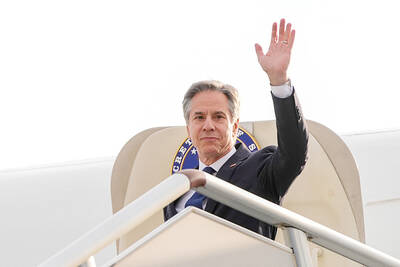
‘IN A DIFFERENT PLACE’: The envoy first visited Shanghai, where he attended a Chinese basketball playoff match, and is to meet top officials in Beijing tomorrow US Secretary of State Antony Blinken yesterday arrived in China on his second visit in a year as the US ramps up pressure on its rival over its support for Russia while also seeking to manage tensions with Beijing. The US diplomat tomorrow is to meet China’s top brass in Beijing, where he is also expected to plead for restraint as Taiwan inaugurates president-elect William Lai (賴清德), and to raise US concerns on Chinese trade practices. However, Blinken is also seeking to stabilize ties, with tensions between the world’s two largest economies easing since his previous visit in June last year. At the

UNSETTLING IMAGES: The scene took place in front of TV crews covering the Trump trial, with a CNN anchor calling it an ‘emotional and unbelievably disturbing moment’ A man who doused himself in an accelerant and set himself on fire outside the courthouse where former US president Donald Trump is on trial has died, police said yesterday. The New York City Police Department (NYPD) said the man was declared dead by staff at an area hospital. The man was in Collect Pond Park at about 1:30pm on Friday when he took out pamphlets espousing conspiracy theories, tossed them around, then doused himself in an accelerant and set himself on fire, officials and witnesses said. A large number of police officers were nearby when it happened. Some officers and bystanders rushed

Beijing is continuing to commit genocide and crimes against humanity against Uyghurs and other Muslim minorities in its western Xinjiang province, U.S. Secretary of State Antony Blinken said in a report published on Monday, ahead of his planned visit to China this week. The State Department’s annual human rights report, which documents abuses recorded all over the world during the previous calendar year, repeated language from previous years on the treatment of Muslims in Xinjiang, but the publication raises the issue ahead of delicate talks, including on the war in Ukraine and global trade, between the top U.S. diplomat and Chinese
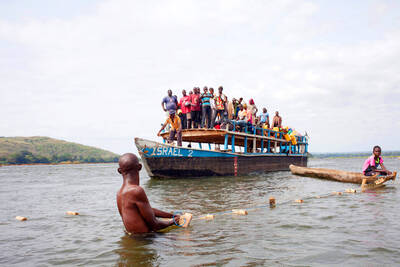
RIVER TRAGEDY: Local fishers and residents helped rescue people after the vessel capsized, while motorbike taxis evacuated some of the injured At least 58 people going to a funeral died after their overloaded river boat capsized in the Central African Republic’s (CAR) capital, Bangui, the head of civil protection said on Saturday. “We were able to extract 58 lifeless bodies,” Thomas Djimasse told Radio Guira. “We don’t know the total number of people who are underwater. According to witnesses and videos on social media, the wooden boat was carrying more than 300 people — some standing and others perched on wooden structures — when it sank on the Mpoko River on Friday. The vessel was heading to the funeral of a village chief in


 RSS
RSS