


Philippine troops killed a bomb-making expert from a Southeast Asian terror network on Sunday, but there was much scepticism yesterday that he may have been executed ahead of a visit by US President George W. Bush.
Philippine President Gloria Macapagal Arroyo said the killing of fugitive Indonesian militant Fathur Rohman al-Ghozi on Sunday after what officials said was a shoot-out in the Mindanao region showed that "terrorists" would never succeed here.
Officials said al-Ghozi, a senior leader of the Jemaah Islamiah group and one of the most wanted men in Asia since escaping from a Manila prison in July, was killed after opening fire on police and troops who stopped the van he was in.
PHOTO: AFP
Television showed grisly pictures of a body lying in a morgue dressed only in underwear and surrounded by security officials.
But police officers and residents in the southern town where the killing took place said there was no sign of a firefight, fuelling rumors that al-Ghozi had already been captured and then killed at the best time to boost Manila's anti-terror image.
"Al-Ghozi's killing reads like an awfully crafted script. The timing is just too perfect," said Teodoro Casino, secretary-general of the left-leaning Bayan activist group.
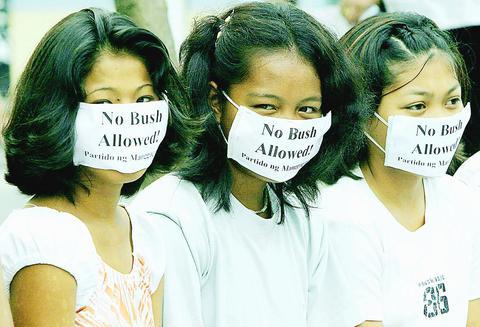
PHOTO: AFP
"We suspect al-Ghozi was captured much, much earlier to be killed just at the right moment, which was yesterday," he said.
Bush flies to Manila for an eight-hour visit on Saturday.
"The death of al-Ghozi signals that terrorists will never get far in the Philippines," Arroyo said in a statement before flying to Mindanao to personally check on the situation.
"We are determined to end this transnational threat decisively," she said.
Al-Ghozi was jailed last year for 17 years for possessing explosives and falsifying documents. He was also accused of masterminding bombings that killed 22 people in Manila in December 2000.
He slipped out of the heavily secured police intelligence building on July 14 with two suspected members of the Abu Sayyaf, after apparently being allowed to walk out of his cell.
His escape was a severe embarrassment for the government. The army killed one of the escaped rebels soon after the break-out and recaptured the other last week.
Philippine police chief Hermogenes Ebdane, who flew to Mindanao yesterday, denied allegations that al-Ghozi's killing had been staged.
Ebdane said two men had opened fire on police who stopped their car near the town of Pigcawayan in North Cotabato af-ter receiving a tip-off on al-Ghozi's planned route.
"It was just unfortunate that when the troops flagged down the vehicle, instead of stopping, they fired at our troops and there was a brief shootout," Ebdane said.
He said al-Ghozi fired two shots, and that police later recovered a .45-caliber pistol from him.
The other man traveling with al-Ghozi was able to escape in the darkness and heavy rain, he said.
Ebdane said al-Ghozi had been pronounced dead on arrival at a hospital with gunshot wounds to his chest, both arms and one side of his body.
"Only a few people could have witnessed the armed encounter because it was raining hard at that time," Ebdane said.
He said fingerprints had confirmed the body was al-Ghozi's and that it would likely be turned over to Indonesian officials without an autopsy being conducted, in line with Muslim custom.
However, the police chief of Pigkawayan town, where Ebdane said al-Ghozi was gunned down, denied there was any gunfire in the area at the time, or that al-Ghozi was fatally shot there.
"We were informed by residents about a shooting incident in Pigca-wayan town but when we arrived there, we did not see indications of any gun battle," Inspector Raulito Suyom said.
"Definitely there was no encounter. There was no exchange of fire," Suyom said by telephone.
He said no police or military unit had coordinated with him. Asked to explain the discrepancy, Ebdane said there had been "no time" to coordinate with local police, and that he apologized to the regional governor for not informing him and his men on the operation.
Ebdane also denied that the timing of al-Ghozi's killing had anything to do with Bush's visit.
"We don't consider any connection between the slaying of al-Ghozi and Bush. This is a routine operation," Ebdane said.
Rumors have swirled in recent weeks that a Muslim rebel group had captured al-Ghozi and was negotiating his handover to the government.
The government had announced a reward of 10 million pesos (US$183,000) for al-Ghozi, dead or alive.
Ebdane said a group of civilians would receive the reward.
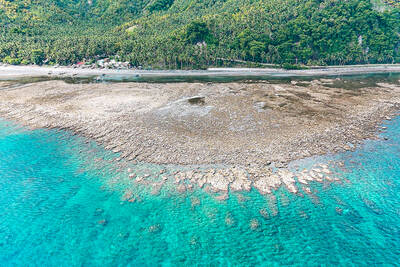
Arsenio Butil Jr fell to his knees and began to pray when last week’s deadly magnitude 7.8 earthquake began shaking his home on the coast of the southern Philippines. When he opened his eyes, he saw a once-familiar shoreline changing in real time, with swathes of previously submerged coral suddenly pushing above the waterline. The June 8 quake, driven by a shifting of the nearby Cotabato Trench, toppled buildings, triggered landslides and killed at least 76 people on the southern island of Mindanao. The tectonic forces at work also thrust chunks of the island’s coastline upward in a phenomenon known as “coastal uplift,”
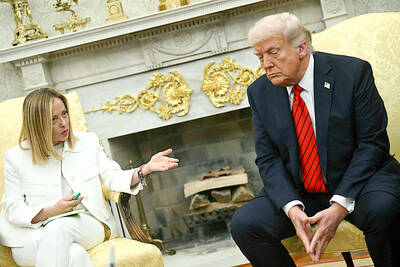
NATO ALLIES: The Italian PM accused Trump of ‘constant, unprovoked ... senseless’ attacks and said ‘my popularity is none of your concern. I suggest you focus on yours’ Italian Prime Minister Giorgia Meloni on Saturday fired back at US President Donald Trump, saying his “constant, unprovoked attacks are senseless” after he escalated a diplomatic row by accusing her of repeatedly seeking a photograph with him. The clash has opened an unusually personal rift between Trump and one of Europe’s most prominent right-wing leaders, who had sought to cast herself as a bridge between Washington and the continent during Trump’s return to power. Trump had initially told Italian broadcaster La7 that Meloni “begged” him for a picture at last week’s G7 summit in France, saying he agreed only because
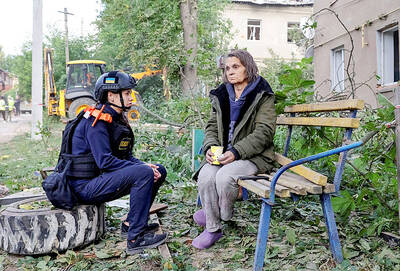
President Volodymyr Zelenskiy on Saturday said that Russian forces were preparing an impending massive attack on Ukraine and warned residents to take special care as Russian strikes in different regions killed at least six people. “Tonight and in the coming hours, it is especially important to pay close attention to air raid warnings,” Zelenskiy said in his nightly video address. “The Russians have prepared for a massive attack. Please take care of yourselves.” Russian forces have staged a series of heavy attacks on Kyiv in the past few weeks and in other major cities. Strikes on Monday last week killed
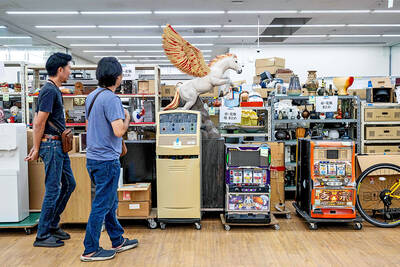
YUCK OR YUM? While it is difficult to sell second-hand goods that are more than seven years old in Japan, they are still popular in foreign markets, an executive said Under a scorching sun in a Bangkok suburb, a whistle blew, and shouts filled the air as dozens of shoppers rushed into a warehouse bearing the sign “Japanese Second-Hand Store.” From bags and bicycles to surfboards and suitcases, the Japanese second-hand market is booming, with quality-conscious buyers in other Asian countries increasingly tapping into the circular economy trend. “What is considered garbage for them can still be useful in Thailand,” said 36-year-old Lookpoo Sathitpanyapon, who runs an online store selling toy keychains. “That bag, that bag,” one shopper shouted while racing through the warehouse, filled with everything from colorful toys


 RSS
RSS