


In a setback for the new Palestinian prime minister, legislators put off a vote on his Cabinet amid bitter disputes yesterday over its composition and size, while in the West Bank, a suicide bomber detonated explosives near an Israeli army base.
The bomber apparently was a woman, radio reports said. The explosion killed the attacker and wounded two people, one seriously, paramedics said. The blast went off near a base outside the West Bank town of Tulkarem, security officials said. There was no immediate claim of responsibility.
The bombing came after Israel ordered a special call-up yesterday of four reserve battalions to patrol the West Bank and Gaza.

PHOTO: REUTERS
The arguments over the Palestinian Cabinet flared in back-room negotiations even as dozens of legislators and hundreds of Palestinian officials gathered for the expected confirmation of an emergency eight-person Cabinet appointed earlier this week by Palestinian President Yasser Arafat.
"Everyone has his own script and so we feel that we need more time. We are sorry for troubling you," Deputy Parliament Speaker Ibrahim Abu Najar told legislators, who had been waiting at Arafat's headquarters here for more than an hour.
The postponement of the Cabinet vote, which was tentatively rescheduled for tomorrow, came as factions within Arafat's Fatah movement argued over the status and size of the Cabinet. The chaos yesterday was considered an embarrassment for new Prime Minister Ahmed Qureia.
"If this government were presented ... today it would have failed," said Salah Tamari, a Fatah legislator.
Some wanted it to remain an emergency Cabinet, which would have expired in one month, while others favored confirming the Cabinet with a vote in the parliament, which would turn it into a regular Cabinet, according to Palestinian Legislator Hanan Ashrawi. Many of the legislators, including those who had not been included in the Cabinet, voiced objections to its small size.
"This is a constitutional crisis," Ashrawi said.
Qureia's success is key to efforts to salvage the US-backed "road map" peace plan, which foresees an end to three years of violence and a Palestinian state by 2005. It has been stalled for months, with neither side carrying out key requirements, and bloodshed has continued.
Yesterday, Israeli Defense Minister Shaul Mofaz ordered a special call up of four reserve battalions, roughly 1,000 soldiers, to patrol the West Bank and Gaza Strip. The call up was to begin in about 10 days, after the end of the weeklong Sukkot holiday which begins tonight.
Mofaz had already ordered on Wednesday two battalions of active-duty soldiers sent to the West Bank and Gaza, canceling leaves and training courses, and ordered the continuation of a strict lockdown on Palestinian areas, reportedly at least through Oct. 22.
Restrictions on Palestinians, barring them from entering Israel and preventing many from leaving their towns, were tightened after an Islamic Jihad bomber killed 19 Israelis in the port city of Haifa last Saturday.
Mofaz reportedly went against the recommendations of security officials who said the level of alerts about possible terror attacks was not unusual.
Israeli Prime Minister Ariel Sharon faced his own Cabinet troubles with the National Religious Party threatening Wednesday to walk out of his center-right government over a religious dispute.
While a decision by the six-strong NRP faction to pull out of Sharon's 68-seat coalition would still leave the prime minister with a slim majority in the 120-seat parliament, Israeli governments have fallen before over relatively marginal matters, not war and peace.
Later, speaking at a meeting of his Likud party, Sharon attacked the opposition parties, accusing them of trying to "topple the government by illegitimate means," an apparent reference to a series of public sector strikes, protesting austerity measures.
Sharon also accused opposition members of "coordinating their actions with the Palestinians behind the government's back."
Qureia has said he hopes to begin truce talks with Israel quickly, but that -- like his predecessor, Mahmoud Abbas -- he will use only persuasion, not force, to get Hamas, Islamic Jihad and other armed groups to halt attacks in Israel.
The violent Islamic groups are enjoying a surge of support, while the Palestinian Authority, headed by Arafat and Qureia, has been unable to persuade Israel to relax roadblocks, curfews and closures that have decimated the Palestinian economy, costing it popular support.
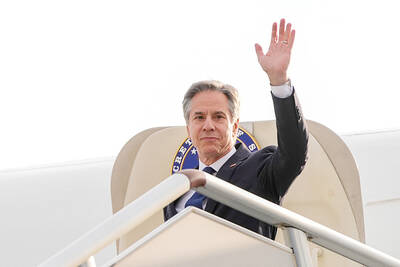
‘IN A DIFFERENT PLACE’: The envoy first visited Shanghai, where he attended a Chinese basketball playoff match, and is to meet top officials in Beijing tomorrow US Secretary of State Antony Blinken yesterday arrived in China on his second visit in a year as the US ramps up pressure on its rival over its support for Russia while also seeking to manage tensions with Beijing. The US diplomat tomorrow is to meet China’s top brass in Beijing, where he is also expected to plead for restraint as Taiwan inaugurates president-elect William Lai (賴清德), and to raise US concerns on Chinese trade practices. However, Blinken is also seeking to stabilize ties, with tensions between the world’s two largest economies easing since his previous visit in June last year. At the

UNSETTLING IMAGES: The scene took place in front of TV crews covering the Trump trial, with a CNN anchor calling it an ‘emotional and unbelievably disturbing moment’ A man who doused himself in an accelerant and set himself on fire outside the courthouse where former US president Donald Trump is on trial has died, police said yesterday. The New York City Police Department (NYPD) said the man was declared dead by staff at an area hospital. The man was in Collect Pond Park at about 1:30pm on Friday when he took out pamphlets espousing conspiracy theories, tossed them around, then doused himself in an accelerant and set himself on fire, officials and witnesses said. A large number of police officers were nearby when it happened. Some officers and bystanders rushed

Beijing is continuing to commit genocide and crimes against humanity against Uyghurs and other Muslim minorities in its western Xinjiang province, U.S. Secretary of State Antony Blinken said in a report published on Monday, ahead of his planned visit to China this week. The State Department’s annual human rights report, which documents abuses recorded all over the world during the previous calendar year, repeated language from previous years on the treatment of Muslims in Xinjiang, but the publication raises the issue ahead of delicate talks, including on the war in Ukraine and global trade, between the top U.S. diplomat and Chinese

RIVER TRAGEDY: Local fishers and residents helped rescue people after the vessel capsized, while motorbike taxis evacuated some of the injured At least 58 people going to a funeral died after their overloaded river boat capsized in the Central African Republic’s (CAR) capital, Bangui, the head of civil protection said on Saturday. “We were able to extract 58 lifeless bodies,” Thomas Djimasse told Radio Guira. “We don’t know the total number of people who are underwater. According to witnesses and videos on social media, the wooden boat was carrying more than 300 people — some standing and others perched on wooden structures — when it sank on the Mpoko River on Friday. The vessel was heading to the funeral of a village chief in


 RSS
RSS