


The US expects the UN Security Council to approve a resolution this month that would expand the NATO-led force in Afghanistan beyond Kabul, US Ambassador John Negroponte said.
Negroponte, the council president for this month, said he received a letter from NATO Secretary-General Lord Robertson asking to expand the alliance's peacekeeping mission into other Afghan cities.
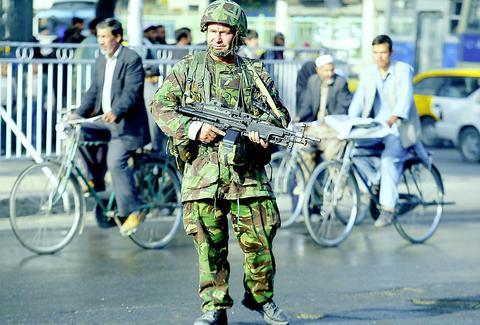
PHOTO: AP
Germany has drafted a Security Council resolution that would authorize an expansion of the 5,500-strong International Security Assistance Force (ISAF), which is now confined to the Kabul area.
NATO took over command of the multinational force in August from Germany and the Netherlands. German and Canadian troops make up the bulk of the current force.
Negroponte told a news conference that Robertson's letter cleared the way for the Security Council to consider the resolution expanding the ISAF's mandate -- and he expects a vote before a Security Council mission heads to Afghanistan on Oct. 31.
``We're hoping between now and the end of the month to have a new resolution,'' Negroponte said. ``I would expect action on that before we go on our trip.''
Germany's UN Ambassador Gunter Pleuger is leading the mission to study the work of the UN and ISAF. The 15-member mission, which will include Negroponte, French UN Ambassador Jean-Marc de La Sabliere, Russia's Sergey Lavrov and Pakistan's Munir Akram, will be in Afghanistan from Oct. 31 to Nov. 8.
In Kabul, the Afghan government welcomed NATO's efforts to expand the peacekeeping force beyond the capital.
``Providing an additional international security blanket over those parts of the country that need them most would assist in the political and reconstruction processes underway in the country,'' the Afghan Foreign Ministry said in a statement yesterday.
Afghan President Hamid Karzai warned last month that unless the world steps up its reconstruction aid and sends more troops, Islamic radicals could regain control in Afghanistan.
He said peacekeepers had to be deployed in the regions where increasing lawlessness is causing many Afghans to long for the security that marked the rule of the Taliban regime. The Afghan government has little control in most of the 32 provinces, where governors often rule like warlords.

‘IN A DIFFERENT PLACE’: The envoy first visited Shanghai, where he attended a Chinese basketball playoff match, and is to meet top officials in Beijing tomorrow US Secretary of State Antony Blinken yesterday arrived in China on his second visit in a year as the US ramps up pressure on its rival over its support for Russia while also seeking to manage tensions with Beijing. The US diplomat tomorrow is to meet China’s top brass in Beijing, where he is also expected to plead for restraint as Taiwan inaugurates president-elect William Lai (賴清德), and to raise US concerns on Chinese trade practices. However, Blinken is also seeking to stabilize ties, with tensions between the world’s two largest economies easing since his previous visit in June last year. At the
Nearly half of China’s major cities are suffering “moderate to severe” levels of subsidence, putting millions of people at risk of flooding, especially as sea levels rise, according to a study of nationwide satellite data released yesterday. The authors of the paper, published by the journal Science, found that 45 percent of China’s urban land was sinking faster than 3mm per year, with 16 percent at more than 10mm per year, driven not only by declining water tables, but also the sheer weight of the built environment. With China’s urban population already in excess of 900 million people, “even a small portion

UNSETTLING IMAGES: The scene took place in front of TV crews covering the Trump trial, with a CNN anchor calling it an ‘emotional and unbelievably disturbing moment’ A man who doused himself in an accelerant and set himself on fire outside the courthouse where former US president Donald Trump is on trial has died, police said yesterday. The New York City Police Department (NYPD) said the man was declared dead by staff at an area hospital. The man was in Collect Pond Park at about 1:30pm on Friday when he took out pamphlets espousing conspiracy theories, tossed them around, then doused himself in an accelerant and set himself on fire, officials and witnesses said. A large number of police officers were nearby when it happened. Some officers and bystanders rushed

Beijing is continuing to commit genocide and crimes against humanity against Uyghurs and other Muslim minorities in its western Xinjiang province, U.S. Secretary of State Antony Blinken said in a report published on Monday, ahead of his planned visit to China this week. The State Department’s annual human rights report, which documents abuses recorded all over the world during the previous calendar year, repeated language from previous years on the treatment of Muslims in Xinjiang, but the publication raises the issue ahead of delicate talks, including on the war in Ukraine and global trade, between the top U.S. diplomat and Chinese


 RSS
RSS