


For White House planners, the image had to be picture perfect: the first lady, the American flag and the Eiffel Tower all in the same photo frame.
So when Laura Bush raised the American flag on Monday to signal the return of the US to UNESCO after a 19-year boycott, there was nothing subtle about the symbols.
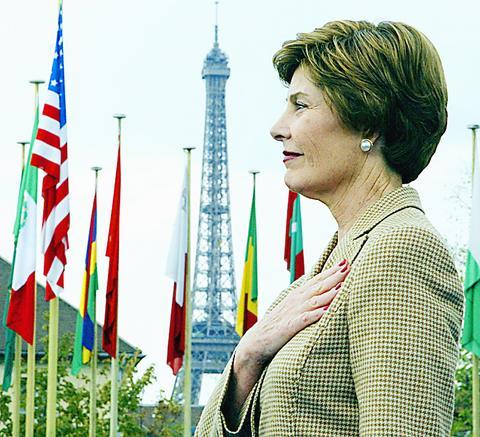
PHOTO: REUTERS
Her five-day trip to Paris and Moscow is seen as part of a campaign to dispel criticism of her husband's administration as unilateralist as it seeks to win international support with a new UN resolution for more money and troops for the American occupation of Iraq.
In her 25-minute address inside the headquarters of the UN Educational, Scientific and Cultural Organization, Bush proclaimed that UNESCO could "help achieve peace by spreading the values that will help defeat terror and lead to a better and safer world: education, tolerance, respect for human life and respect for each other's differences."
Part of her speech focused on what she characterized as the administration's achievements in postwar Afghanistan and Iraq, including reopening schools. "As the civilized world stands against terror, UNESCO's work can make an enormous difference," she said.
The Reagan administration withdrew from UNESCO in 1984, charging that it had become a forum for spreading anti-American propaganda and was chronically mismanaged and corrupt. The agency lost the US contribution -- a quarter of its budget.
Koichiro Matsuura, the soft-spoken Japanese diplomat who has been UNESCO's director general since November 1999, has shaken up and slimmed down the bureaucracy, finally convincing Washington that UNESCO was worthy of rejoining.
After her speech, in the courtyard, Bush stood ramrod straight, her hand on her heart, as the mezzo-soprano Susan Graham sang The Star-Spangled Banner and the American flag was raised to join the flags of the 189 other members.
But Bush did not face the flag as the anthem was sung; instead, she stood perpendicular to it, enabling photographers to capture her in profile, with the flag and the Eiffel Tower behind. The scene was carefully planned for days by a White House advance team, much to the amusement of longtime UNESCO employees.
Bush, on her third solo trip abroad as first lady, also tried to burnish America's image in the eyes of France and to assure her hosts of her country's friendship.
"We can have disagreements and remain friends," she said in an interview with France 3 television that was shown on Monday. "Our attachment is very emotional."
Recalling that last year she and the president visited the graves of American soldiers killed on the Normandy beaches in World War II, she described the friendship between France and the US as "intimate and intense at the same time."
Early in the day, President Jacques Chirac welcomed Bush for a 30-minute meeting at Elysee Palace. Not one to be outdone by a photo opportunity, he kissed her hand in front of cameramen and photographers.
It was just a year ago that President Bush announced to the UN General Assembly that the United States would rejoin UNESCO.
But for Representative Tom Lantos, the ranking Democrat on the House International Relations Committee and a member of the visiting American delegation, it was a congressional, not an administration, initiative that brought America back.
"This is sort of my baby," he boasted in a telephone interview, saying that in May 2001 he and Representative Jim Leach, successfully pushed for passage of an amendment to an authorization bill directing Bush to rejoin and authorizing US$60 million for America's assessment.
"I explained to the administration that at a time when it was being accused of being unilateral, nothing could be more helpful in helping its image than rejoining."
For re-entry into the club, which will take effect on Oct. 1, the United States has pledged to pay a one-time deposit to the capital fund of US$5 million and US$82 million of the total US$577 million budget for next year and 2004.
Bush's delegation included Louise V. Oliver, the Republican fund-raiser nominated by the administration to be ambassador to UNESCO, and some of Bush's best friends from Texas, including Adair Margo, an El Paso art dealer who heads the White House committee on the arts and humanities. Graham, the singer, is from Bush's hometown of Midland, Texas, and their mothers attend the same Sunday school.
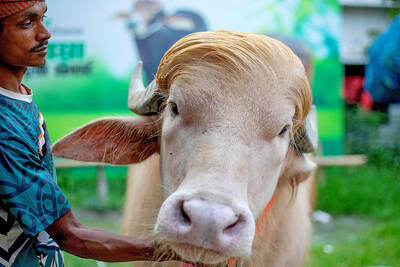
Crowds in Bangladesh are flocking to snap photographs with an unlikely social media star — an albino buffalo with flowing blond hair nicknamed “Donald Trump” that is due to be sacrificed within days. Owner Zia Uddin Mridha, 38, said his brother named the 700kg bull over its flowing helmet of hair resembling the signature look of the US president. “My younger brother picked this name because of the buffalo’s extraordinary hair,” he said at his farm in Narayanganj, just outside the capital, Dhaka. Mridha said that a constant stream of curious visitors — social media fans, onlookers and children — have come throughout

It began as a satirical online project. Now millions of young people in India are flocking to it as an outlet for their frustration. A parody political party called the Cockroach Janta Party, with the insect as its symbol, has exploded across India’s social media by turning absurdist humor into protest. Memes and short videos mocking corruption, joblessness and political dysfunction have flooded social media sites, where millions of users are embracing the cockroach — known for its ability to survive harsh conditions — as a tongue-in-cheek symbol of endurance. The online movement’s rise has been unusually rapid. The Cockroach Janta Party (CJP)
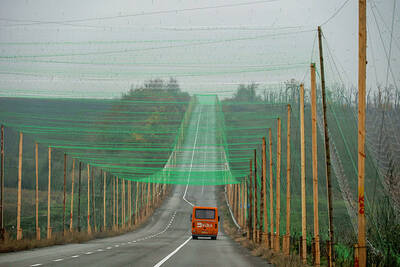
BIGGER ROLE: Beijing has said it maintains an impartial stance on the war in Ukraine, but by training Russian troops, China is far more involved than previously known China’s armed forces secretly trained about 200 Russian military personnel in China late last year, and some have since returned to fight in Ukraine, according to three European intelligence agencies and documents seen by Reuters. While China and Russia have held a number of joint military exercises since Moscow’s full-scale invasion of Ukraine in 2022, Beijing has repeatedly said that it is neutral in the conflict and presents itself as a peace mediator. The covert training sessions, which predominantly focused on the use of drones, were outlined in a dual-language Russian-Chinese agreement signed by senior Russian and Chinese officers in Beijing on
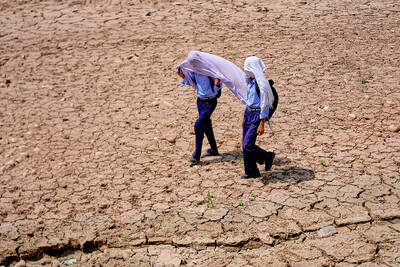
HOTTER: While Indians are accustomed to summer heat, climate change has caused northwestern India to warm faster than other parts of the country, an academic said Roads and markets have emptied during afternoons and some farmers have switched to nighttime work to avoid scorching temperatures as a heat wave grips large parts of India. The India Meteorological Department forecast maximum temperatures for yesterday of about 45°C in the capital, New Delhi, where authorities have opened temporary “cooling zones” to help people cope. The weather department warned that conditions would likely persist across several northern regions in the coming days, with temperatures staying well above seasonal averages. Authorities urged people to stay indoors during the hottest hours and take precautions against heat-related illnesses. India declares a heat wave whenever maximum temperatures


 RSS
RSS