


For Palestinian and Israeli medical students Taraji al-Qadi and Yael Oren the journey to lectures at two Jerusalem teaching hospitals is perilous -- but for entirely different reasons.
To get to East Jerusalem's Makkased hospital, Qadi has to scale a concrete wall patrolled by Israeli paramilitary police and scramble for an hour by foot up a hill to the facility. The barrier blocks the road to the hospital, a 10-minute drive away.
Across the wall, Oren sits on a bus on a nerve-racking trip to Hadassah hospital. She jolts when the bus lets on passengers, eyeing them to see whether one might be a Palestinian suicide bomber in disguise, hiding a bomb in a bag or under his clothes.
The 3m high wall dividing the two students is newly erected by Israel for the declared purpose of preventing suicide bombers -- who have killed more than 430 people in three years -- from crossing into Israel from the West Bank.
Soon the barrier will be replaced by a permanent wall, 8m high, covered by barbed wire with a fenced-off dirt track for soldiers making daily patrols for infiltrators.
It will have all the hallmarks of a border, which Israel has assured its sceptical ally, the US, it is not.
"They are taking our freedom away," said Qadi, 24. She believes the wall will do little to deter suicide bombers and that the real Israeli motivation is far more nefarious.
"They are taking East Jerusalem away from us," she said, referring to the half of the holy city captured by Israel in the 1967 Middle East war. Like many other Palestinians, Qadi wants East Jerusalem for the capital of a future Palestinian state.
Slicing mercilessly through the invisible border between the town of Abu Dis and the sprawling neighborhoods of East Jerusalem, the barrier which Palestinians call the "Berlin Wall" has, like its namesake, already been defaced by graffiti.
"Ghetto Abu Dis" someone has daubed in large Hebrew letters, perhaps a student from the adjacent al-Quds University whose campus will probably be cut in half by the wall -- sports grounds on one side and the rest of the university on the other.
At the moment gaping holes in the temporary wall allow Palestinians to climb over to the East Jerusalem side to visit family or sell food at the markets. Groups of children scurry back and forth to get to school.
"Mama, mama," bawled a terrified toddler as a stranger lifted him up and carried him over the wall. He stopped crying when his mother climbed over and grabbed his hand.
Women wearing Islamic headscarves and clutching hand bags -- embarrassed by the gaze of onlookers -- gingerly scale the crevasses of the wall with help from others waiting their turn.
An old lady with a walking stick peers through at her once local pharmacy. Either she will have take a taxi to the pharmacy, just meters away or the pharmacist will have to come out and sell her medicine through a hole.
The slabs of concrete of the Abu Dis wall are recycled. They were last used to protect Israeli apartments from Palestinian gunmen who occasionally opened fire during a three-year-old Palestinian uprising in the occupied West Bank and Gaza Strip.
Colorful pictures painted on the cement blocks by the Israelis whose homes the slabs once protected break up the grey bleakness of the wall and strings of barbed wire haphazardly thrown over it like grotesque streamers.
"This situation causes a lot of absurdity," said Oren, 26. "It absurd that she [Qadi] has to climb over a wall to get to lectures. It's absurd that we can't be friends.
"I can't begin to imagine how difficult the lives of Palestinians are. But the situation is like this -- we need to take care of ourselves before we take care of others."

‘IN A DIFFERENT PLACE’: The envoy first visited Shanghai, where he attended a Chinese basketball playoff match, and is to meet top officials in Beijing tomorrow US Secretary of State Antony Blinken yesterday arrived in China on his second visit in a year as the US ramps up pressure on its rival over its support for Russia while also seeking to manage tensions with Beijing. The US diplomat tomorrow is to meet China’s top brass in Beijing, where he is also expected to plead for restraint as Taiwan inaugurates president-elect William Lai (賴清德), and to raise US concerns on Chinese trade practices. However, Blinken is also seeking to stabilize ties, with tensions between the world’s two largest economies easing since his previous visit in June last year. At the

UNSETTLING IMAGES: The scene took place in front of TV crews covering the Trump trial, with a CNN anchor calling it an ‘emotional and unbelievably disturbing moment’ A man who doused himself in an accelerant and set himself on fire outside the courthouse where former US president Donald Trump is on trial has died, police said yesterday. The New York City Police Department (NYPD) said the man was declared dead by staff at an area hospital. The man was in Collect Pond Park at about 1:30pm on Friday when he took out pamphlets espousing conspiracy theories, tossed them around, then doused himself in an accelerant and set himself on fire, officials and witnesses said. A large number of police officers were nearby when it happened. Some officers and bystanders rushed

Beijing is continuing to commit genocide and crimes against humanity against Uyghurs and other Muslim minorities in its western Xinjiang province, U.S. Secretary of State Antony Blinken said in a report published on Monday, ahead of his planned visit to China this week. The State Department’s annual human rights report, which documents abuses recorded all over the world during the previous calendar year, repeated language from previous years on the treatment of Muslims in Xinjiang, but the publication raises the issue ahead of delicate talks, including on the war in Ukraine and global trade, between the top U.S. diplomat and Chinese
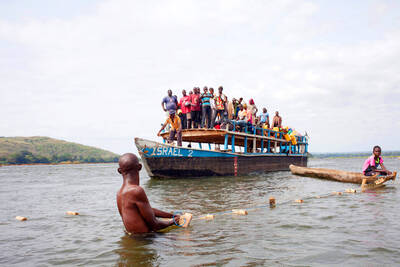
RIVER TRAGEDY: Local fishers and residents helped rescue people after the vessel capsized, while motorbike taxis evacuated some of the injured At least 58 people going to a funeral died after their overloaded river boat capsized in the Central African Republic’s (CAR) capital, Bangui, the head of civil protection said on Saturday. “We were able to extract 58 lifeless bodies,” Thomas Djimasse told Radio Guira. “We don’t know the total number of people who are underwater. According to witnesses and videos on social media, the wooden boat was carrying more than 300 people — some standing and others perched on wooden structures — when it sank on the Mpoko River on Friday. The vessel was heading to the funeral of a village chief in


 RSS
RSS