


The shops and cafes in front of the centuries-old Id Kah mosque in the ancient Chinese Silk Road city of Kashgar were once a gathering point for many of the city's Muslim Uighurs.
Until three months ago that is. In their place now stands a swathe of broken land the size of two football fields that is dotted with piles of refuse and designated as the future site of a vast square, a shopping mall and a motorway.
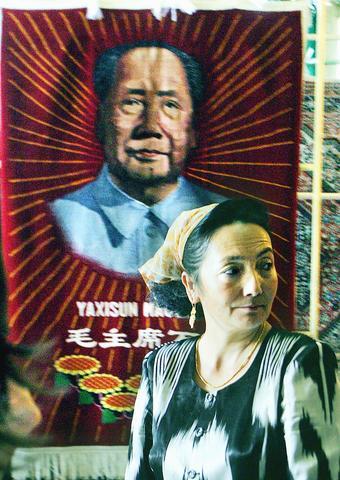
PHOTO: AP
Progress? Not for some.
"Look! Look what they've done to our holy place. Every day we are losing a bit of our culture, and people wonder why there are tensions between Hans and Uighurs," flatbread hawker Nizilghur, 29, shouted over the din of a nearby bazaar.
His outburst captures the frustration of Uighurs in China's westernmost Xinjiang region after five decades of communist rule and resentment over what is seen as discrimination by Han Chinese and a widening wealth gap that sparked riots, bombings and assassinations in the 1990s.
The worst rioting left nine dead and more than 200 wounded in Yining near the border with Kazakhstan in February 1997.
China has been hoping to allay mutual distrust by pushing what it sees as the magic pill of economic development, most recently with its "Go West" masterplan to bring the fruits of economic progress to the remote hinterland.
It is also working closely with Russia and its neighbors in the former Soviet Muslim republics in central Asia, with whom it held a meeting in Beijing on Tuesday, to meet the challenge of radical Islam in the region.
Money is indeed evident in Xinjiang, from glitzy new high-rises in the capital, Urumqi, to motorways clogged with Honda Accords and Volkswagen Passats.
The question is who, and how many, actually get their hands on the wealth.
"The kind of industries set up there benefit either Han Chinese coming in from the east or Uighurs who have been educated in Chinese," said Michael Dillon, director of the Centre for Contemporary Chinese Studies at Britain's University of Durham.
Xinjiang's highest-ranking official defended Beijing's policies.
"Economic disparity stems from your abilities. Incomes are ... not judged by ethnic groupings," Wang Lequan, Xinjiang's party boss and a Han Chinese, told visiting reporters.
But even the Shandong native, who has lived in Xinjiang for 13 years, conceded: "The central government has invested in the west for three years, but because conditions in the region are less than favorable, there are many constraints."
In a white paper released last year, Beijing said fixed asset investments in Xinjiang totalled 501.5 billion yuan (US$60.6 billion) from 1950 to 2001, while government subsidies rose to 18.38 billion yuan in 2001 from 11.9 billion in 2000.
But many Uighurs feel left out -- and not only economically.
"How many Uighurs do you see in top business or government posts? There may be a handful, but it's a tiny percentage," said Manzana, a petite Uighur teacher from Aksu.
"They talk about integration and development. They talk about raising our standard of living. How come I don't see it?"
Xinjiang separatists have been fighting for the last 150 years for an independent East Turkestan homeland, claiming a region they have inhabited for more than 1,250 years.
Formally incorporated as a province of China in 1884, Xinjiang saw a brief period of virtual independence from 1938 when it sought aid from the Soviet Union. China regained control after the Communists swept to power in 1949.
That began a tide of transmigration. That year, the UN estimates that ethnic Han Chinese made up just seven percent of Xinjiang's population. That figure has now risen to 40 percent.
"This is the land of our fathers, grandfathers and great-grandfathers. You want us to give it up?" snorted Yasin, a fiery barber in Kashgar, a city of 3.5 million that is pungent with the aroma of animals and raw sewage and for two millennia served as a trading post on the fabled Silk Road.
Today, Turkic-speaking Uighurs and Mandarin-speaking Han live side-by-side in a sparsely populated region rich with oil and minerals. Few dare to talk openly about the tensions simmering only just below the surface.
The crackdown on Uighur separatists has gained momentum since the Sept. 11, 2001, attacks on New York and Washington, although Washington has urged Beijing not to use the war on terror as a pretext to crack down on political dissent.
Indeed, the Han and Uighur cultures differ greatly. Many Uighurs live by Xinjiang time -- two hours behind the official Beijing time that is imposed China-wide.
"The Han and us Uighurs never mix. We are as different as night and day. They don't understand our language, our religion and our culture," said Abdeluky, a sprightly 79-year-old.
Experts say the divide will persist for some time to come.
The only way the Chinese government can conceive of dealing with ethnic tension is either through repression or economic investment, said Dru Gladney at the University of Hawaii.
"They've tried both for 50 years with no real tangible improvement," said the expert on China's Muslims.

‘IN A DIFFERENT PLACE’: The envoy first visited Shanghai, where he attended a Chinese basketball playoff match, and is to meet top officials in Beijing tomorrow US Secretary of State Antony Blinken yesterday arrived in China on his second visit in a year as the US ramps up pressure on its rival over its support for Russia while also seeking to manage tensions with Beijing. The US diplomat tomorrow is to meet China’s top brass in Beijing, where he is also expected to plead for restraint as Taiwan inaugurates president-elect William Lai (賴清德), and to raise US concerns on Chinese trade practices. However, Blinken is also seeking to stabilize ties, with tensions between the world’s two largest economies easing since his previous visit in June last year. At the

UNSETTLING IMAGES: The scene took place in front of TV crews covering the Trump trial, with a CNN anchor calling it an ‘emotional and unbelievably disturbing moment’ A man who doused himself in an accelerant and set himself on fire outside the courthouse where former US president Donald Trump is on trial has died, police said yesterday. The New York City Police Department (NYPD) said the man was declared dead by staff at an area hospital. The man was in Collect Pond Park at about 1:30pm on Friday when he took out pamphlets espousing conspiracy theories, tossed them around, then doused himself in an accelerant and set himself on fire, officials and witnesses said. A large number of police officers were nearby when it happened. Some officers and bystanders rushed

Beijing is continuing to commit genocide and crimes against humanity against Uyghurs and other Muslim minorities in its western Xinjiang province, U.S. Secretary of State Antony Blinken said in a report published on Monday, ahead of his planned visit to China this week. The State Department’s annual human rights report, which documents abuses recorded all over the world during the previous calendar year, repeated language from previous years on the treatment of Muslims in Xinjiang, but the publication raises the issue ahead of delicate talks, including on the war in Ukraine and global trade, between the top U.S. diplomat and Chinese
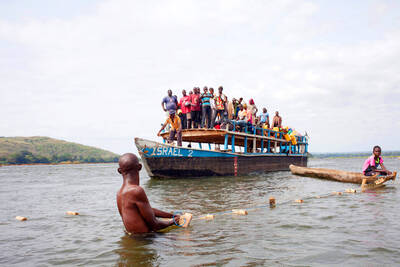
RIVER TRAGEDY: Local fishers and residents helped rescue people after the vessel capsized, while motorbike taxis evacuated some of the injured At least 58 people going to a funeral died after their overloaded river boat capsized in the Central African Republic’s (CAR) capital, Bangui, the head of civil protection said on Saturday. “We were able to extract 58 lifeless bodies,” Thomas Djimasse told Radio Guira. “We don’t know the total number of people who are underwater. According to witnesses and videos on social media, the wooden boat was carrying more than 300 people — some standing and others perched on wooden structures — when it sank on the Mpoko River on Friday. The vessel was heading to the funeral of a village chief in


 RSS
RSS