


The Palestinians are urging the UN to demand that Israel ensures Yasser Arafat's safety and key Security Council members are pushing both parties to implement the peace plan known as the "road map."
The council scheduled an open meeting yesterday on the situation in the Middle East amid mounting criticism of the decision by Israel's security Cabinet on Thursday to "remove" Arafat in a manner and time to be decided.
The statement Sunday by Israel's Vice Prime Minister Ehud Olmert that killing Arafat is a possibility was certain to intensify the Palestinian demand for speedy UN action.
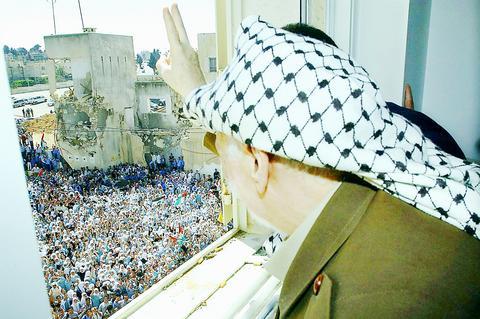
PHOTO: REUTERS
The council began consultations on a resolution drafted by the Palestinians late Friday and then adjourned until yesterday, despite Palestinian pressure for a quick vote.
Council ambassadors said they wanted to consult their capitals and wait for the outcome of Secretary-General Kofi Annan's meeting in Geneva on Saturday with the foreign ministers of the five permanent council nations -- the US, Russia, China, Britain and France.
In the interim, the council issued a press statement expressing "the view that the removal of chairman Arafat would be unhelpful and should not be implemented."
The statement, read by the council president, British Ambassador Emyr Jones Parry, reflected the consensus among the 15 council members.
US Secretary of State Colin Powell said Sunday that Israel would incite rage not only among Arabs but also Muslims everywhere by exiling or executing Arafat.
Deputy US ambassador James Cunningham made clear on Friday that Washington's primary aim is to get the peace process back on track.
"Our view is that we should focus on trying to get people focussed on implementing the road map, and that this isn't the right time to be looking at a Security Council resolution," he said.
After Saturday's meeting in Geneva, Annan announced that the four parties that drafted the road map -- the US, the UN, the EU and Russia -- have agreed to meet in New York later this month to consider "all relevant aspects of the issue" and help Israel and the Palestinians move forward with the peace process.
"The permanent ministers of the Security Council recognized that both sides have obligations under the ... road map and ... that it is now essential to go ahead with its implementation," Annan said.
No date was announced for the meeting, but it is likely to take place when ministers are at the UN for the high-level General Assembly meeting which starts on Sept. 23.
Recent attacks by both sides have stalled progress on implementing the road map, which envisions a Palestinian state by 2005, and Israel's threat against Arafat has heightened tensions.
The Palestinian UN envoy Nasser al-Kidwa said the council must take an immediate stand "when illegal actions are taken by member states."
The Palestinian draft "demands that Israel, the occupying power, desist from any act of deportation and to cease any threat to the safety of the elected president of the Palestinian Authority."
It calls for the cessation of violence -- including all acts of terror, provocation, incitement and destruction -- and increased efforts by both sides to ensure implementation of the road map.
It also would reiterate the council's concern over the "tragic and violent" events that have taken place since September 2000 when the latest Israeli-Palestinian clashes began, "and the recent dangerous deterioration of the situation, including the escalation in extrajudicial executions and suicide bombings."
Arye Mekel, Israel's deputy UN ambassador, told Israel Radio that the Palestinians had written the resolution in a manner to avoid a US veto. He said Israel would use the meeting as an opportunity to explain why Arafat is an obstacle to peace.
"This discussion also gives us an opportunity to explain all of Arafat's wrongdoings in the past three years ...," Mekel said.
"We will also explain that anyone who wants progress in the peace process has to work towards Arafat's removal because so long as he is in the region there is no chance that there will be progress."

‘IN A DIFFERENT PLACE’: The envoy first visited Shanghai, where he attended a Chinese basketball playoff match, and is to meet top officials in Beijing tomorrow US Secretary of State Antony Blinken yesterday arrived in China on his second visit in a year as the US ramps up pressure on its rival over its support for Russia while also seeking to manage tensions with Beijing. The US diplomat tomorrow is to meet China’s top brass in Beijing, where he is also expected to plead for restraint as Taiwan inaugurates president-elect William Lai (賴清德), and to raise US concerns on Chinese trade practices. However, Blinken is also seeking to stabilize ties, with tensions between the world’s two largest economies easing since his previous visit in June last year. At the

UNSETTLING IMAGES: The scene took place in front of TV crews covering the Trump trial, with a CNN anchor calling it an ‘emotional and unbelievably disturbing moment’ A man who doused himself in an accelerant and set himself on fire outside the courthouse where former US president Donald Trump is on trial has died, police said yesterday. The New York City Police Department (NYPD) said the man was declared dead by staff at an area hospital. The man was in Collect Pond Park at about 1:30pm on Friday when he took out pamphlets espousing conspiracy theories, tossed them around, then doused himself in an accelerant and set himself on fire, officials and witnesses said. A large number of police officers were nearby when it happened. Some officers and bystanders rushed

Beijing is continuing to commit genocide and crimes against humanity against Uyghurs and other Muslim minorities in its western Xinjiang province, U.S. Secretary of State Antony Blinken said in a report published on Monday, ahead of his planned visit to China this week. The State Department’s annual human rights report, which documents abuses recorded all over the world during the previous calendar year, repeated language from previous years on the treatment of Muslims in Xinjiang, but the publication raises the issue ahead of delicate talks, including on the war in Ukraine and global trade, between the top U.S. diplomat and Chinese

RIVER TRAGEDY: Local fishers and residents helped rescue people after the vessel capsized, while motorbike taxis evacuated some of the injured At least 58 people going to a funeral died after their overloaded river boat capsized in the Central African Republic’s (CAR) capital, Bangui, the head of civil protection said on Saturday. “We were able to extract 58 lifeless bodies,” Thomas Djimasse told Radio Guira. “We don’t know the total number of people who are underwater. According to witnesses and videos on social media, the wooden boat was carrying more than 300 people — some standing and others perched on wooden structures — when it sank on the Mpoko River on Friday. The vessel was heading to the funeral of a village chief in


 RSS
RSS